AI Agent and Automation in Finance: 15 Real Deployments | Ontik Technology
In early 2024, Klarna said its AI assistant was doing the work of 700 full-time customer service agents. In 2025, its CEO said the company was hiring human agents again because the chatbots delivered lower quality. Both statements are on the record, and a CFO reviewing an AI automation business case will ask about both.
Most writing on AI automation in finance lists categories (fraud detection, credit scoring, chatbots) and stops there, which does not help you defend a budget. This post covers 15 named deployments at banks, card networks, lenders and wealth managers, all publicly documented. For each one we show what was reported, who reported it (the company, a regulatory filing or the vendor), and whether the figure is a business outcome or only a usage count. Two of the 15 were later walked back. We kept them in because they show where the numbers stop being reliable.
How to use these examples: most were built by in-house engineering teams at large institutions or bought as vendor platforms, so they show what works and how to measure it, not what to copy at the same scale. What transfers to any firm is the work around the model: integration with existing systems, controls and measurement. That is where custom AI agent development earns its cost. For standard needs such as underwriting or transaction monitoring, a specialist vendor is often the better buy, and this post says so.
Scope: this covers financial services institutions. If you run finance inside a non-financial company (accounts payable, receivables, month-end close), the patterns overlap but the deployments are different. Figures were checked in October 2026.
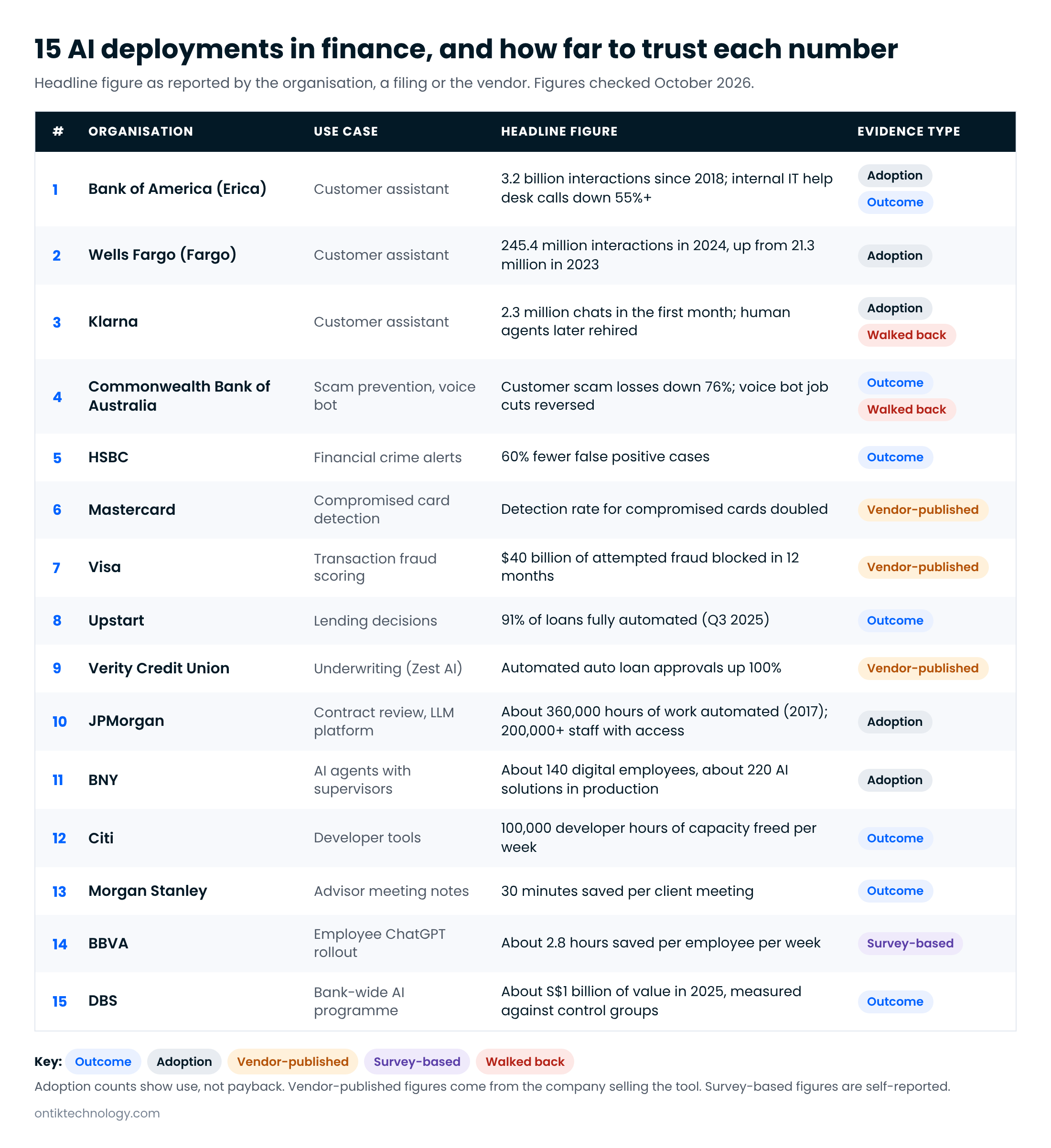
The 15 deployments at a glance
- Bank of America (Erica): 3.2 billion client interactions since 2018, and more than 55% fewer internal IT help desk calls.
- Wells Fargo (Fargo): 245.4 million interactions in 2024, up from 21.3 million in 2023.
- Klarna: 2.3 million chats handled in the first month, then a partial return to human agents.
- Commonwealth Bank of Australia: customer scam losses down 76% over two years, and a voice bot job-cut plan reversed.
- HSBC: 60% fewer false positive financial crime alerts.
- Mastercard: detection rate for compromised cards doubled.
- Visa: $40 billion of attempted fraud blocked in a year.
- Upstart: more than 90% of loans fully automated.
- Verity Credit Union: automated auto loan approvals up 100%.
- JPMorgan: contract review work of about 360,000 hours a year automated, and 200,000+ staff on its LLM platform.
- BNY: about 140 AI "digital employees" working alongside staff.
- Citi: 100,000 developer hours a week freed by automated code reviews.
- Morgan Stanley: 30 minutes saved per client meeting.
- BBVA: about three hours a week saved per employee, self-reported.
- DBS: about S$1 billion in measured AI value in 2025.
How to read the numbers in this post
Not all figures carry the same weight. Four types appear below:
- Outcome metrics change a cost, a loss or a cycle time. HSBC's false positives, Citi's developer hours and CBA's scam losses are examples.
- Adoption metrics show people use the system, not that it paid back. Interaction counts, licences issued and share of staff trained all fall here.
- Vendor-published results come from the company selling the tool. They are useful, but they are not independent.
- Ratios without definitions deserve a question before they go into a business case. Mastercard's "up to 200%" cut in false positives cannot be literal, because a reduction tops out at 100%.
Figures are as reported by the organisations named. Numbers can be revised, so check the original source, linked in each section, before you quote them.
AI assistants that talk to customers
1. Bank of America: Erica, past 3 billion interactions
Erica is Bank of America's virtual assistant, launched in 2018. It handles balance checks, transfers, bill reminders and spending insights, and it now sits inside commercial and wealth channels such as CashPro and Merrill. It predates the large language model wave, which is part of why it has had years to scale.
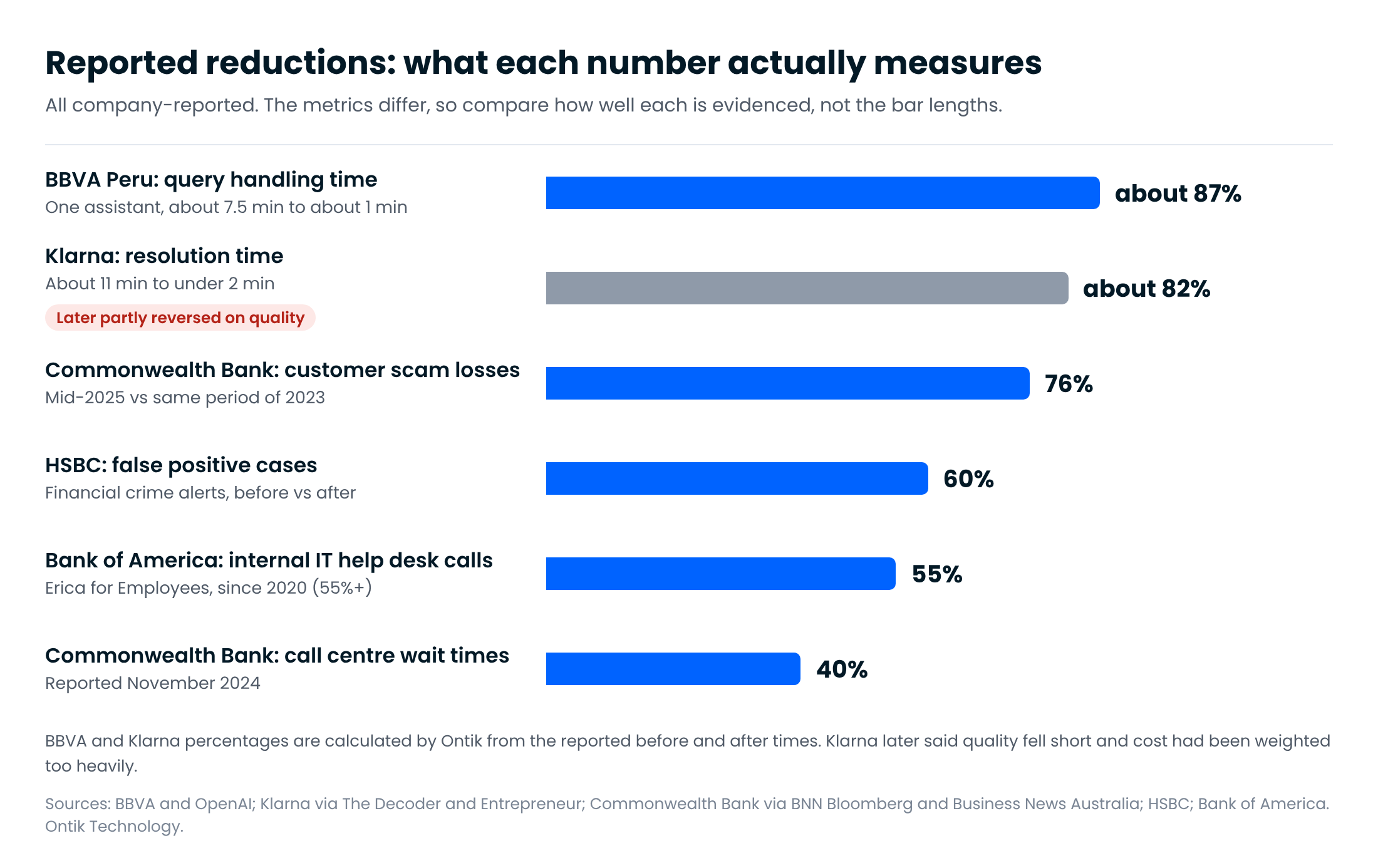
Reported result: According to the bank's 2025 annual report, Erica has handled more than 3.2 billion interactions and helps more than 20 million clients today. A 2025 press release adds that Erica handles more than 40% of client interactions in CashPro Chat. The internal version, Erica for Employees, has cut IT service desk calls by more than 55% since 2020.
How to read it: Interactions are a volume metric. Bank of America has not published cost per contact or containment rate, so the 55% drop in internal help desk calls is the strongest evidence of business impact.
2. Wells Fargo: Fargo, with a privacy pipeline around the model
Fargo is Wells Fargo's mobile assistant for bill payments, transfers, transaction look-ups and account questions, by voice or text. It launched in 2023 on Google Cloud technology.
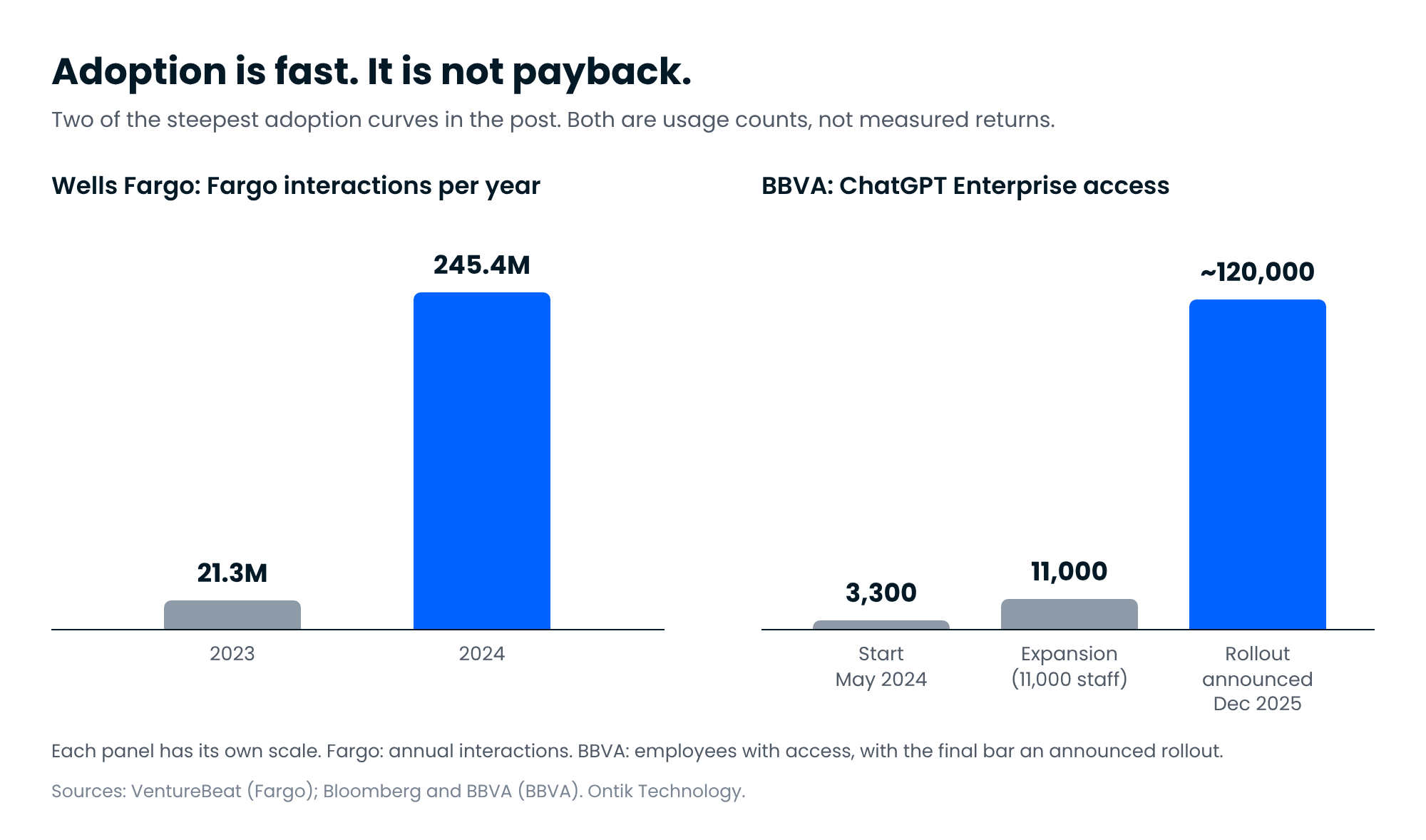
Reported result: VentureBeat reported 245.4 million interactions in 2024, up from 21.3 million in 2023 and more than double the bank's own forecast. In March 2026, Wells Fargo said Fargo had passed 1 billion interactions in under three years.
Design detail worth copying: Speech is transcribed on the device, the bank's own systems strip personal data, and only then does a Google model extract the customer's intent. The model never sees names or account data, and the bank's systems carry out the action.
3. Klarna: fast results, then a course correction
Klarna put an OpenAI-powered assistant in front of customer service in early 2024. In the first month it handled 2.3 million conversations, two-thirds of all chats, which Klarna equated to the work of 700 full-time agents. Reported figures included satisfaction on par with human agents and a projected $40 million profit improvement for 2024. Resolution time fell from about 11 minutes to under two, and repeat inquiries dropped 25%.
What happened next: In 2025, CEO Sebastian Siemiatkowski told Bloomberg that Klarna was hiring human agents again. He said the chatbots were cheaper but delivered lower quality, and that cost had been weighted too heavily in the original decision. Klarna's position is that this is a rebalancing, with AI first and a human always available on request, not a retreat.
How to read it: The 700 figure was a workload equivalence, not 700 layoffs, because much of Klarna's support was outsourced. The lesson is not that the assistant failed. It is that cost per contact alone is the wrong success metric for customer service.
4. Commonwealth Bank of Australia: scam losses halved, one rollout reversed
CBA uses AI to monitor more than 20 million payments a day, flag suspicious ones and warn customers. Its protection features include NameCheck, CallerCheck and CustomerCheck, and it issues about 20,000 proactive alerts a day, with plans to reach 35,000, according to Retail Banker International.
Reported result: In November 2024, CBA said generative AI tools had halved customer scam losses, cut customer-reported fraud by 30% and reduced call centre wait times by 40% through AI-powered app messaging. By mid-2025 it reported a 76% reduction in customer scam losses compared with the same period of 2023, alongside about A$900 million spent in FY25 on fraud, scam, financial crime and cyber protection.
What went wrong: In August 2025, CBA reversed a plan to cut 45 customer service roles after the Finance Sector Union disputed the claim that a new voice bot had cut call volumes by 2,000 a week. The union said volumes were rising and managers were being asked to cover calls. CBA conceded that calls had risen and called the decision an error.
How to read it: The fraud results are the strongest part of the story, but the 76% figure reflects a wider program of AI plus controls and investment, not one model. The voice bot episode is the cautionary half: confirm that call volume data holds up before you announce any headcount change.
Fraud and financial crime
5. HSBC: AI-driven anti-money laundering with Google Cloud
HSBC screens about 1.2 billion transactions a month across 40 million customer accounts for signs of financial crime. With Google Cloud, it replaced much of its rules-based monitoring with a system it calls Dynamic Risk Assessment, built on Google's AML AI.
Reported result: HSBC says it now sees 60% fewer false positive cases. In Google Cloud's launch announcement, HSBC identified two to four times more suspicious activity while alert volumes fell by more than 60%. Google notes that legacy rules-based systems often produce more than 95% false alerts.
How to read it: This is one of the most useful results for a buyer, because false positive rate and detection rate can both be measured before and after. Both are self-reported, and Google co-announced the second one.
6. Mastercard: finding compromised cards before they are used
Mastercard applies generative AI and graph technology to its network data to predict the full details of compromised cards, then alerts issuing banks so they can block and reissue the card before fraud happens.
Reported result: In its May 2024 announcement, Mastercard said the system doubled the detection rate of compromised cards, cut false positives on those cards by up to 200%, and sped up identification of at-risk merchants by 300%. The release also describes the gain as doubling the speed of detection, so the framing is not consistent.
How to read it: A false positive reduction cannot exceed 100%, so the 200% figure is almost certainly a ratio. Ask for the baseline and the definition before a number like this goes into your own business case.
7. Visa: AI scoring on every transaction
Visa scores about 300 billion transactions a year with AI models that weigh more than 500 attributes per transaction, according to its head of risk and identity solutions, as reported from a CNBC interview. It has since added deep learning models for card-not-present payments and for real-time account-to-account payments, per Finextra.
Reported result: Visa says it blocked $40 billion of fraudulent activity in the 12 months to September 2023, nearly double the prior year, covering about 80 million transactions. It also says it invested over $10 billion in technology over five years, including $500 million for AI and data infrastructure.
How to read it: This is Visa's own figure and the counterfactual is not published. It is better evidence of scale than of return on investment.
Lending and underwriting
8. Upstart: loans approved and funded without human review
Upstart is an AI lending marketplace where models decide approvals and pricing, and where software handles the process from rate request to funding with no human involvement from Upstart.
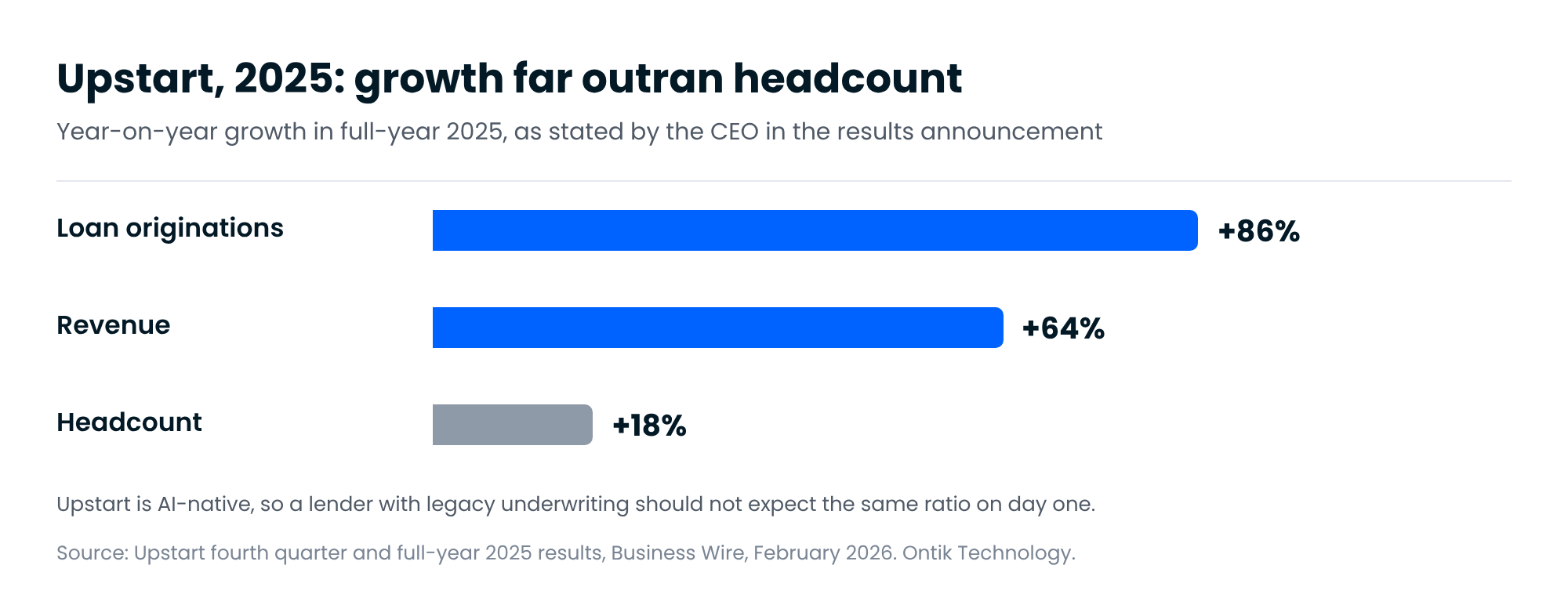
Reported result: 91% of loans were fully automated in the third quarter of 2025, after a record 92% in the first quarter. In its full-year 2025 results, the CEO said originations grew 86% and revenue 64% while headcount grew 18%.
How to read it: Automation rates vary by product. When Upstart automated home equity line approvals in June 2025, less than 1% of home loans were approved automatically at first. Upstart is also AI-native, so a lender with legacy underwriting should not expect the same ratio on day one.
9. Verity Credit Union: automated underwriting at community-bank scale
Verity is a Seattle-based credit union with about $859 million in assets. It replaced generic credit scores with Zest AI's underwriting models, integrated with its loan origination system.
Reported result: Automated approvals rose 100% for auto loans, 84% for credit cards and 69% for personal loans, according to the announcement of the partnership's results.
How to read it: This is vendor-published and measured in approvals, not in loss performance, so it speaks to speed and reach rather than credit quality. It is still the clearest example here of a mid-sized institution, not a megabank, getting value from automated decisioning.
Documents, operations and engineering
10. JPMorgan: from COiN to an LLM platform for 200,000 staff
JPMorgan's Contract Intelligence platform, COiN, reads commercial loan agreements and extracts key terms in seconds. As the ABA Journal summarised Bloomberg's 2017 report, the work once took about 360,000 hours a year of lawyers' and loan officers' time, and the software reduced servicing errors linked to interpreting 12,000 new contracts a year.
Where it went next: More than 200,000 JPMorgan employees now have access to its internal LLM Suite, and a little under half use generative AI tools daily, according to its chief analytics officer's comments to McKinsey in October 2025, as reported by AI News. The bank counts more than 450 AI use cases in production.
How to read it: The 360,000 hours describe the manual workload COiN replaced, as reported in 2017, not an audited saving. The newer evidence is adoption data, which shows breadth rather than payback.
11. BNY: AI agents with identities, permissions and supervisors
BNY built Eliza, an internal platform where employees create AI agents under central governance. It also runs "digital employees", agents with their own identities, access controls and human supervisors. OpenAI's case study lists payment instruction validation and code security among their tasks, and Fortune reports use cases such as reconciling transactions and repairing payments.
Reported result: In its first-quarter 2026 investor presentation, BNY reported about 220 enterprise AI solutions in production and about 140 digital employees. Around half of employees use AI daily, and more than half are building agents.
How to read it: BNY has not attributed a single efficiency number to Eliza, so this is an adoption and architecture story. The part worth copying is the control model: every agent has an identity, permissions and a supervisor, which is what regulated firms need before agents touch payments.
12. Citi: automated code reviews at scale
Citi's headline AI result is in software engineering. Automated code reviews in its generative AI developer tools have run more than a million times, and CEO Jane Fraser told analysts in October 2025 that AI had freed up 100,000 hours of developer capacity a week. Almost 180,000 employees in 83 countries have access to Citi's internal AI tools, per the same Reuters report.
How to read it: Capacity created is not cost removed. Citi has not said whether the hours were redeployed to new work or absorbed. It is still a specific, checkable figure tied to one tool, which is more than most deployments publish.
Copilots for advisors and employees
13. Morgan Stanley: AI@MS Debrief for 15,000 advisors
Debrief records client meetings (with client consent each time), writes the notes and a draft follow-up email, and logs the call in Salesforce. Building it meant integrating OpenAI's transcription and language models with Zoom and the firm's CRM. About 15,000 financial advisors have access.
Reported result: An average of 30 minutes saved per one-hour client meeting, according to Celent's 2025 Model Wealth Manager summary of the project.
How to read it: The time saving is the firm's own, but it is easy to verify internally by measuring after-meeting admin time before and after. It also shows where the effort sits: in integration with Zoom and the CRM, not in the model.
14. BBVA: ChatGPT Enterprise from 3,300 licences to 120,000 staff
BBVA started in May 2024 with 3,300 ChatGPT Enterprise licences and grew to 11,000 employees before announcing a rollout to about 120,000 staff in December 2025. OpenAI's case study reports more than 20,000 custom GPTs built by employees. One assistant used by over 3,000 employees in Peru cut query handling time from about 7.5 minutes to about one minute.
Reported result: BBVA reports an average of 2.8 hours saved per employee per week, with more than 80% of licence holders actively using the tool.
How to read it: Hours saved are self-reported, not time-and-motion measured. Treat them as a credible signal that justifies a wider pilot, not as the basis for a headcount model. The Peru assistant is the more rigorous data point because it measures one task.
15. DBS: AI value measured against control groups
DBS, Southeast Asia's largest bank, is the one institution here that measures AI value the way a CFO would. It compares AI-enabled customers with control groups, according to FinTech News Singapore's coverage of its 2025 results.
Reported result: About S$1 billion in economic value from AI and analytics in 2025, up from S$750 million in 2024, with more than 2,000 models and 430 use cases deployed, per the CEO's annual report letter. More than 60% of staff actively use its internal DBS-GPT tool.
How to read it: DBS's CEO has said that as AI becomes embedded in daily work, isolating its value gets harder, and the bank expects to lean more on measuring capacity. Even so, the control-group method is the one to borrow.
What the 15 deployments have in common
- They started with a narrow, high-volume process. Alert triage, contract extraction, post-meeting notes and intent recognition. None began with a general "AI strategy".
- The model is the smaller part of the build. Morgan Stanley's effort was integration with Zoom and Salesforce. Wells Fargo's was a privacy pipeline. BNY's was agent identity and permissions.
- The best numbers have a before and after. HSBC's false positives, BBVA Peru's handling time and DBS's control groups. The weakest numbers are interaction counts.
- Humans stayed in the loop where judgment mattered. Klarna and CBA are the evidence for what happens when that is rushed.
- Governance shipped with the product. Wells Fargo scrubs data before the model sees it, and BNY gives each agent a supervisor.
How to build the business case your CFO will accept
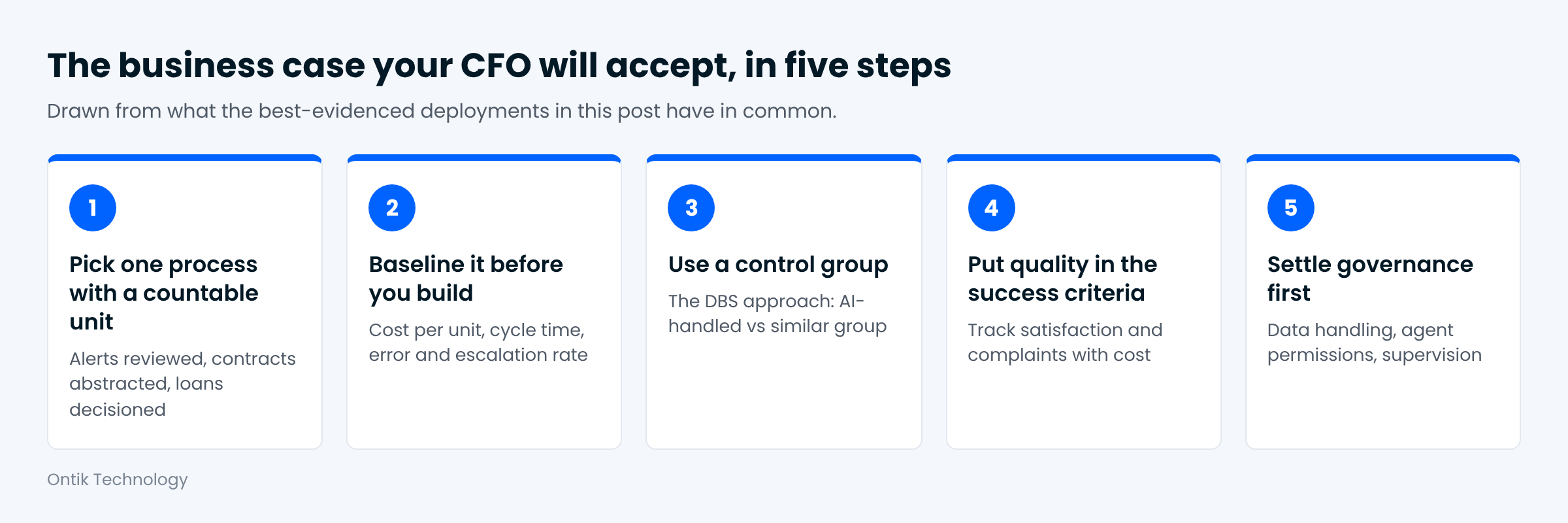
- Pick one process with a countable unit. Alerts reviewed, contracts abstracted, loans decisioned or meetings documented.
- Baseline it before you build. Capture cost per unit, cycle time, error rate and escalation rate for several weeks, so the result is not an anecdote.
- Use a control group. This is the DBS approach: compare the AI-handled group against a similar group that was not.
- Put quality in the success criteria. Track satisfaction, escalations and complaints alongside cost. Klarna's reversal came from weighting cost too heavily. If your use case is support, our guide to AI customer support agent cost is a useful companion.
- Settle governance first. Decide how data is handled, what each agent may do, who supervises it and how model risk is reviewed before launch.
What this means if you do not have a megabank budget
Network-scale systems like Visa's scoring or Erica's 20-million-client footprint are not realistic first projects. Several of the 15 are. Automated underwriting through a specialist vendor, as at Verity. Machine learning on top of existing transaction monitoring, as at HSBC. Meeting notes and CRM updates for advisors, as at Morgan Stanley. Internal knowledge assistants, as at BBVA and DBS.
Those projects share a profile: one process, one owner, a number you can baseline, and integration with systems you already run. That is where AI agent development and automation work best.
Scoping an AI automation project?
Ontik Technology builds AI agents and automation workflows that connect to existing core systems. If you are weighing one of the deployments above, the useful first step is a short discovery to baseline the process and agree the metric, before any model is chosen. Our AI consulting team can run that, and our guides to AI implementation and AI automation for enterprises cover the wider picture.
Frequently asked questions
What are examples of AI automation in finance?
Virtual assistants such as Bank of America's Erica and Wells Fargo's Fargo, fraud and anti-money laundering systems at HSBC, Mastercard and Visa, automated lending at Upstart, contract extraction at JPMorgan, and advisor copilots such as Morgan Stanley's Debrief.
Which AI use case in finance has the clearest measured result?
Fraud and financial crime alert reduction, because false positive rates and detection rates can be compared before and after. HSBC's 60% reduction in false positive cases is the most concrete example here, though it is self-reported.
How much time does AI save finance employees?
Reported figures depend on the task. Morgan Stanley reports about 30 minutes saved per client meeting, BBVA reports about 2.8 hours per employee per week from a self-reported survey, and Citi reports 100,000 developer hours of weekly capacity across the bank. Treat self-reported time savings as directional.
Why did Klarna rehire human customer service agents?
Its CEO said the AI assistant was cheaper but produced lower quality service, and that cost had been weighted too heavily in the decision. Klarna now routes customers to AI first, with a human always available on request.
AI Automation in Finance: 15 Real Deployments and Their Results
15 named AI deployments across banks, card networks and lenders, with the real results, what was walked back, and how to build a CFO-ready business case.