AI Automation for Enterprises: Complete Strategy Guide

Here's a number worth sitting with for a moment. Enterprises are losing 51 workdays per employee per year to technology friction, even as AI investment hits record highs. That's not a data problem or a model problem. That's an execution problem.
Most companies are spending heavily on AI right now. 78% of organizations report using AI in at least one business function. But ask those same organizations what they're actually getting from it, and the honest answers sound a lot like "we're more efficient in a few areas" rather than "we transformed how the business runs."
Revenue growth, competitive advantage, and genuine operational transformation remain aspirational for the majority. The technology is capable enough. The bottleneck is almost always in how organizations plan, select, implement, and adopt AI automation not in the AI itself.
This guide walks through everything you need to know before committing serious budget to enterprise AI automation. What it actually is, where it creates real value, why so many projects fail, how to implement it properly, and how to measure results in a way that holds up to scrutiny.
Ontik Technology helps enterprises navigate exactly this process, from identifying the right use cases through to production deployment and long-term support. But the foundation starts with understanding what you're actually buying into.
What Is Enterprise AI Automation?
Enterprise AI automation means using AI systems to run complex, multi-step business processes that used to need human judgment at every turn — not just software following a fixed set of rules.
That sounds like a subtle distinction. It isn't.
Think about what traditional automation actually does. It executes instructions. "If invoice total exceeds $10,000, route to finance director." That's useful. It saves time. But add an unusual vendor name, a slightly different invoice format, or a line item that doesn't match the purchase order, and the whole thing either fails silently or throws an error. Someone has to intervene. The exception handling always falls back on a person.
AI automation doesn't work that way. It reads context. It handles data that doesn't fit a neat template. It learns from the exceptions it encounters and gets better at handling them over time. It can make judgment calls on routine cases and flag only the genuinely ambiguous situations for human review.
In practice, enterprise AI automation operates across three distinct levels.
Task automation is the entry point. Single, contained actions: summarizing a meeting transcript, classifying a support ticket, extracting data from a document. Fast to build, fast to see results.
Workflow automation connects multiple tasks across systems. An invoice arrives, gets read and validated by AI, checked against contract terms, routed to the right approver with a summary note, and logged for audit purposes. No human involved unless the AI identifies something that needs review.
Agentic automation is the frontier. AI agents that reason through multi-step problems, call APIs, browse knowledge bases, and complete complex tasks without waiting for a human at each step. Enterprise AI trends in 2026 include agentic AI adoption across apps expected to reach up to 40% by year-end, alongside expanding use of RAG for contextual workflows and real-time orchestration for customer experience and operational systems.
Knowing which level your use case sits at determines your budget, your timeline, and your governance requirements. Getting that wrong early is expensive.
AI Automation vs. Traditional Automation: What Actually Changed
The simplest way to explain the difference: traditional automation follows a script. AI automation rewrites the script when it needs to.
That's a meaningful shift, and it matters practically for how you decide what to automate and what to leave alone.
Old RPA tools were brilliant at structured, stable processes. Same format every time, same fields, same outcomes. The moment something changed, a new invoice layout, an unusual input, a vendor that formatted their data differently, the bot failed. You'd get an error notification. Someone would fix it manually. You'd automate the easy 80% and leave the hard 20% as a permanent exception pile.
AI-powered automation handles the variation. It reads documents the way a human does, understanding what a total is supposed to equal and flagging it when it doesn't. It checks context against other data sources. It improves its own accuracy as it processes more examples.
Here's a straightforward comparison of where each approach actually fits:
The decision rule is simple. If your process is stable and inputs are consistent, traditional RPA is often cheaper and faster to implement. If your process involves variation, judgment, or unstructured data, AI automation is the right tool. If you need autonomous multi-step reasoning across systems, agentic AI is where you're headed.
Don't over-engineer simple tasks. Don't under-engineer complex ones. Those two mistakes together account for a significant portion of enterprise AI budget waste.
Where Enterprise AI Automation Delivers the Most Value
The processes with the highest ROI from AI automation tend to share three characteristics. They're high-volume. They're data-intensive. And they currently require human judgment on cases that actually follow predictable patterns if you look closely enough.
That covers more ground than most people initially expect.
Customer Support and Service
Customer support is where AI automation has the longest track record and the clearest results. AI agents handle tier-1 and tier-2 requests at scale: password resets, order tracking, policy explanations, account changes, refund status updates.
An air carrier is using AI agents to help customers complete common transactions such as rebooking a flight or rerouting bags, freeing up human agents for more complex matters.
What's changing in 2026 is the measurement standard. The leading organizations have stopped asking "how many tickets did we resolve?" and started asking "what outcome did the customer actually achieve?" That's a harder target, and AI automation is what makes it achievable at the volume most enterprises deal with.
Platforms like Decagon have built their entire product around omnichannel customer support automation. Moveworks takes a broader approach, covering employee and customer-facing support through enterprise-wide conversational AI.
Finance and Accounting
If there's one department where the volume of repetitive, high-stakes work is genuinely relentless, it's finance. Invoice processing, expense reconciliation, compliance checks, audit preparation, and financial close processes run continuously and they cannot be wrong.
A large US-based banking enterprise automated its loan document verification process using AI. What earlier required multiple teams and several days was reduced to just a few hours, with a noticeable drop in operational costs and faster loan approvals within the first six months.
The value here isn't just speed. AI validates data against business rules, spots anomalies that humans miss on the 47th document of the day, triggers downstream workflows automatically, and creates a complete audit trail without additional work. Connecting this to strong business intelligence and analytics infrastructure is what lets finance leadership actually see these patterns and act on them.
HR and Employee Experience
HR teams spend a remarkable amount of time answering the same questions. Benefits queries, leave policy questions, onboarding documentation requests, equipment provisioning, payroll clarifications. Most of it predictable. Most of it time-consuming. None of it requiring a senior HR professional to handle personally.
A financial services company is building agentic workflows to automatically capture meeting actions from video conferences, draft communications to remind participants of their commitments, and track follow-through.
Organizations using AI for HR request handling consistently report two things: faster resolution for employees and HR teams that finally have time for the strategic work they were hired to do. Autonomous payroll workflows are already saving thousands of hours annually in companies that have invested in building this properly.
IT Operations
IT might be the clearest case for AI automation that exists. Alert triage, incident classification, routine support requests, system monitoring these generate enormous operational load and most of them follow patterns that AI identifies quickly.
One team deployed an AI system to automate alert triage. The AI handled initial classification and false positive filtering, processing alerts in seconds rather than hours, escalating only what genuinely required human judgment.
The broader shift this creates is IT moving from reactive firefighting to proactive reliability management. Predictive agents catch problems before they become incidents and route issues with context already gathered. Getting your cloud solutions infrastructure right for AI workloads from the start is what makes this kind of proactive IT possible at scale.
Supply Chain and Operations
Supply chains involve a genuinely overwhelming number of variables. Supplier performance, transport costs, inventory levels, demand signals, weather disruptions, regulatory changes, and competitor pricing all interact continuously. No human team tracks all of it simultaneously.
A manufacturer is using AI agents to support new product development initiatives, with AI finding the optimal balance between competing objectives such as cost and time-to-market.
The manufacturing, retail, and logistics sectors are seeing consistent, measurable improvements in planning accuracy and waste reduction from AI automation. The common thread across all of them is that AI handles the continuous monitoring and pattern recognition while humans focus on the decisions that genuinely need strategic judgment.
Sales and Marketing
Dynamic pricing, lead qualification, personalized outreach sequencing, content generation, and retention prediction are now delivering measurable results for enterprises that have moved beyond experimentation.
Retail, travel, and eCommerce companies using AI-powered dynamic pricing are adjusting prices in real time based on demand signals, inventory positions, and competitor moves. That's not something any human pricing team can do continuously at scale. The AI and machine learning solutions powering these systems have become accessible to mid-market companies, not just the largest global enterprises.
Top Enterprise AI Automation Platforms in 2026
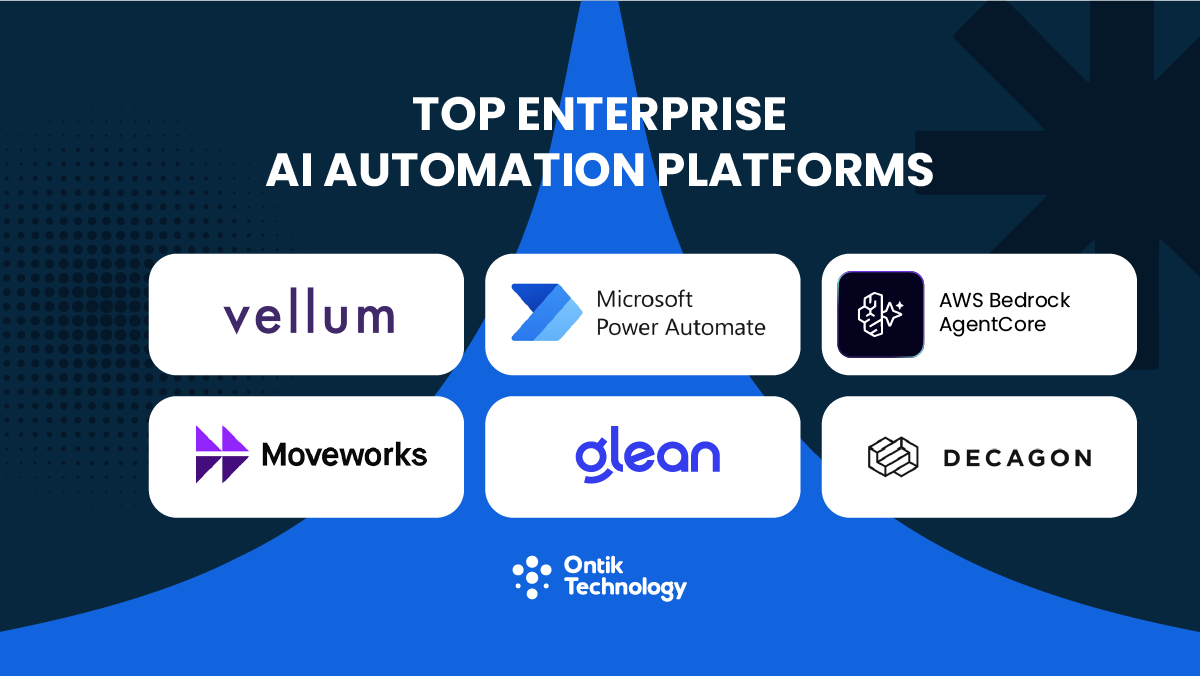
The platform question doesn't have a universal answer. What works brilliantly for a Microsoft-heavy enterprise with in-house engineering capability will be the wrong choice for a company without that infrastructure. Here's an honest look at what's leading the market and where each tool actually fits.
Vellum AI is worth a serious look for any enterprise that needs to build, evaluate, and govern AI agents with genuine observability. Vellum makes it easy for teams to build automations using natural language prompts in the Agent Builder, with built-in evaluations and versioning for safe iteration, end-to-end observability and audit trails, and flexible deployment across cloud, on-premise, or hybrid environments. The governance depth is what sets it apart from lighter-weight alternatives.
Microsoft Power Automate is the obvious choice if your organization runs heavily on Microsoft 365. The Copilot integration is genuinely useful. But pushing this platform hard outside the Microsoft ecosystem creates friction that adds up quickly.
AWS Bedrock AgentCore is strong on security architecture and scalability for enterprises already deep in AWS. For teams without that AWS foundation, the learning curve is real and worth factoring into your timeline.
Moveworks has built one of the most capable conversational AI products for enterprise employee support. The pricing reflects an enterprise positioning that makes it less viable for smaller organizations. For large enterprises with high employee support volumes, the investment makes sense.
Glean addresses a problem that large organizations almost universally have but rarely name directly: employees cannot find information spread across dozens of internal tools. When it works well, the productivity impact is significant. When the underlying data is messy, the results reflect that directly.
Decagon is specialized and focused, which is either a strength or a limitation depending on your needs. If customer support automation is your primary objective and you want depth over breadth, it's worth serious evaluation.
For enterprises whose automation requirements don't fit cleanly into packaged platforms, custom software development built around your specific workflows often delivers better long-term results than forcing a generic product to adapt to your processes.
Why Most Enterprise AI Automation Projects Fail
Roughly 80% of enterprise AI automation projects never make it past the proof-of-concept stage. Blaming the technology is convenient, but it's almost never accurate.
The real causes are operational and organizational. They show up consistently across industries and company sizes, which means they're predictable and largely avoidable if you know what to watch for.
No measurable KPIs defined before work starts. The primary cause of failure is lack of defined KPIs. Executives often chase general metrics instead of targeting narrow, measurable processes like reducing help desk tickets by 40% or speeding up code commits. Wanting to "improve efficiency" is not a target you can build toward or prove you achieved. Name the specific process, the specific metric, and the specific improvement you're aiming for. Without that, you can't demonstrate ROI, and you won't secure budget for phase two.
Internal blockers show up late and with authority. Staff functions were the most frequent blockers. Legal worried about liability. HR worried about change management. Risk and compliance worried about regulatory exposure. These functions have organizational authority to slow or stop projects regardless of executive support. The solution is straightforward: bring legal, compliance, and risk into the conversation early. Getting them involved after the prototype is built guarantees delays.
Automating a broken process. This one is deceptively simple and consistently overlooked. AI automation doesn't fix a bad workflow. It runs it faster. If your process has inconsistencies, unclear ownership, or undefined exception handling, automating it amplifies every one of those problems at scale. Spend time cleaning up the process before you build the automation.
The data foundation wasn't ready. 70% of organizations find that their data infrastructure is fundamentally lacking only after launching ambitious AI initiatives. The moment of truth typically occurs six months in, after a successful pilot implementation. Pilots pass because they run in controlled environments with curated data. Production exposes the real state of your data infrastructure. An honest assessment before you build saves months of painful rework.
Pilot costs don't predict production costs. A successful pilot typically runs at 15 to 25% of what full production deployment actually costs. It skips security hardening, governance integration, compliance testing, monitoring infrastructure, and exception handling at real-world scale. Never use pilot budget figures to estimate production investment. They're measuring different things.
Nobody budgeted for change management. When workers aren't properly trained on how to use AI tools within their daily workflows, adoption stalls, workarounds multiply, and the friction becomes self-reinforcing. Vendor switching won't solve a problem that originates in insufficient change management, inadequate onboarding, and a lack of ongoing user support. Technology handles about 20% of what makes an AI initiative succeed. The other 80% is in how people adapt their work around it.
How to Implement Enterprise AI Automation: A Practical Roadmap

The sequence matters more than most organizations realize. Enterprises that succeed with AI automation almost always follow a clear progression: process selection, then infrastructure assessment, then governance design, then building, then adoption. The ones that fail typically skip the first three and wonder why the last two don't work.
Stage 1: Select the Right Processes First
Start narrow. Rather than spreading resources thin, enterprises should focus on 3 to 5 use cases where AI directly impacts revenue, operational efficiency, or customer experience. This accelerates visible ROI and builds enterprise-wide alignment.
The processes worth automating first share a common profile: high volume, data-rich, currently requiring judgment that actually follows patterns if you look carefully. Invoice processing, support ticket routing, employee HR requests, IT alert triage fit the profile well.
The processes to avoid automating first: anything with too many unique exceptions, workflows that are already inconsistent or broken, and tasks where the human relationship itself is what creates the value. Understanding our process for evaluating and sequencing use cases can help you build a prioritized roadmap before any budget gets committed.
Stage 2: Assess Your Data and Infrastructure Honestly
Before building anything, take a clear-eyed look at your data. Where does it live? How clean is it? Can your current infrastructure handle automated workflows at production scale without falling over?
The gaps that derail projects most often: data fragmented across systems that don't connect, inconsistent quality standards between departments, no centralized data layer, and cloud infrastructure that was never designed with AI workloads in mind.
Fix the foundation before building on top of it. Cloud solutions architected specifically for AI workloads from the start will save you the expensive rework that comes from discovering structural gaps six months into a live deployment.
Stage 3: Build Governance Into the Design
As AI moves from experimentation to deployment, governance is the difference between scaling successfully and stalling out. Enterprises where senior leadership actively shapes AI governance achieve significantly greater business value than those that delegate it to technical teams alone.
Governance sounds like a compliance checkbox. In practice, it's what makes automated systems trustworthy enough to actually use and scale.
Before anything goes into production, you need answers to these questions: Who owns this workflow? Who can modify the automation? How do exceptions get escalated? What audit trail is required? Which regulatory frameworks apply? Building governance in from the start costs a fraction of retrofitting it later. Most teams learn this the hard way once.
Stage 4: Build an MVP and Validate Before Scaling
Run a real test, not a demo. Take your highest-priority use case, build a working MVP against real data with real users, and measure what actually happens.
The discipline here is setting success metrics before you start, not after. Pick something specific and measurable: cut invoice processing time by half, resolve 35% of tier-1 support tickets without human intervention, reduce employee HR request resolution from three days to four hours. Then track it.
CFOs require clear financial justification before approving broader AI investments. Measured pilots that demonstrate value are the most reliable way to secure that justification.
A strong MVP either gives you proof to build the business case for broader rollout, or it surfaces the problems that would have cost far more to discover in a full deployment. Both outcomes are valuable. Ontik Technology's MVP development services are built specifically for this stage, and their practical guide to AI MVP development covers the methodology in detail.
Stage 5: Take Adoption Seriously
More AI automation projects succeed technically and fail operationally than most organizations want to admit. The system works. The employees don't use it, don't trust it, or work around it in ways that eliminate the efficiency gains.
Train your teams on working alongside AI, not just on how to operate the tool. Be specific with frontline workers about what changes in their role, what stays the same, and how they escalate issues. Position automation as relief from the work people hate most, not as a replacement for the work they're proud of.
Build feedback loops so employees can flag when the AI gets something wrong. Those signals are how the system improves over time. Without them, the accuracy plateaus and people stop reporting errors because they've already stopped trusting the output.
A dedicated development team that stays embedded in your environment after initial deployment is one of the most reliable ways to keep improving the system rather than watching it gradually drift toward irrelevance.
How to Measure ROI on Enterprise AI Automation
Telling your CFO you "saved hours" is the beginning of a conversation, not the end of one. Hours saved are only worth something if they get redirected to work that produces output, revenue, or meaningful cost reduction.
Measure across four dimensions to build a case that holds up.
Productivity is the most straightforward. How long did this process take before? How long does it take now? How many more transactions can you process with the same team? Cycle time reduction and throughput increases are the clearest measures.
Quality often gets undercounted. AI doesn't have bad days, doesn't get tired at the end of a shift, and doesn't misread the 47th document the same way a person might. Error rate reduction, fewer escalations, and better compliance adherence are all financially quantifiable when you set baselines properly.
Revenue impact is harder to isolate but often the largest number. Faster lead response times, better conversion rates, reduced customer churn, real-time pricing improvements these connect automation directly to revenue when the system touches customer-facing or revenue-generating processes.
Risk reduction is the category that dominates in regulated industries. Fewer compliance incidents, cleaner audit outcomes, reduced regulatory exposure. In financial services and healthcare, this dimension alone frequently justifies the entire investment.
A practical approach to measurement that actually works:
First, set specific baselines for each metric before deployment. Second, define target improvements with clear timeframes: 30 days, 90 days, 180 days. Third, measure performance against those baselines at each checkpoint. Fourth, convert improvements into financial terms using your own cost and revenue data. Fifth, compare the result against total cost of ownership including build, maintenance, change management, and ongoing support.
Research from global leaders identifies that sector-specific agents provide a 500% ROI on average compared to horizontal AI deployments. Focused, specific automation consistently outperforms broad, generic AI tools. Pick one workflow, solve it properly, and build the business case from there.
None of this is measurable without a solid data infrastructure underneath it. Business intelligence and analytics capability is what turns "we think it's working" into "here's exactly what it delivered and why."
AI Automation Governance and Compliance
Governance isn't paperwork. For enterprises running automated systems at scale, it's the mechanism that keeps those systems safe, trustworthy, and legally defensible.
Most organizations treat governance as something to sort out after the system is built. The ones running AI automation successfully treat it as a design requirement from day one.
Here's what governance actually means in practice.
Audit trails that capture everything. Every automated action, every AI output, every decision made by a model should be logged with enough context to reconstruct what happened and why. When something goes wrong, and it will occasionally, you need to trace it clearly. You also need this for compliance audits in regulated industries.
Access controls that match the work. An AI agent processing supplier invoices doesn't need access to employee records. An HR automation tool doesn't need access to financial systems. Define scope precisely and enforce it technically, not just through policy documentation that nobody reads.
Explainability built into the design. Particularly in finance, healthcare, and insurance, automated decisions need to be explicable. Black-box outputs create regulatory exposure. If you can't articulate why the system made a particular decision, that's a problem waiting to surface at the worst moment.
Clear human-in-the-loop pathways. Organizations need to define where humans should remain in control, how automated decisions are audited, and which records of system behavior should be retained. This isn't about limiting what AI can do. It's about designing systems with oversight built in, so problems get caught before they compound.
Regulatory alignment from the start. GDPR, HIPAA, SOC 2, and the EU AI Act each have specific implications for automated decision-making. Understanding which apply to your use cases before building costs a fraction of what compliance remediation costs after the fact.
Agentic workflows are spreading faster than governance models can address their unique needs. In many cases, agents can handle roughly half of the tasks people currently do, but that requires a new kind of governance to manage risks and improve outputs.
A governance checklist worth completing before any production deployment: named process owner, documented escalation path, defined exception handling procedures, scheduled performance review cadence, and a tested rollback procedure for when something doesn't perform as expected.
Enterprise AI Automation Trends Shaping 2026
Four things are shifting how enterprises actually deploy AI automation right now. These aren't predictions for the future. They're what's happening in organizations that are scaling successfully today.
Agentic AI has moved past the experiment phase. 79% of senior executives say AI agents are already being adopted inside their companies. CFOs report that 25% of total AI budgets are already dedicated to agents. The organizations still treating agentic AI as a future consideration are watching competitors scale capabilities that compound over time. The gap is already opening.
Specialized models are beating general-purpose ones in real-world use. Models tailored to medical, legal, financial, telecom, manufacturing, and banking domains deliver higher accuracy, tighter control, and dramatically lower risk than general-purpose alternatives. Trained on industry-grade datasets, they reflect the vocabulary, structure, rules, and edge cases of a domain in ways that horizontal models simply don't. The practical implication: for any regulated or specialized industry, the case for domain-specific AI over a general-purpose model is strong and getting stronger.
Governance has become the primary constraint on scaling. Governance becomes the main constraint, not model quality. If you can't answer who changed what, when, and why, scaling stalls. This is a shift worth internalizing. The bottleneck in 2026 isn't finding a capable model. It's building the organizational infrastructure to govern it responsibly at scale.
The hybrid workforce model is becoming the default. AI handles volume, pattern recognition, and continuous monitoring. Humans handle judgment, relationships, and decisions that require genuine contextual understanding. Cognitive process automation can reduce process time by up to 50 to 60%, with significant improvements in accuracy, compliance, and labor efficiency. Companies designing for this model now are building structural advantages that will be difficult to close over the next several years.
Final Thoughts
The organizations getting real results from AI automation in 2026 aren't necessarily the ones with the biggest budgets or the most sophisticated platforms. They're the ones that picked the right processes, built governance in from the start, invested in making adoption actually work, and measured results against specific baselines rather than vague ambitions.
The technology has been ready for a while. What makes the difference now is the discipline to implement it well.
If your organization is at the point of moving from planning into execution, Ontik Technology brings both the strategic capability and the engineering depth to take an AI automation program from concept through to production. They work alongside your team through every stage rather than handing off a deliverable and moving on.
For automation requirements that go beyond what packaged platforms can handle, their custom software development services are worth a conversation. Sometimes the right solution is one built specifically for your workflows, not adapted from a product designed for a different company's problems.
Frequently Asked Questions
What is enterprise AI automation?
It's the use of AI systems to handle complex, multi-step business processes across an organization. Unlike traditional rule-based automation, AI automation adapts to variation, handles unstructured data, learns from feedback, and in its most advanced form, reasons through multi-step tasks autonomously.
How is AI automation different from RPA?
RPA follows fixed rules and breaks when inputs change. AI automation adapts to variation and improves over time. RPA works well for stable, structured processes with consistent inputs. AI automation is better suited for processes involving judgment, variable data, or unstructured information. Most enterprises need both, applied to the right processes.
Which processes are most worth automating first?
High-volume processes with consistent underlying patterns are the best starting point. Customer support triage, invoice processing, IT alert management, HR request handling, and demand forecasting consistently deliver strong results. The processes to avoid first are those with too many unique exceptions or where human judgment and relationship are the actual value being delivered.
How long until you see ROI?
For focused, high-volume use cases like support ticket routing or document processing, measurable results typically appear within three to six months. More complex, multi-system workflows take longer to stabilize, often 6 to 12 months. The biggest variable is how clearly success was defined before work started. Vague goals produce vague results on unpredictable timelines.
What is agentic AI?
Agentic AI refers to systems that plan and execute multi-step tasks without human instruction at each step. They call tools, retrieve information from multiple sources, make decisions based on context, and complete workflows autonomously. It's the most advanced form of enterprise automation and it's moving from experimental pilots to production deployment across industries in 2026.
What causes most AI automation projects to fail?
Poor process selection, inadequate governance design, weak data infrastructure, and insufficient investment in change management account for the majority of failures. The technology itself is rarely the primary cause. These are all avoidable with proper planning before a build begins.
Get Your AI Roadmap
Plan the right AI automation strategy for your enterprise with clear next steps.

.avif)