AI Implementation Strategy: Roadmap, Framework, Services, Cost, and Common Challenges
That’s because they’re treating it as a tech experiment, not a business move. If you genuinely want AI to assist your bottom line, you need a clear plan, the proper people, and reasonable expectations for the long term.
Everything you need to know is in this guide. From designing your first AI project to choosing the perfect partner, you'll find practical methods, real numbers and guidance you can apply right immediately.
What Is AI Implementation and Why Does It Matter?
AI deployment is the entire process of moving AI from concept to regular use. It’s not just about constructing a model or buying software. It’s the alignment of technology to your company objectives, preparation of your data, educating your team and setting up rules so everything runs smoothly.
“AI is no longer in the test phase by 2026. Companies are not wondering if they should employ AI anymore. They’re asking how quickly they can put it out without damaging what already works. We are currently in the transition from little experiments to full production systems. Companies saying AI is intrinsic to what they do, not something we are dabbling in, are moving ahead.
Why it matters to you. Done well, AI can save operating costs by 20-30 percent. It speeds up decision-making, automates tedious procedures and reveals insights hidden in your data. But these perks aren't merely handed to you. They come from careful AI implementation planning that connects technology to results your leaders actually care about.
The companies winning with AI in 2026 all share one thing. They built an AI implementation strategy before they wrote a single line of code.
AI Implementation Planning
Before you spend money on AI, you need a plan. Most organisations that miss this stage end up wasting 6-12 months designing solutions that solve the wrong problems or working with data that isn’t ready.
Start with one business challenge. Don't try to alter everything overnight. Pick a use case where AI can deliver clear benefit within 6 months. Good areas to start are customer service automation, demand forecasting, or document processing.
Then check your data. “AI needs data to do its job, and most companies have no idea how dirty their data is.” 80-90% of data in companies is unstructured data. It’s siloed by department, it’s in multiple forms and it’s rarely labelled for machine learning.” In fact, data cleaning and organization sometimes consumes 30 to 50 percent of your whole AI spend. Keep this in mind.
Then, hire the right individuals. You need buy-in from business leaders who define success, IT teams that manage your systems, and compliance officials who make sure you follow the rules. If none of these groups are in early interactions, you'll run against walls down the line.
Finally, draw up a realistic budget and timeframe. A proof of concept could take between 8 to 12 weeks. Usually it takes six to twelve months to have a production-ready system. Consider continuing costs of maintenance, retraining and support. There is no “one and done” with AI. That’s a continuing ability.
If you need help building this plan, an AI implementation consultant can save you months of trial and error.
AI Implementation Roadmap
A solid AI implementation roadmap takes you from idea to live system in five clear phases. Each phase has specific goals and decision points.
Phase One: AI Readiness and Use Case Selection (Weeks 1 to 4)
Check your current state. Look at data quality, infrastructure, and team skills. Rank use cases by business impact and technical feasibility. Drop ideas that sound exciting but lack clear return on investment.
Phase Two: Proof of Concept (Weeks 5 to 12)
Build a small, focused test. See if your data can support the model and if the predicted results hold up in real life. A proof of concept is a learning tool, not a finished product. Expect it to break. That's the whole point.
Phase Three: Minimum Viable Product (Months 3 to 6)
Build a working version that connects to one or two real workflows. This is where MVP development skills matter. You want something functional enough to test with real users, but small enough to build quickly. Many companies work with specialists who understand AI MVP development to avoid building too much too soon.
Phase Four: Production Deployment and Scaling (Months 6 to 12)
Roll out the system to more teams. Watch performance, fix connection issues, and adjust based on user feedback. This is where most projects stall if they lack a clear AI implementation process.
Phase Five: Continuous Improvement (Ongoing)
Retrain models as data changes. Update workflows as business needs shift. AI systems get worse without attention. Plan for this from day one.
AI Implementation Framework
An AI implementation framework gives you the blueprint for sustainable AI operations. It covers five layers that work together.
Data Layer
Your data must be reachable, clean, and governed. This means setting up ownership, quality standards, and connection pipelines. Without this base, even the best models give you garbage.
Technology Stack
Choose your tools carefully. Cloud platforms offer flexibility but ongoing costs. On-site solutions give you control but need heavy upfront investment. Most mid-market companies use a mix of both. Your stack should include model development tools, deployment pipelines, and monitoring systems.
Governance Layer
Set up compliance rules before you launch. The EU AI Act, GDPR, and industry-specific regulations all apply. You need audit trails, bias checks, and clear accountability for AI-driven decisions. Skip this and you risk fines, lawsuits, and reputation damage.
People Layer
Map the skills you have against the skills you need. Most companies don't have enough data engineers, ML engineers, or AI-savvy product managers. You can build these skills internally, hire full-time, or use team augmentation to fill gaps fast. Many organizations find that hiring remote developers with AI skills is quicker than local recruiting.
Integration Layer
AI must connect to your existing systems. Older software, ERP platforms, and customer databases don't always work well with modern AI tools. Plan for API development, data syncing, and backup workflows when AI systems hiccup.
A strong framework turns AI from a fragile experiment into a reliable business tool.
AI Implementation Process and Methods
The AI implementation process breaks into repeatable methods that keep projects on track.
Agile AI Development
Build in short cycles. Train a model, test it, deploy it, get feedback, and repeat. This lowers risk and catches problems early. Waterfall approaches fail here because AI projects have too much uncertainty.
MLOps Practices
Treat machine learning like software engineering. Use version control for models and data. Automate training pipelines. Set up A/B testing for model comparisons. Watch performance in production and trigger retraining when accuracy drops.
Change Management
AI changes how people work. If you don't manage this on purpose, employees will resist or work around your new systems. Involve end users early. Show them how AI makes their jobs easier, not how it replaces them.
Risk Mitigation
Build in safeguards. Use retrieval-augmented generation to ground large language model outputs in real data and reduce made-up answers. Add bias checks in training pipelines. Create human-in-the-loop workflows for high-stakes decisions.
Method Selection
Pick your approach based on the problem. Supervised learning works when you have labeled historical data. Reinforcement learning fits changing environments like pricing or logistics.
Fine-tuning large language models makes sense for domain-specific language tasks. Prompt engineering is faster but less precise. Choose the AI implementation methods that fit your timeline, budget, and accuracy needs.
Top 10 AI Implementation Consultants
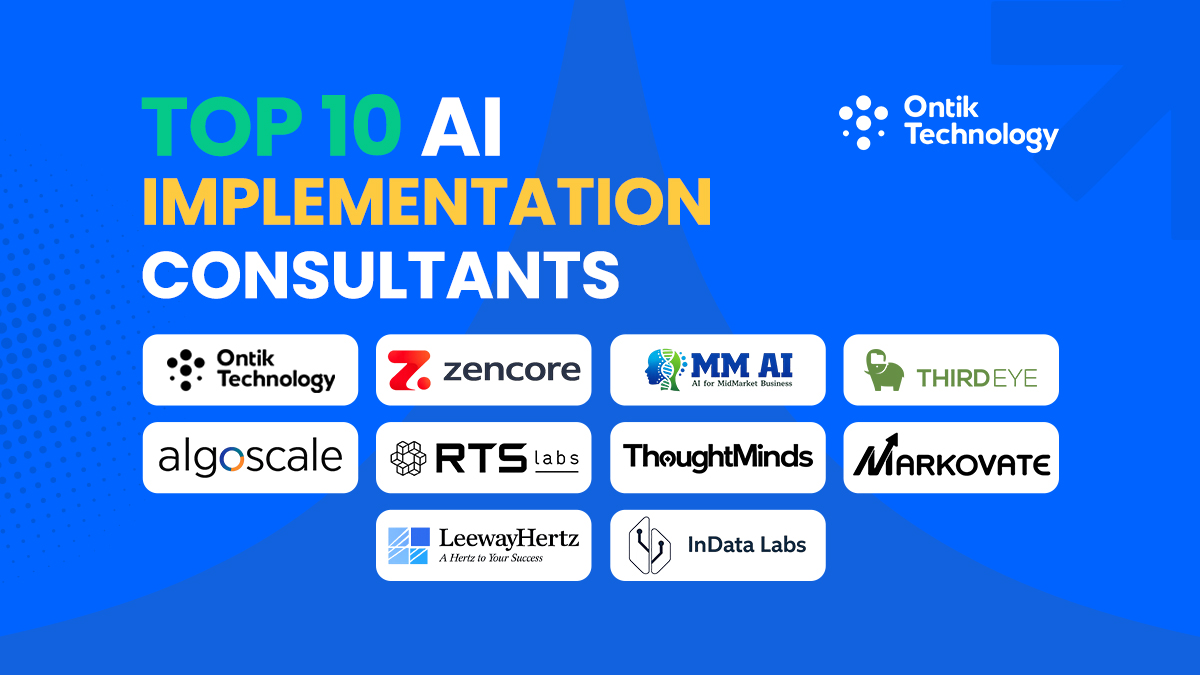
The right partner speeds up your timeline and helps you avoid expensive mistakes. Here's a quick look at ten firms that specialize in AI implementation for mid-market and enterprise clients.
Now let's look at each firm in more detail.
1. Ontik Technology
Ontik Technology is an Australia-based AI consulting and software engineering firm that helps startups, scale-ups, and enterprises turn ideas into scalable digital products. They focus on AI solutions, MVP development, SaaS development, custom software, and dedicated development teams.
With skills across AI development, product engineering, software architecture, and long-term tech support, Ontik works with clients from strategy and validation through development, scaling, and ongoing improvement. Their real strength is building user-focused digital products and scalable software platforms. They mix hands-on engineering with business-focused execution.
Company size: 50 to 200 employees
Year founded: 2016
Locations: USA, Australia, Canada, Bangladesh
Specialties: AI Strategy Development, AI Agent Development, AI Product Development, Conversational AI, RAG AI Development, Data and LLM Engineering
Website: ontiktechnology.com
2. Zencore
Zencore is an AI and analytics boutique that helps mid-market companies put machine learning and predictive analytics to work. They focus on turning complex data into useful intelligence.
Company size: ~100 employees
Year founded: 2015
Headquarters: Austin, TX, USA
Specialties: ML systems, predictive analytics, AI dashboards, data platform implementation
Website: zencore.ai
3. MidMarket AI
MidMarket AI helps mid-sized businesses adopt and use AI tools to improve performance, streamline workflows, and connect solutions to existing operations. They focus on practical execution and cost-conscious rollouts.
Company size: ~50 to 100 employees
Year founded: ~2020
Headquarters: United States
Specialties: AI assessment, AI tool selection, integration, automation
Website: midmarketai.com
4. ThirdEye Data
ThirdEye Data delivers scalable, production-ready AI systems built for mid-sized organizations. They're known for strong data engineering, governance frameworks, and analytics-driven updates.
Company size: ~100 to 200 employees
Year founded: ~2010
Headquarters: San Jose, CA, USA
Specialties: Data engineering, AI systems, analytics, governance
Website: thirdeyedata.io
5. Algoscale
Algoscale helps companies streamline operations through automation, predictive analytics, and custom AI systems. They deliver applied machine learning solutions for mid-sized and growing companies.
Company size: ~100 to 200 employees
Year founded: ~2014
Headquarters: Newark, NJ, USA
Specialties: AI engineering, predictive analytics, automation
Website: algoscale.com
6. RTS Labs
RTS Labs is a technical AI and analytics consultancy that delivers fast MVP development, AI-enabled applications, and scalable data-driven systems. They work especially with healthcare and fintech clients.
Company size: ~100 to 250 employees
Year founded: 2010
Headquarters: Richmond, VA, USA
Specialties: Analytics, AI MVP development, enterprise integration
Website: rtslabs.com
7. ThoughtMinds
ThoughtMinds uses generative AI platforms and custom LLM tools to speed up product development. They deliver fast implementation results for mid-tier businesses.
Company size: ~50 to 150 employees
Year founded: ~2019
Headquarters: Sacramento, CA, USA
Specialties: GenAI platforms, custom LLM tools, rapid prototypes
Website: thoughtminds.io
8. Markovate
Markovate focuses on custom machine learning and generative AI systems. They work with mid-market organizations to build AI-driven products and proofs-of-concept.
Company size: ~50 to 150 employees
Year founded: ~2015
Headquarters: San Francisco, CA, USA
Specialties: AI product development, custom ML, generative AI prototypes
Website: markovate.com
9. LeewayHertz
LeewayHertz delivers engineered AI solutions, NLP systems, LLM-based products, and automation frameworks. They serve mid-to-large companies that need deep technical execution.
Company size: ~200 to 400 employees
Year founded: 2007
Headquarters: United States with global offices
Specialties: Custom AI engineering, NLP, LLM development, automation
Website: leewayhertz.com
10. InData Labs
InData Labs provides scalable AI systems, predictive analytics, and automation solutions. They serve mid-sized businesses across several industries.
Company size: ~100 to 200 employees
Year founded: Not specified
Headquarters: Boston, MA, USA
Specialties: Machine learning, NLP, AI deployment, analytics
Website: indatalabs.com
AI Implementation Services and Consultant Support
AI implementation services fall into four main categories. Knowing these helps you buy what you actually need instead of overspending on things you'll never use.
Strategy Consulting
This is where you figure out what to build and why. Services include AI readiness checks, roadmap building, use case ranking, and ROI modeling. A good strategy engagement leaves you with a concrete plan, not just slides. If you're early in your AI journey, start here. Ontik Technology's process includes this strategic phase before any development starts.
Technical Implementation
This is the hands-on work. Custom AI development, system integration, data pipeline building, and model deployment. You need engineers who understand both machine learning and your existing tech stack. Look for partners with experience in custom software development who can build AI that fits your infrastructure rather than forcing you to rebuild around their tool.
Managed Services
Ongoing model monitoring, performance tuning, retraining, and technical support. AI models drift over time. Data patterns change. Without managed services, your system gets less accurate every quarter.
Training and Change Management
Workforce upskilling, change management programs, and AI fluency training. This is where most implementations fail quietly. You can build perfect technology, but if your team won't use it, you've wasted your money. Many firms offer AI consulting implementation support and training as part of their work.
When to Hire vs. Build
Build internally if AI is core to your competitive edge and you can attract the talent. Hire consultants if you need speed, specialized skills, or an outside view. Most companies use a mix. They hire consultants for initial rollout and shift to internal teams over time.
Generative AI Implementation
Generative AI implementation is moving from experiment to production in 2026. If you're still running pilots, you're already behind.
The big shift is from single-model strategies to multi-model setups. One year ago, companies picked one large language model and built around it. That approach is outdated now. Different tasks need different models. Claude handles reasoning well. GPT-4 covers general tasks. Gemini connects deeply with Google tools. Llama offers cost control for high-volume work. Smart implementations route requests to the right model automatically.
Retrieval-augmented generation, or RAG, is now standard for reducing made-up answers. Instead of letting models invent responses, RAG grounds them in your actual documents and data. This matters for customer-facing uses where wrong answers cost you trust.
Use cases that are delivering real value now include:
- Content generation for marketing and documentation
- Code help for development teams
- Customer service automation through conversational AI
- Internal knowledge management, or "chat with your data" systems
- Personalized interfaces that adapt based on user behavior
But here's what most companies miss. Eighty-three percent of organizations haven't restructured jobs around AI yet. They're using generative AI as a faster way to do old tasks instead of redesigning the work itself. The real gains come from rethinking workflows, not just speeding them up.
If you're planning generative AI implementation, start with one workflow you can fully redesign. Measure before and after. Then expand.
AI Implementation Challenges
AI implementation challenges fall into four groups. Knowing them upfront helps you prepare instead of panicking when they show up.
Strategic Foundation Problems
Vision misalignment kills projects. When business leaders expect magic and technical teams deliver small improvements, everyone feels let down. Define success in business terms before you start. Product ownership is another gap. Someone needs to own the AI product like any other product. Without this, priorities shift and projects stall.
Technical Infrastructure Barriers
Data silos are the silent killer. Your customer data sits in the CRM, transaction data in the ERP, and behavioral data in analytics tools. AI needs unified data, and most companies underestimate the integration work. Older systems add friction. They weren't built for real-time AI or modern API connections.
Vendor lock-in is a growing risk. Cloud providers bundle AI services with attractive pricing that gets expensive to leave. Plan for portability from day one.
Human Capital Gaps
Not enough workforce skills are the biggest barrier to AI adoption according to Deloitte's 2026 industry report. Data scientists, ML engineers, and AI product managers are in short supply. Cultural resistance runs deep. Employees worry about job security. Managers don't understand what AI can and can't do. Training helps, but only if it's tied to real work, not abstract ideas.
Risk and Governance Hurdles
Ethics, security, and compliance aren't afterthoughts. The EU AI Act classifies AI systems by risk level and sets strict rules for high-risk uses. GDPR governs how you use personal data in training. Made-up answers in customer-facing systems can damage trust overnight.
Real companies have faced these challenges directly. Starbucks unified their data across channels to power personalization. Unilever saw a 41 percent productivity gain by integrating AI into their research workflows. DBS Bank generated $750 million in value by building strong AI governance from the start.
Cost of Implementing AI
The cost of implementing AI ranges from $10,000 to $300,000 for most businesses. Enterprise-wide systems typically start at $500,000 and can reach several million depending on scope and complexity.
What Drives Cost
Data preparation is your biggest expense. Count on 30 to 50 percent of your budget going here. Model complexity matters too. A simple classification model costs less than a custom large language model. Infrastructure choices affect ongoing costs significantly. Cloud APIs charge per request, which adds up fast at scale. On-site hardware needs upfront investment but offers predictability. Integration depth determines how much custom development you need. Shallow integrations cost less but deliver less value.
Pricing Models You'll See
Pay-per-use or API-based pricing works for low-volume, experimental projects. Subscription models offer predictability for standard tools. Custom development engagements charge by project or time and materials. Hybrid models mix upfront development with ongoing usage fees.
ROI Expectations
Most companies see 20 to 30 percent operating efficiency gains from well-implemented AI. Break-even typically happens within 12 to 18 months. But these numbers assume you picked the right use case and executed well. Poorly chosen projects never pay back.
Hidden Costs to Budget For
Maintenance and retraining run 15 to 25 percent of initial development cost each year. Compliance checks add overhead, especially in regulated industries. Change management and training cost money too, though they're often left out of initial budgets.
Cost-Saving Strategies
Start with pre-built tools and APIs rather than custom models. Prioritize high-ROI use cases that pay for the next phase. Invest in phased rollouts rather than big launches. And consider staff augmentation best practices to access specialized talent without the overhead of full-time hires.
Training, Support, and Adoption
Your AI system is only as good as your team's willingness to use it. Training, support, and adoption determine whether your investment pays off or sits unused.
The Skills Gap Reality
Deloitte's 2026 research finds not enough workforce skills as the top barrier to AI adoption. Yet 53 percent of companies only offer basic AI fluency training. That's not enough. Your team needs practical skills tied to their actual jobs.
Role-Based Training
Business units need to learn use case design and how to evaluate AI outputs. Data and engineering teams need development, deployment, and operations skills. Leadership needs strategy and governance knowledge. One-size-fits-all training fails because different roles face different AI challenges.
Adoption Tactics That Work
Build AI into daily workflows rather than making it a separate tool people must remember to open. Use real company data in training so examples feel relevant. Be honest about what AI can't do. When employees understand limits, they trust the system more and misuse it less.
Change Management Essentials
Involve employees early in the design process. When people help build something, they resist it less. Engage employee representatives if you have them. Clear rules reduce anxiety. People need to know what's expected, what's allowed, and what happens if something goes wrong.
Ongoing Support
Set up help desks for AI questions. Find internal AI champions who answer peer questions. Create feedback loops so users can report problems and suggest improvements. Adoption isn't a launch-day event. It's an ongoing process.
If you need to scale your training and support quickly, team augmentation can bring in experienced AI specialists who coach your existing team while delivering results.
How to Measure AI Implementation Success
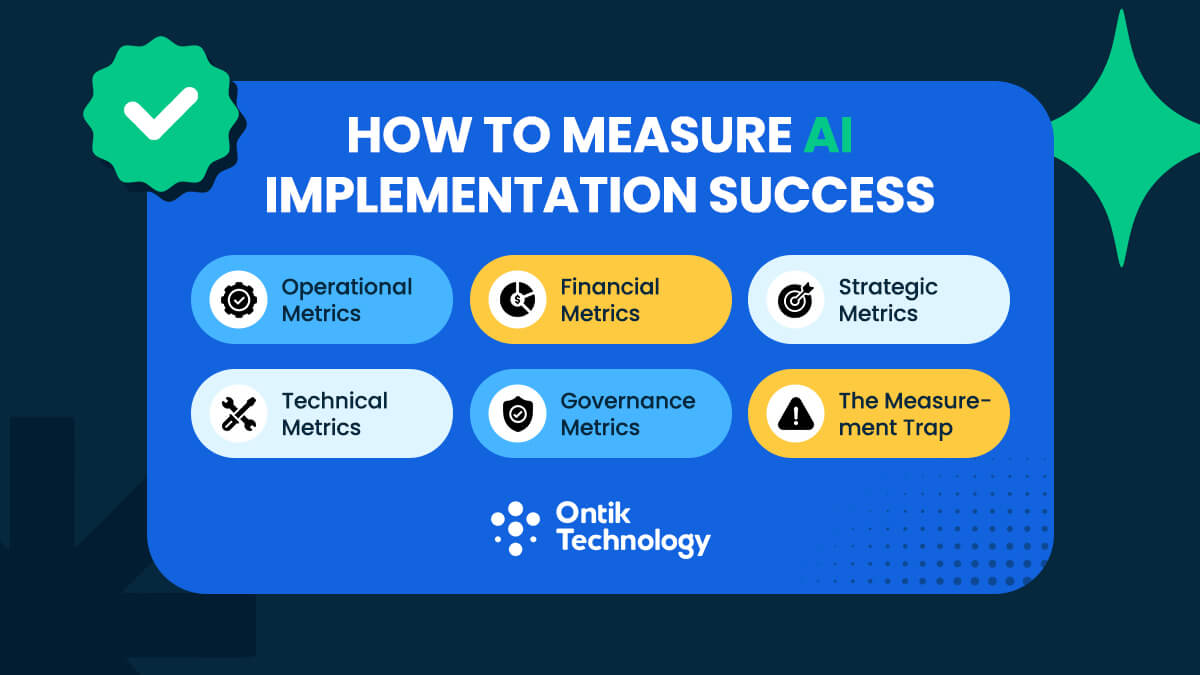
You measure AI implementation success across five areas. Tracking only one or two gives you an incomplete picture and leads to bad decisions.
Operational Metrics
Track time savings, error reduction, automation rate, and processing speed. These are easy to measure and show immediate impact. But they're also the most basic. A chatbot that answers faster isn't successful if the answers are wrong.
Financial Metrics
Watch cost reduction, revenue growth, return on investment, and total cost of ownership. These connect AI to results your CFO cares about. They're harder to trace cleanly, but they're essential for justifying continued investment.
Strategic Metrics
Measure decision quality improvement, customer satisfaction scores, and employee productivity. These show whether AI is changing how work gets done, not just how fast.
Technical Metrics
Watch model accuracy, response speed, system uptime, and drift detection. These tell you if your AI system is healthy or getting worse.
Governance Metrics
Track compliance adherence, audit scores, and bias detection rates. These protect you from regulatory and reputation risk.
The Measurement Trap
Early metrics around speed and cost are tempting because they're easy to collect. But the real value of AI builds over time across teams and use cases. GitHub Copilot shows this well. Studies found 55 percent faster coding, but the real value extended to faster onboarding and more consistent code quality. Measure broadly and measure over time.
How to Choose the Right AI Implementation Company
You choose the right AI implementation company by matching their skills to your specific needs, not by picking the biggest name or lowest price.
Check Capability Alignment
Do they specialize in your use case? A firm strong in predictive analytics might not be your best pick for generative AI. Ask for case studies in your specific field. Generic AI experience doesn't mean they can solve your problem.
Assess Technical Depth
Look for MLOps skills, not just model building. Can they connect to your existing systems? Do they understand your infrastructure? Ask about their approach to model monitoring, retraining, and backup plans.
Check Industry Experience
Domain knowledge matters. Healthcare AI needs understanding of HIPAA and clinical workflows. Fintech AI demands knowledge of fraud patterns and regulatory rules. A partner who knows your industry avoids beginner mistakes.
Review Their Scaling Approach
Ask how they move from pilot to production. Many consultants are great at proofs of concept but stall when it's time to deploy at scale. You want a partner with a track record of production rollouts, not just demos. Ontik Technology's approach emphasizes this production-ready mindset from the start.
Verify Governance and Compliance Understanding
They should know the EU AI Act, GDPR, and your industry regulations. Ask how they handle bias detection, audit trails, and explainability. Vague answers are warning signs.
Understand Their Support Model
Will they train your team? Do they offer ongoing maintenance? How do they transfer knowledge? You don't want to depend on them forever.
Red Flags to Avoid
Vague roadmaps with no milestones. No governance framework in their proposal. Push for single-vendor lock-in. Unrealistic ROI promises. If they guarantee 500 percent returns in six months, walk away.
The best AI implementation in consulting comes from partners who treat your success as their success, not just another invoice.
Final Thoughts
AI implementation isn't a technology project. It's a business change that happens to use technology. The companies seeing real results in 2026 approached it that way from the start. They planned carefully. They chose partners wisely. They invested in their people. And they measured what mattered.
You can do the same. Start with one clear problem. Build a realistic roadmap. Pick a partner who understands your business, not just algorithms. And commit to the long game. AI rewards patience and punishes shortcuts.
If you're ready to move from planning to action, the next step is simple. Define your first use case, check your data, and start talking to partners who can help you execute. The sooner you begin, the sooner you'll see what AI can actually do for your business.
Start Your AI Strategy
Plan, build, and scale AI solutions with expert implementation support