AI Agents and Automation in Healthcare: 15 Cases | Ontik Technology
Hospitals have moved AI automation and AI agents in healthcare from pilot to production, and the published results are now specific enough to compare. This guide documents 15 real deployments: eight where AI drafts, scores or flags and a person acts, and seven where an AI agent completes a task and hands off the exceptions. Each entry gives the outcome the organisation reported and the caveat that comes with it.
Eighty-one percent of US physicians now use AI in their work, up from 38% in 2023, according to the AMA's 2026 physician survey of 1,692 doctors. Healthcare AI spending reached $1.4 billion in 2025, nearly triple the prior year, per Menlo Ventures' State of AI in Healthcare report. Adoption is settled. The harder questions are which deployments produce results you can defend to a CFO or a clinical governance board, and whether AI agents, the newest category, have earned the same trust as automation.
Key figures
- 81% US physicians using AI in 2026 (AMA)
- $1.4B Healthcare AI spend in 2025 (Menlo Ventures)
- 2.2x Healthcare AI adoption pace vs the wider economy (Menlo Ventures)
- 15 Real deployments reviewed: 8 AI automation, 7 AI agents
- 0 of 7 AI agent deployments in this guide report a patient outcome
Key takeaways
- Automation reports clinical measures. Agents report throughput. Three of the 8 automation deployments report mortality, cancer detection or functional independence. None of the 7 AI agent deployments reports a patient outcome, only calls, wait times, appointments, hours or recommendation quality.
- Documentation is the best-documented automation category. Kaiser Permanente's ambient AI scribe saved nearly 16,000 documentation hours across about 2.5 million encounters, and both scribe deployments here report less time spent on notes.
- AI agents show the fastest operational gains on the thinnest evidence. Tampa General reports call abandonment falling from 34% to 14.9% within two weeks, and Epic reports a 42% cut in prior authorisation submission time at Summit Health. Neither figure has been independently checked.
- Only two agent deployments have a published study, and the vendor is involved in both. K Health funded the Cedars-Sinai Connect study, and several authors of the Ufonia Dora evaluation work for or hold shares in Ufonia.
- Most healthcare agents are bounded task agents. They complete one job, such as rescheduling an appointment or a follow-up call, and hand off exceptions. None of the 15 coordinates care across systems on its own.
- Data and disclosure rules shape the build. Victorian guidance and UAE law push processing in-country, US vendors need a business associate agreement, and AI voice agents add consent and disclosure duties. Australia's automated decision-making transparency rules start on 10 December 2026.
- Check the evidence rating before you quote a number. Nine of the 15 results rest on health service or vendor reports, and one publishes no outcomes.
AI agents vs AI automation in healthcare: what counts
AI automation in healthcare is software that interprets unstructured inputs such as speech, scans, clinical notes or payer documents, then drafts, scores or flags so staff can act. An AI agent in healthcare goes one step further. It plans and completes a multi-step task, such as calling a patient, rescheduling an appointment or preparing a prior authorisation, works within tools and guardrails, and hands exceptions to a person. That is what vendors and analysts mean by agentic AI in healthcare. Both differ from robotic process automation, which replays fixed rules on structured data.
Robotic process automation
- How it works: Replays fixed, rule-based steps in existing screens.
- Healthcare example: Eligibility checks, claim status look-ups.
- Input type: Structured fields.
- Typical failure: Breaks when a screen or payer rule changes.
- Human role: Handles exceptions.
AI automation
- How it works: Uses machine learning or language models to interpret speech, images or documents, then drafts, scores or flags.
- Healthcare example: Ambient note drafting, imaging triage, early warning scores.
- Input type: Unstructured speech, text and images.
- Typical failure: Confident wrong output that nobody reviews.
- Human role: Reviews and decides.
AI agents
- How it works: Plans and completes a multi-step task with tools and guardrails, then hands off exceptions.
- Healthcare example: Rescheduling and scheduling calls, patient outreach, prior authorisation, post-operative follow-up calls.
- Input type: Conversations plus records from several systems.
- Typical failure: Takes an unsafe or off-policy action, or escalates too much.
- Human role: Sets policy, monitors, takes escalations.
Vendors also sell this stack as healthcare workflow automation, healthcare process automation or intelligent automation in healthcare, so judge a product by what it does without a person in the loop and where it hands off, not by its label. Most hospitals run all three at once. A revenue cycle team may use RPA for eligibility checks, AI automation to predict denials and an agent to prepare authorisations. The 15 deployments below mix automation and agents, and each one is labelled.
We sort them on a three-level autonomy scale:
- Level 1, Assist. AI drafts, scores or flags and a person decides and acts. Eight of the 15 deployments sit here.
- Level 2, Act. AI completes a bounded task with a patient or payer and a person handles exceptions. Seven of the 15 sit here.
- Level 3, Coordinate. AI plans multi-step work across systems and teams. None of the 15 has published evidence at this level. WellSpan has announced an orchestrator for care-plan coordination, but it is in co-development.
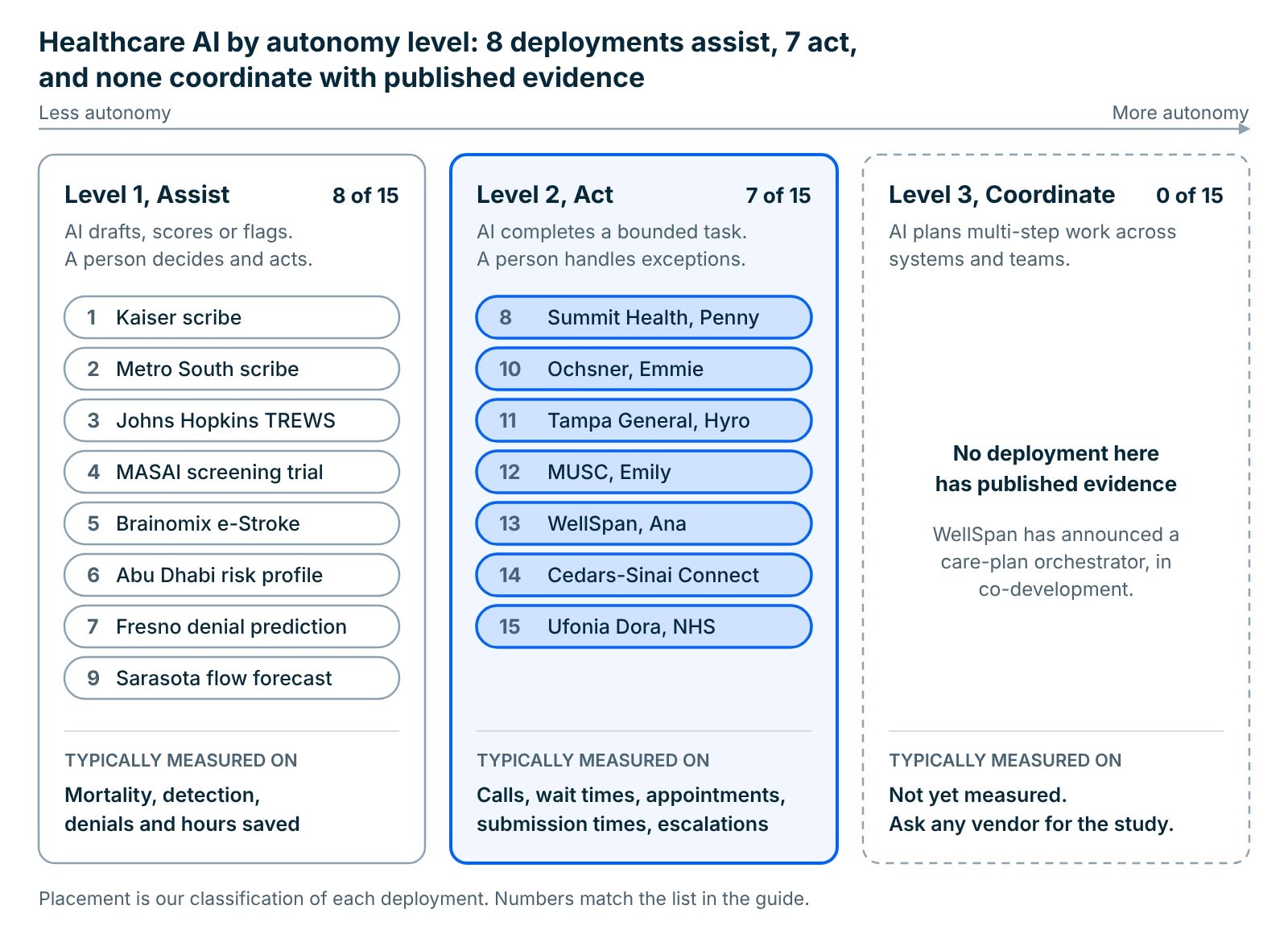
Level 3 is where the marketing sits and the evidence does not. Treat any claim of a fully autonomous clinical agent as a Level 3 claim and ask for the study.
How we chose and rated the 15 deployments
Selection tests
Every deployment had to pass four tests:
- A named health system, hospital or regulator, not an anonymous "leading provider".
- Live use in care or operations, not a lab validation alone.
- At least one measured outcome, or a stated scale figure where outcomes are not yet published.
- A source page we opened and read.
How strong is the evidence?
Results in healthcare AI are reported at very different levels of rigour. Each deployment below carries one evidence rating so you can weigh the claim.
- Rating 1: Randomised controlled trial. Strongest. Shows cause and effect.
- Rating 2: Published study or evaluation. Credible, but confounding, selection bias and vendor involvement can remain.
- Rating 3: Results reported by the health service itself. Useful for scale and workflow, not independently checked.
- Rating 4: Results issued by the vendor. A claim to verify, not a finding.
- No rating: No outcome published.
Source check. One widely repeated figure, 59 minutes saved per doctor per day, was attributed to Metro South Health's AI scribe trial. MobiHealthNews later corrected it: the number came from research by the vendor, Heidi Health, and was not a finding of the trial. This guide uses only figures traced to the primary source.
AI scribes: 2 healthcare automation deployments that cut documentation time
Ambient AI scribes are the best-documented form of AI automation in healthcare. The two deployments below span the US and Australia and share one finding, less time spent writing notes, with caveats on how each result was measured.
1. Kaiser Permanente: an AI medical scribe for 7,260 physicians
- Where: Northern California, United States
- Type: AI automation, Level 1 (ambient scribe)
- What it does: Transcribes the visit and drafts the note in the EHR for physician review.
- Scale: 7,260 Permanente Medical Group physicians and about 2.5 million patient encounters, October 2023 to December 2024.
- Reported result: Nearly 16,000 documentation hours saved over 15 months. In a survey of 102 physicians, 84% reported a positive experience.
- Evidence rating: 2. Analysis published in NEJM Catalyst; figures confirmed via Becker's Hospital Review.
- Caveat: The hours saved are reported as an estimate, and the experience survey covers 102 of 7,260 users.
2. Metro South Health: Heidi AI scribe across five Queensland hospitals
- Where: South-east Queensland, Australia
- Type: AI automation, Level 1 (ambient scribe)
- What it does: Transcribes the consultation and drafts the clinical note for the clinician to review.
- Scale: A 70-clinician trial in 2025 across emergency, medicine, surgical and mental health. The network rollout began in June 2026 across five hospitals and other services covering 1.2 million residents, which Metro South Health calls Australia's largest AI scribe deployment.
- Reported result: 92% of trial clinicians reported spending less time on administration, 56% rated the scribe's documentation as equal to or better than their own, and 22% said it improved their wellbeing. More than 70% of patients said their clinician spent more time with them.
- Evidence rating: 3. Reported by Metro South Health and MobiHealthNews.
- Caveat: Outcomes are self-reported. Clinicians remain responsible for reviewing every note, and in interviews with 50 trial clinicians all noted that scribes are not error-free and stressed checking the output.
The same direction shows up elsewhere. At Mass General Brigham and Emory Healthcare, a survey study in JAMA Network Open found burnout prevalence down 21.2 percentage points at 84 days at Mass General Brigham, with no control group and low response rates. At The Prince Charles Hospital in Brisbane, a six-month paediatric outpatient pilot cut average GP letter turnaround from 44 days to within one day.
Both deployments report less documentation time, but neither shows that care quality improved, and both keep the clinician as the reviewer of every note. If you build or buy an AI medical scribe, design the review step first. It is where the time saving is won or lost.
AI in hospitals: 4 clinical decision support and imaging deployments
Early warning, imaging and risk-prediction systems show the largest clinical effects in this guide, and the weakest study designs. Only one of the four below, a Swedish screening trial, was randomised, and one, in Abu Dhabi, has published no outcomes.
3. Johns Hopkins and Bayesian Health: TREWS sepsis alerts
- Where: Five Johns Hopkins Medicine-affiliated hospitals, Maryland, United States
- Type: AI automation, Level 1 (machine learning early warning)
- What it does: Reads EHR data, flags patients at high risk of sepsis and lists the reasons for the alert.
- Scale: 590,736 patients monitored. The analysis covered 6,877 sepsis patients flagged before antibiotics began.
- Reported result: When a clinician confirmed the alert within three hours, in-hospital mortality was 3.3 percentage points lower, an 18.7% relative reduction, than when it was not.
- Evidence rating: 2. Prospective multi-site cohort study in Nature Medicine.
- Caveat: The comparison is confirmed alerts against unconfirmed ones, not AI against no AI, so clinician selection can bias the result. The senior author founded Bayesian Health, which sells TREWS, and Johns Hopkins holds equity in it.
4. Swedish national breast screening: the MASAI trial
- Where: Four screening sites in southwest Sweden (Malmö, Lund, Landskrona and Trelleborg)
- Type: AI automation, Level 1 (imaging decision support)
- What it does: Supports radiologists reading screening mammograms in place of standard double reading.
- Scale: 105,915 women randomised 1:1, with 53,043 in AI-supported screening and 52,872 in standard screening.
- Reported result: AI-supported screening detected 338 cancers against 262, a 29% higher detection rate (6.4 against 5.0 per 1,000), with a 44% lower screen-reading workload and no increase in false positives.
- Evidence rating: 1. Randomised controlled trial published in The Lancet Digital Health, registered as NCT04838756.
- Caveat: Detection is not survival. The primary endpoint, interval cancer rate, awaits two years of follow-up, and health economic analyses are still under way.
5. Brainomix e-Stroke: NHS stroke networks in England
- Where: Royal Berkshire Hospital and the Thames Valley stroke network, England, with a wider NHS rollout
- Type: AI automation, Level 1 (imaging)
- What it does: Interprets stroke brain scans and shares images across hospitals so thrombectomy referrals start sooner.
- Scale: Royal Berkshire admits more than 700 stroke patients a year. e-Stroke went live there in March 2020.
- Reported result: Door-in-door-out time for thrombectomy transfers fell from 140 to 79 minutes, and 48% of referred patients reached functional independence (mRS 0 to 2) against 16% before. Across the Oxford AHSN region the thrombectomy rate rose from 2.8% in 2020/21 to 6.6% in 2021/22.
- Evidence rating: 4 for the hospital figures, from a Brainomix press release on a conference presentation. 3 for the regional rate, from the Oxford AHSN evaluation.
- Caveat: A before-and-after comparison at one hospital, across a pandemic period, with no control group. The clinical lead attributes the outcome mainly to the faster transfer time.
6. Abu Dhabi Department of Health: a patient risk profile on the Malaffi health exchange
- Where: Abu Dhabi, United Arab Emirates
- Type: AI automation, Level 1 (risk prediction on health information exchange data)
- What it does: Gives every authorised doctor a Patient Risk Profile built from diagnoses, chronic conditions and lab results held in the Malaffi exchange. It estimates the likelihood of conditions such as diabetes or certain cancers and shows which results or visits drove the assessment.
- Scale: Rolled out across all hospitals and clinics. A Department of Health digital health director said the risk model covers every person in Abu Dhabi.
- Reported result: No accuracy, uptake or outcome figures are published.
- Evidence rating: None published. Reported by the Department of Health and Khaleej Times.
- Caveat: This is scale without outcomes. It is the national model to watch, not yet one to benchmark against.
Two more deployments point the same way. Kaiser Permanente's Advance Alert Monitor across 21 hospitals was linked to 16% lower mortality, though it was not randomised and relies on a dedicated nurse response team. Viz.ai announced a 39.5-minute faster time to specialist contact in stroke care, a vendor-reported process time rather than a patient outcome.
Also watching: Cleveland Clinic Abu Dhabi launched Aila with Owkin on 17 June 2026, starting with prostate cancer across health records, notes, pathology and imaging, and has published no outcome data yet. Owkin's earlier K Pro deployment at the hospital ran in a closed Azure environment with UAE in-region AI models and no data leaving the hospital, the pattern UAE health data rules push providers toward.
AI revenue cycle management: automation and an AI agent compared
Revenue cycle is the one workflow in this guide where an AI automation tool and an AI agent can be compared side by side. Community Medical Centers uses prediction to decide which claims to fix. Summit Health uses Epic's Penny agent inside medication prior authorisation. Both report operational numbers, because denials and submission times were already being counted before the AI arrived.
7. Community Medical Centers, Fresno: AI revenue cycle management for denials
- Where: Fresno, California, United States
- Type: AI automation, Level 1 (denial prediction and recovery scoring)
- What it does: Predicts which claims will be denied before submission and scores incoming denials by their probability of recovery, using the organisation's own claims and remittance data.
- Scale: A beta test of a clearinghouse vendor's tool. The denial prediction module went live in early 2023.
- Reported result: In the first six months, denials under code 197 (authorisation or precertification absent) fell 22% and denials under code 109 fell 18%.
- Evidence rating: 3. Interview with the director of patient financial services in Healthcare IT News.
- Caveat: A six-month before-and-after at one organisation using a beta product. Secondary blogs often misname this organisation and add staff-hours savings that the interview does not report.
8. Summit Health: Epic's Penny agent for medication prior authorisation
- Where: United States (the source does not give a site)
- Type: AI agent, Level 2 (Epic's Penny, a revenue cycle agent)
- What it does: Produces AI-generated responses in the medication prior authorisation process, which staff accept or edit before they go out.
- Scale: Not published.
- Reported result: Submission time cut by 42%, and 92% of AI-generated responses accepted without edits. Across the health systems using Penny most actively, Epic reports coding-related denials down by more than 20% and denial appeal letters created 23% faster.
- Evidence rating: 4. Reported by Epic in a March 2026 post and at HIMSS26 through Healthcare IT News.
- Caveat: No baseline, period or sample size is published. "Accepted without edits" measures staff acceptance, not payer approval, and the EHR vendor is the only reporter.
Read the two together. Prediction tells staff which claims to work, and an agent does part of the work. Neither reports net revenue or cash collected, which is the number a CFO will ask for first.
AI agents and automation for patient access and flow: 4 deployments
Patient access is where AI agents are most visible, because the work is calls, scheduling and routing that a contact centre already counts. Predictive automation handles the hospital side of the same problem, bed flow. The four deployments below show both.
9. Sarasota Memorial Health Care System: predictive discharge forecasting
- Where: Sarasota, Florida, United States
- Type: AI automation, Level 1 (predictive analytics, LeanTaaS iQueue for Inpatient Flow)
- What it does: Forecasts discharges at unit and hospital level so case management, environmental services and transport can prepare before the discharge order is written.
- Reported result: Within six months, emergency department boarding hours fell 32% while ED visits rose 22%. Average length of stay fell by 13 hours and the time from discharge order to departure fell 10%, while average daily census rose 23%.
- Evidence rating: 3. Interview with the executive director of logistics and patient throughput in Healthcare IT News.
- Caveat: Reported by the health system with the vendor's product and no control group, so staffing changes or other programmes could contribute. The executive's own advice is that the tool only works if teams change how they act on its forecasts.
10. Ochsner Health: Epic's Emmie agent for appointment rescheduling
- Where: New Orleans, Louisiana, United States
- Type: AI agent, Level 2 (Epic's Emmie, a patient-facing assistant)
- What it does: Lets patients reschedule appointments through Emmie instead of calling staff.
- Scale: More than 14,900 appointments rescheduled. The period is not published.
- Reported result: Almost 750 staff hours saved, which works out at about three minutes per rescheduled appointment.
- Evidence rating: 4. Reported by Epic in a March 2026 post and through Healthcare IT News.
- Caveat: The hours are an estimate with no published method, and there is no count of patients who tried to reschedule and then phoned anyway. Ochsner also says it is investing in agentic support in its contact centres, with no results reported yet.
11. Tampa General Hospital: a Hyro voice agent for the contact centre
- Where: Tampa, Florida, United States
- Type: AI agent, Level 2 (conversational voice agent from Hyro)
- What it does: Greets callers, identifies the reason for the call and either resolves routine requests such as scheduling, refills, insurance verification and directions, or routes the call to the right team, replacing phone menus.
- Scale: Live within a 90-day rollout from late September 2025. Almost half a million calls answered by early December 2025.
- Reported result: Call abandonment fell 56%, from 34% to 14.9%, and average wait fell from 6.2 to 2.4 minutes within two weeks of go-live. Appointments scheduled by the experience centre rose 21%.
- Evidence rating: 3. Reported by Tampa General executives to Fierce Healthcare and Healthcare IT News.
- Caveat: No independent check and no stated baseline period. The two interviews give different appointment gains: 21% within two weeks in one, 17% on average daily in the other.
12. MUSC Health: SoundHound's Emily voice agent for patient access and pharmacy
- Where: Charleston, South Carolina, United States
- Type: AI agent, Level 2 (voice agent on SoundHound's platform, integrated with Epic)
- What it does: Handles patient access and other non-clinical service calls, first for appointment management from 2024. In July 2026 it extended to retail and specialty pharmacy lines for refill requests, refill status, opening hours and locations, and routing callers to pharmacy teams.
- Scale: More than 2.2 million patient calls since 2024.
- Reported result: No outcome metrics are published. MUSC's chief digital transformation officer says the collaboration delivers "measurable efficiencies" but gives no figures.
- Evidence rating: 4. A SoundHound press release dated 29 July 2026.
- Caveat: Call volume is not resolution. The release gives no resolution, containment, abandonment or satisfaction rates, and the claim of being one of the first agentic voice implementations for an Epic system is the vendor's.
In the three access agents, abandonment, wait times and appointment counts move first, which a contact centre can measure within weeks. None reports whether patients reached the right appointment, kept it or did better for it.
AI agents for patient outreach, intake and follow-up: 3 deployments
The newest healthcare AI agents talk to patients directly, so they raise a safety question that scheduling agents do not. Two of the three below have a published study, and the vendor is involved in both.
13. WellSpan Health: a generative AI voice agent for patient outreach
- Where: York, Pennsylvania, United States
- Type: AI agent, Level 2 (generative voice agent built with Hippocratic AI)
- What it does: Calls patients in their preferred language about colorectal screening, colonoscopy preparation, mammography results and missed imaging appointments, and answers inbound calls to schedule primary care. Transcripts go to clinicians for review and calls can transfer to a human. Patients are told they are speaking with an AI.
- Scale: More than 160,000 patient calls a month and more than 7,000 hours of conversation, after nearly two years in service. In July 2026 WellSpan expanded the partnership to inbound, outbound, ambulatory and inpatient settings.
- Reported result: 2.7 million calls completed to date and double the engagement rate of traditional outreach, according to an AMGA case summary.
- Evidence rating: 3. Reported by WellSpan, a July 2026 announcement and the AMGA solutions library, with design details in Healthcare Innovation.
- Caveat: The published figures cover call volume and engagement, not screenings completed or clinical outcomes, and the sources do not define engagement.
14. Cedars-Sinai Connect: AI intake and decision support for virtual urgent care
- Where: Los Angeles, California, United States
- Type: AI agent, Level 2 (conversational intake with decision support, built with K Health)
- What it does: Collects symptoms from the patient before the visit, summarises them for the physician and suggests a diagnosis and treatment for the physician to approve. It replaces the nurse intake step of a traditional visit.
- Scale: More than 42,000 patients had used it by mid-2025.
- Reported result: In a review of 461 physician-managed visits, 77% of AI recommendations were rated optimal against 67% of physicians' decisions. Cedars-Sinai's chief medical officer says the AI follows guidelines more closely while physicians handle nuance better.
- Evidence rating: 2. A retrospective study published in Annals of Internal Medicine in April 2025, reported by Cedars-Sinai and the American Hospital Association.
- Caveat: The ratings judge recommendations, not patient outcomes. K Health funded the study and co-owns the service through a joint venture.
15. Ufonia Dora: an autonomous voice agent for cataract surgery follow-up in the NHS
- Where: Oxford University Hospitals NHS Foundation Trust and Buckinghamshire Healthcare NHS Trust, England
- Type: AI agent, Level 2 (autonomous voice agent, Dora R2, from Ufonia)
- What it does: Phones patients three weeks after routine cataract surgery, asks about symptoms, answers questions and records "no concerns" or "potential concerns". A clinician reviews every report, patients with potential concerns are called back within 48 hours, and at least 10% of calls are checked by a human reviewer.
- Scale: 1,636 patient consultations across the first seven months at each of the two trusts.
- Reported result: 97% of listed patients were eligible and 86% of those called answered. 63% of patients who answered had no concerns. The paper reports a negative predictive value of 99.5% for "no concerns" calls (763 of 767), a positive predictive value of 16.8% for "potential concerns" (75 of 446) and a Net Promoter Score of 47.
- Evidence rating: 2. A service evaluation in Clinical Ophthalmology, published 17 April 2026.
- Caveat: Not a trial. Several authors are Ufonia employees, directors or shareholders, and the work was funded by a grant to Ufonia. The abstract and results sections give different completion counts (1,269 against 1,213 completed calls), so check the paper before you quote it. The agent over-escalates by design: only about one flagged call in six was a true concern. The patients were mostly low risk, three weeks after routine surgery.
Australia and the UAE: announced, not yet evidenced. We found no AI agent deployment in either market with published outcomes as of 10 October 2026. Silverchain began a three-month pilot of an AI voice assistant for in-home aged care in Western Australia in June 2025 and has published no results. New South Wales bodies are described as building agentic capability, again without outcomes. In the UAE, Burjeel Holdings announced in April 2025 that it would deploy Hippocratic AI agents across facilities in the UAE and Oman, and the announcement did not say any were live.
Building an agent like WellSpan's or Ufonia's means designing consent, human escalation and in-region data handling before the first call. Those are the parts of AI agent development and conversational AI projects that decide whether a pilot survives governance review.
AI automation: 8 deployments where AI drafts, scores or flags and a person acts
- 1. Kaiser Permanente (US, evidence 2): nearly 16,000 documentation hours saved in 15 months.
- 2. Metro South Health (Australia, evidence 3): 92% of trial clinicians report less admin time.
- 3. Johns Hopkins TREWS (US, evidence 2): 18.7% lower mortality when alerts were confirmed within 3 hours.
- 4. MASAI trial (Sweden, evidence 1): 29% more cancers detected, 44% less reading workload.
- 5. Brainomix e-Stroke (England, evidence 4): door-in-door-out time from 140 to 79 minutes.
- 6. Abu Dhabi Department of Health (UAE, no outcomes published): risk profile available to every authorised doctor.
- 7. Community Medical Centers, Fresno (US, evidence 3): code 197 denials down 22% in six months.
- 9. Sarasota Memorial (US, evidence 3): ED boarding hours down 32%.
AI agents: 7 deployments where the agent completes a task and hands off the exceptions
- 8. Summit Health (US, evidence 4): prior authorisation submission time down 42%.
- 10. Ochsner Health (US, evidence 4): more than 14,900 appointments rescheduled and almost 750 staff hours saved.
- 11. Tampa General Hospital (US, evidence 3): call abandonment down from 34% to 14.9%.
- 12. MUSC Health (US, evidence 4): more than 2.2 million patient calls, no outcomes published.
- 13. WellSpan Health (US, evidence 3): 160,000+ calls a month, double the engagement of traditional outreach.
- 14. Cedars-Sinai Connect (US, evidence 2): 77% of AI recommendations rated optimal vs 67% for physicians.
- 15. Ufonia Dora (England, evidence 2): 63% of answered calls had no concerns, with a 99.5% negative predictive value.
Evidence ratings: 1 randomised trial, 2 published study, 3 health service report, 4 vendor release.
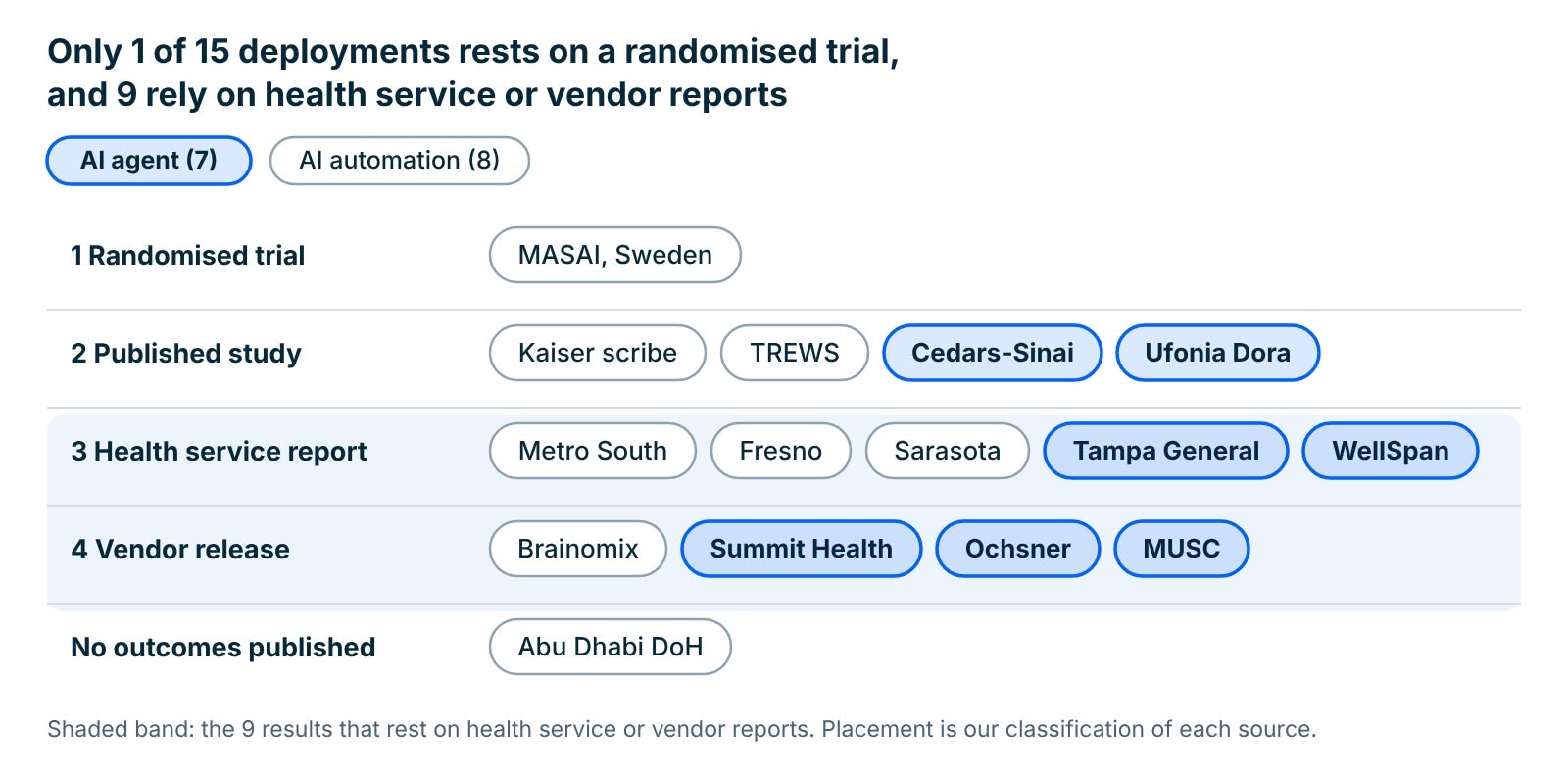
Nine of the 15 results come from health service or vendor reports, which is why every figure in this guide carries its evidence rating.
What the 15 deployments show about AI agents vs automation
- Different things get measured. The automation cases report mortality (3), cancer detection (4) and functional independence (5). The agent cases report abandonment, wait times, appointment counts and submission times. The one agent study that tests safety, Ufonia's, does it with predictive values, not patient outcomes.
- Escalation is a cost, so count it. Ufonia's agent flagged 446 calls as potential concerns and 75 were real. Each flagged call goes back to a clinician within 48 hours. An agent that hands off too much moves work around instead of removing it.
- Integration decides adoption. Three of the seven agents (8, 10 and 12) run inside or integrate with Epic, and Sarasota Memorial credits its EHR integration for staff uptake. API development and integration is where much of the real effort lands.
- Start where the task is bounded. The agents with the clearest numbers handle high-volume, narrow jobs with a clear handoff: rescheduling, call routing, prior authorisation responses, follow-up of low-risk patients. None of the 15 is an open-ended clinical agent.
How to deploy AI agents and automation in healthcare: 6 steps drawn from the 15 cases
The deployments that report results share six habits. They start with a workflow that was already measured, decide what the software may do alone, keep a human reviewer, pilot small, embed the tool in existing systems and scale only after a gate.
- Start with a workflow whose outcome is already counted. Community Medical Centers measured denials by code, Sarasota Memorial counted ED boarding hours and Tampa General tracked call abandonment. A baseline you already trust is the cheapest evidence you will get.
- Decide what the software may do alone and what it must hand off. Ufonia's agent classifies every call and a clinician reviews every report. WellSpan sends transcripts to clinicians and can transfer calls to a human. Write the handoff rules before the build, and staff the queue they feed.
- Design the human review step first. Every scribe in this guide leaves the clinician as reviewer, and in the TREWS study the benefit appeared when a clinician confirmed the alert within three hours. The model is one part of the intervention.
- Pilot small, then scale on a gate. Mass General Brigham went from 18 physicians in July 2023 to more than 800 providers by July 2024 and to all physicians by April 2025. Metro South Health ran a 70-clinician trial before committing five hospitals. Tampa General phased its voice agent in over 90 days.
- Embed the tool where staff already work. Three of the seven agents here run inside or integrate with Epic. Sarasota Memorial credits its integration with the existing EHR and dashboards for adoption, because staff did not have to learn a separate system.
- Settle data residency, consent and disclosure before go-live. Victoria requires scribes to process data in Australia, UAE law restricts moving health data offshore, US vendors that handle patient data need a business associate agreement, and AI voice calls bring consent and disclosure rules. The compliance checkpoints below set out each market.
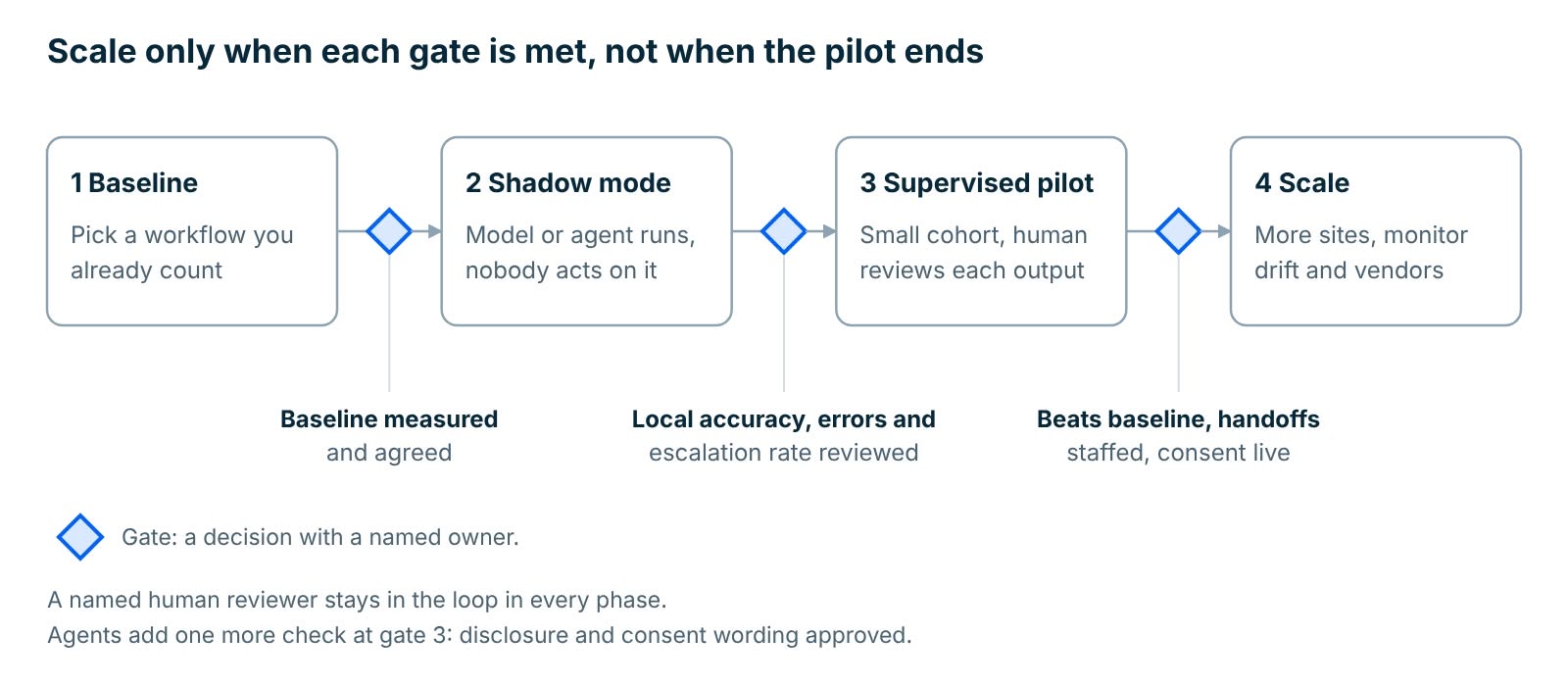
Each gate is a decision with a named owner, so a pilot that misses its gate pauses instead of drifting into production.
Build or buy?
Buy a packaged product
- Best for: Mature workflows such as ambient scribing, contact-centre voice agents and agents built into your EHR.
- Main risk: Churn: 67% of outpatient providers using ambient scribes expect to switch vendors within three years. Four of the 15 results here also rest on vendor releases.
- Ask before you commit: Where is data processed, is a BAA signed, how are model updates reviewed, and what does the vendor report on resolution and escalation rates, not just call volume.
Build or extend a custom agent
- Best for: Workflow-specific agents, legacy integrations and regional data rules. AI customer support agent cost gives a budget benchmark for voice and chat agents.
- Main risk: Integration cost and the ongoing work of validating the model.
- Ask before you commit: Who monitors drift, who owns escalation to a human, who signs off changes.
Potential failure points and compliance for healthcare AI agents and automation
The 15 deployments also show where healthcare AI automation and AI agents break. Plan for these before the pilot, not after the first incident.
- Scale mistaken for outcomes. WellSpan reports 160,000 calls a month and MUSC more than 2.2 million calls, and neither publishes a clinical outcome. How to reduce it: Define resolution, escalation and follow-through measures before launch, and report them next to volume.
- An agent that escalates too much. Ufonia's agent flagged 446 calls as potential concerns and 75 were real, a deliberate safety trade-off that sends work back to clinicians. How to reduce it: Track escalation volume and the share of escalations that were justified from day one, and set a target for both.
- Weak accuracy on local data. The TREWS authors noted that one widely deployed sepsis model had a sensitivity of only 33%, catching about one case in three. How to reduce it: Run the model in shadow mode on your own data before alerts reach clinicians.
- Unreviewed errors. In interviews with 50 Metro South clinicians, all said scribes are not error-free and stressed checking the output. How to reduce it: Build review into the workflow and track how often notes are edited.
- Result without a counterfactual. TREWS compares confirmed with unconfirmed alerts, Kaiser's monitor was not randomised, and Tampa General and Epic publish no baseline period. Only MASAI is a randomised trial. How to reduce it: Use a comparison group or a staggered rollout, as Kaiser did.
- Inconsistent or vendor-supplied numbers. A 59-minute daily scribe saving was attributed to a health service trial, then corrected as the vendor's own research. Tampa General's two interviews give different appointment gains, and the Ufonia paper's abstract and results disagree on completion counts. How to reduce it: Trace every number to its primary source and read the results section, not just the abstract.
- Vendor churn. 67% of outpatient providers using ambient scribes expect to switch vendors within three years. How to reduce it: Keep integrations and prompts portable and negotiate exit terms.
- Data leaving the jurisdiction. An Australian health department briefing noted that providers may not realise scribe data is sent to servers outside Australia. How to reduce it: Confirm the hosting region in the contract and the architecture diagram.
- An alert or escalation nobody is staffed to answer. Kaiser's alerts reach a dedicated nurse team, the TREWS benefit depended on confirmation within three hours, and Ufonia's flagged calls go back to a clinician within 48 hours. How to reduce it: Staff the response before switching the agent or alert on.
Compliance checkpoints by market
This is general information, not legal advice. Confirm requirements with counsel and your regulator.
United States
- Core rule: HIPAA requires a signed business associate agreement before a vendor handles patient data.
- AI voice calls: In February 2024 the FCC ruled that AI-generated voices fall under the TCPA rules for artificial voices. Calls need the right level of consent, a clear statement of who is calling and an opt-out. Check whether an exemption applies to your call type.
- Disclosure: California AB 3030, in force since 1 January 2025, requires generative AI patient messages about clinical information to carry an AI disclaimer and instructions for reaching a human, unless a provider reviews them first.
- Device regulation: Tools that diagnose or recommend treatment may be regulated as medical device software, so check FDA status.
- Data location: No federal residency rule. State recording-consent laws vary and some require all-party consent.
- First practical step: Sign the BAA, add the tool to your security risk analysis and confirm call consent and disclosure wording.
Australia
- Core rule: Ahpra and the National Boards have issued scribe guidance, and a federal health department briefing records significant variation in how clinicians gain consent.
- Automated decisions: From 10 December 2026, Privacy Act transparency rules require covered entities to describe in their privacy policy the kinds of decisions made, or substantially and directly informed, by a computer program that significantly affect a person's rights or interests. Access to healthcare is one of the examples. Check whether your agent's decisions are covered.
- Device regulation: The TGA regulates medical device software, but the same briefing says many AI scribes fall outside that framework.
- Data location: Victorian public health guidance says health services must only use scribes that store and process data in Australia.
- First practical step: Confirm hosting in Australia, the product's TGA status and whether the new privacy policy duty applies to you.
United Arab Emirates
- Core rule: Federal Law No. 2 of 2019 bars storing, processing or transferring health data outside the UAE without approval.
- AI-specific rules: Abu Dhabi's Department of Health has had an AI in healthcare policy since 2018. It calls for certification of AI tools, auditable validation statements and regular audits reported to the regulator.
- Device regulation: Emirate regulators add their own rules, including the Department of Health in Abu Dhabi and the Dubai Health Authority.
- Data location: In-country by default, with 10 exceptions set by a 2021 ministerial decision.
- First practical step: Keep inference and storage in-region and confirm any approval needed.
FAQ: AI agents and automation in healthcare
What are AI agents in healthcare?
AI agents in healthcare are software systems that plan and complete multi-step tasks, such as calling a patient, rescheduling an appointment or preparing a prior authorisation, and hand exceptions to a person. The term agentic AI in healthcare describes the same idea. Examples in this guide include Tampa General's voice agent, WellSpan's outreach agent and Ufonia's cataract follow-up agent.
What is the difference between AI agents and AI automation in healthcare?
AI automation interprets unstructured inputs such as speech, scans and documents, then drafts, scores or flags so a person can act, for example an ambient scribe or a sepsis alert. An AI agent goes on to complete a bounded task itself and hands off the exceptions. Robotic process automation (RPA) is different again: it replays fixed rules on structured data and breaks when a screen or payer rule changes. Most hospitals run all three.
What are examples of AI agents in healthcare?
Epic's Penny agent for prior authorisation at Summit Health, Epic's Emmie agent for rescheduling at Ochsner Health, Hyro's voice agent at Tampa General Hospital, SoundHound's Emily at MUSC Health, WellSpan's Hippocratic AI voice agent, the Cedars-Sinai Connect intake agent and Ufonia's Dora for cataract follow-up in the NHS. Most report calls, wait times or time saved rather than patient outcomes.
What are examples of AI automation in healthcare?
Ambient AI scribes that write visit notes (Kaiser Permanente, Metro South Health), sepsis early warning (Johns Hopkins TREWS), imaging support for stroke and breast screening (Brainomix, the MASAI trial), revenue cycle tools that predict denials (Community Medical Centers) and discharge forecasting (Sarasota Memorial).
Are AI agents safe to use with patients?
They can be, with conditions. The safest designs keep a clinician reviewing the output and hand off anything uncertain. Ufonia's agent flags potential concerns for clinician callback within 48 hours, and WellSpan's agent tells patients they are speaking with an AI and can transfer to a human. Safety also depends on disclosure and consent rules, which differ in the US, Australia and the UAE.
Do AI agents and automation reduce healthcare costs?
They can lower costs in specific workflows, but the proof is mostly self-reported. Community Medical Centers in Fresno reports 22% fewer authorisation-related denials, Sarasota Memorial a 32% drop in ED boarding hours and Tampa General a fall in call abandonment from 34% to 14.9%. These are before-and-after results reported by the organisations, and none publishes a net financial return.
How long does it take to roll out an AI agent or automation project in healthcare?
Voice agents can go live faster than clinical tools. Tampa General's voice agent went live within a 90-day rollout. Mass General Brigham took about 21 months to go from an 18-physician scribe pilot in July 2023 to all physicians by April 2025.
Conclusion: where AI agents and automation work in healthcare
AI automation in healthcare works best where the outcome was already measured and a human stays in the loop. Documentation and revenue cycle tools have the clearest operational numbers, early warning and imaging tools the largest clinical effects. AI agents have the scale and the speed, and the least published proof: none of the seven reports a patient outcome. Treat every figure in this guide as a claim with an evidence rating, and ask any vendor for the same.
Scoping an AI agent or automation project?
Ontik Technology helps you define the baseline, handoff rules and integration plan before the build. Book a meeting to scope it.