E-Migration: How to Build a Team Beyond Borders
A US employer sponsoring a developer on an H-1B competes for one of 85,000 new cap-subject petitions a year. An Australian employer sponsoring on the Skills in Demand visa can wait up to 10 months for a Core Skills decision. Neither timeline fits a sprint plan.
E-migration is the other route. The developer stays in their home country and joins your team full time. You add the capacity without a visa application, a relocation or a sponsorship queue.
This guide covers how e-migration works through Ontik's two-stage process, how to choose between hourly staff augmentation and agile pods, and what "without visas" still leaves for you to settle: contracts, IP and tax.
What E-Migration Is
E-migration (n.): working for a team abroad, without leaving. For an employer, it means engineers stay in their home country and work as a full part of your team. They join your standups, your repo and your roadmap. The border stays where it is.
It is not freelancing, and it is not classic outsourcing. The difference is who the developer answers to and who owns delivery.
- Sponsored relocation: the developer lives in your country. You direct the work and you own delivery. A work visa is needed.
- Freelancer marketplace: the developer lives in their own country. The freelancer directs the work and owns delivery. No visa is needed.
- Traditional outsourcing: the developer lives in the vendor's country. The vendor's project manager directs the work and the vendor owns delivery. No visa is needed.
- E-migration: the developer lives in their own country. Your team (or a pod lead) directs the work. You own delivery, or share it in pods. No visa is needed.
Why Companies Choose E-Migration Over Sponsorship
Sponsoring a developer is possible in the US, Australia and the UAE, but each route adds cost, delay or uncertainty. Rules as of October 2026:
- United States (H-1B): New petitions are capped at 85,000 a year, with 20,000 reserved for US advanced degrees. DHS has proposed an extra $103,265 fee on cap-subject petitions. The comment period closed on 24 September 2026 and the rule is not final. A separate $100,000 fee was vacated in court and is not being collected while the appeal continues. Sources: Fragomen on the proposed fee and Fragomen on the $100,000 fee.
- Australia (Skills in Demand visa, subclass 482): The employer needs Standard Business Sponsorship and, unless exempt, two job ads run for at least 28 days. From 1 July 2026 the minimum salary for Core Skills is AUD 79,423, and the main applicant visa charge is AUD 4,015. Processing times reported in July 2026 run up to 10 months for Core Skills and up to 57 days for Specialist Skills.
- UAE (employer-sponsored work visa): Every foreign employee needs one, and without a UAE entity you cannot sponsor. Visa costs typically run AED 3,000 to 7,000 per employee, and entity setup costs vary widely by free zone or mainland route.
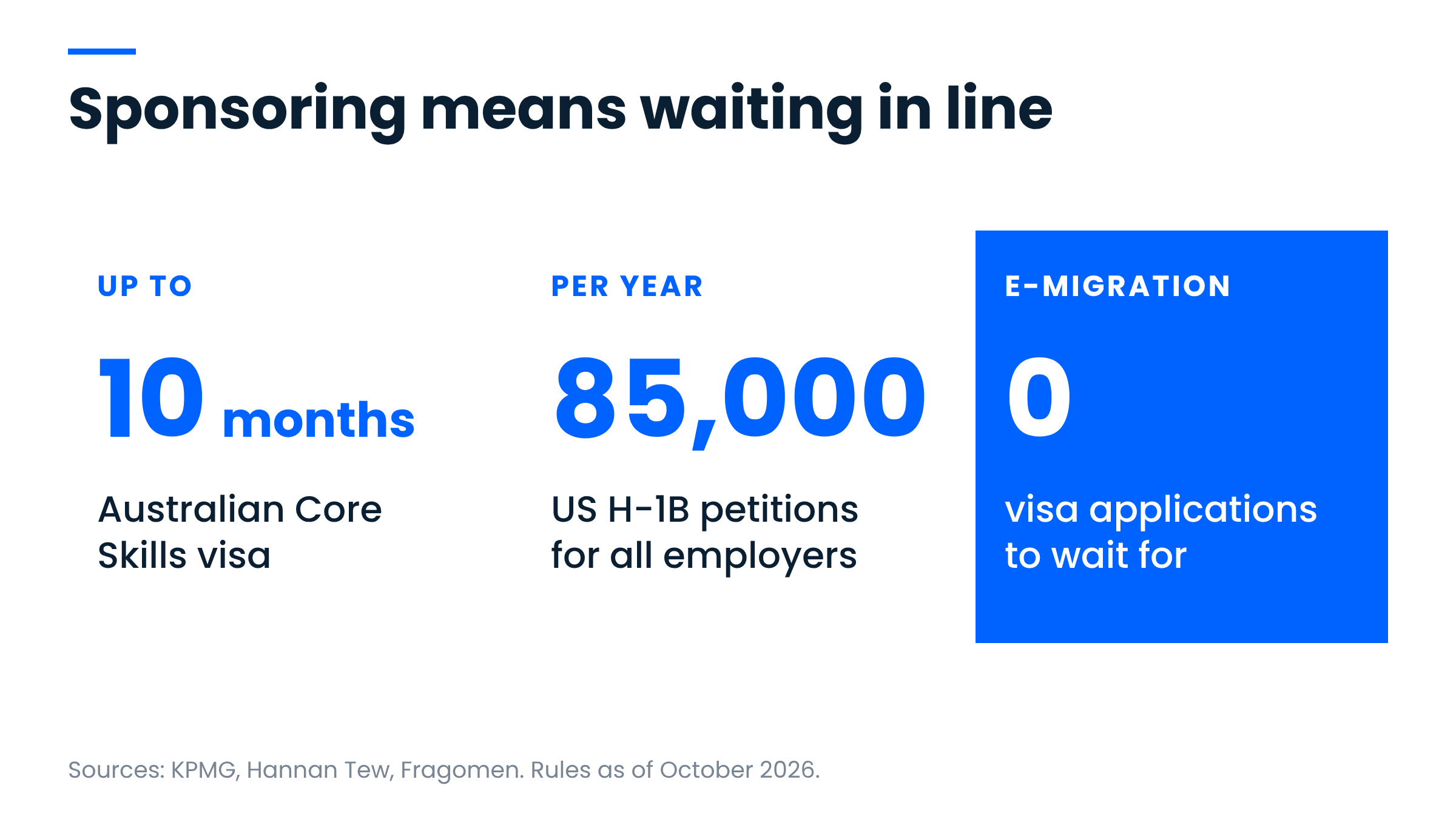
E-migration removes the sponsorship step. It does not remove the need for a sound contract, which is covered below.
How E-Migration Works: A Two-Stage Process
With Ontik, only qualified talent reaches your desk. One stage runs inside Ontik and the other is led by you.
Stage 1: Ontik internal. Ontik sources, screens and interviews, so you only see the best fits.
- You share a job description.
- Ontik searches its in-house talent pool.
- A final shortlist goes to you.
- Candidates are interviewed on technical expertise, cultural fit and communication skills.
Stage 2: Client side. You review, interview and choose, with Ontik supporting every step.
- You review Ontik's shortlist.
- You interview candidates on the same three criteria: technical expertise, cultural fit and communication skills.
- You select a candidate, or request a fresh shortlist, which sends the search back to Stage 1.
Once you select a candidate, the developer is onboarded into your team. Your hire, your call: Ontik makes sure every option is worth your time.
Who Is in the Talent Pool
Shortlists come from Ontik's in-house talent pool of 150+ experts. The pool by stack:
- AI (15+): OpenAI, Claude, Gemini, Llama, LangChain, PyTorch, TensorFlow and more.
- Web (60+): JavaScript, Node.js, React, Vue.js, Angular, Django, Laravel, Spring Boot and more.
- Mobile (25+): Android, iOS, Swift, Kotlin, React Native and Flutter.
- Data (15+): Python, R, Power BI and Tableau.
- Enterprise (20+): SAP, Odoo, Dynamics and Oracle ERP.
- Cloud (20+): AWS, Google Cloud and Azure.
- Database (20+): PostgreSQL, MySQL, MariaDB, SQL Server, MongoDB and DynamoDB.
Choose Your Model: Hourly Staff Augmentation or Agile Pods
Ontik offers two ways to engage. The real difference is who carries the risk.
Hourly staff augmentation
- What it is: individual specialists inside your team, working to your plan.
- Best when: you have a clear plan and in-house technical leadership, and need to close a skill or capacity gap fast.
- You carry: planning, task allocation, quality and delivery risk.
- You get: flexible headcount, fast onboarding, direct day-to-day control and no payroll or HR overhead.
- How it is bought: one person, per hour, typically 160 hours per person per month.
Agile pods
- What it is: self-contained teams that own a feature set or module, working in 1 to 3 week sprints. Multiple pods can run in parallel under the same project, coordinated as one team.
- Best when: requirements will evolve and you want delivered outcomes, not hours to manage.
- You carry: priorities and acceptance. The pods carry execution and quality.
- You get: faster shipping, one accountable team, easy adaptation to change, and parallel pods on one project.
- How it is bought: one team, per capacity block, typically a 1,000-hour block across the pod.
A simple test: if you can write the backlog today, choose hourly staff augmentation. If you can only describe the outcome you want, choose pods and let the sprints shape the scope.
Neither model needs the developer to relocate. Both need clear ownership on your side, which is why the "You carry" line matters more than the price.
What "Without Visas" Really Means
The developer never enters your country, so no work visa is needed. That removes the immigration step. It does not remove five legal questions you should settle before the first sprint.
- Contract: who employs the developer, and on what terms? Put a written agreement in place with the provider that covers scope, term, notice and exit.
- IP ownership: who owns the code? Require a written assignment of all work product, from the developer to the provider and from the provider to you.
- Confidentiality and data: who can see production data and systems? Use NDAs, least-privilege access, managed devices and a clear data handling policy.
- Tax exposure: does directing the work day to day create a taxable presence anywhere? Take local tax advice in both countries, since the rules vary by jurisdiction.
- Worker classification: could an authority treat the developer as your employee? Structure the engagement through the provider's employment of the developer, and confirm it with counsel.
Ask any provider for these documents before you sign. A provider that cannot show them is not ready to join your team.
This section is general information, not legal advice.
Time Zones Are a Schedule, Not a Blocker
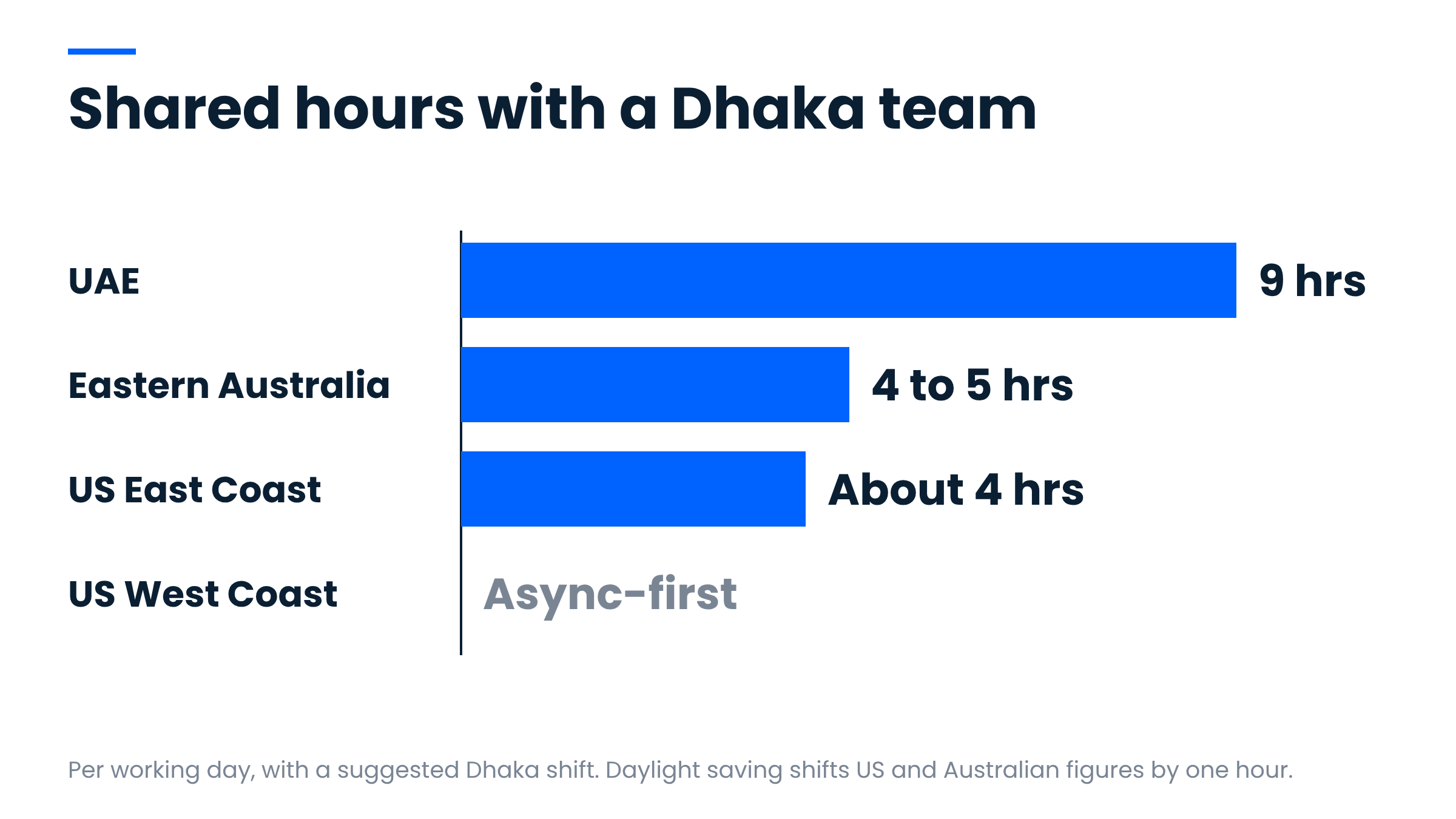
Dhaka runs on UTC+6 all year. The gap to your team depends on where you sit, and daylight saving moves the US and Australian gaps by one hour.
- UAE (2 hours): a Dhaka shift of 11am to 8pm covers the full UAE working day of 9am to 6pm.
- Eastern Australia (4 to 5 hours): an early Dhaka start gives roughly 4 to 5 shared hours in the Australian afternoon.
- US East Coast (10 to 11 hours): an afternoon to late-evening Dhaka shift shares the US morning, about 4 hours.
- US West Coast (13 to 14 hours): a short fixed overlap or a late shift, with most work handled asynchronously.
The gap matters less than the habits around it:
- Fix one daily overlap window and protect it for standup, blockers and review.
- Write handoffs down: what shipped, what is blocked, what the next person picks up.
- Set a pull request review turnaround so work does not wait a full day for feedback.
- Record demos instead of scheduling them across awkward hours.
How to Start: Write the Job Description First
Stage 1 begins with your job description. It is the only thing you must have ready before the first conversation. Cover these seven points:
- Stack and tools: languages, frameworks, cloud and the tools your team already uses
- Roles and seniority: how many developers, at what level
- Model: hourly staff augmentation or agile pods
- Hours: your working hours and the daily overlap window you need
- Timeline: start date and expected duration
- Security and IP: NDA, access and data handling requirements
- Ownership: who on your side sets priorities and accepts the work
Ready to hire remote developers? You can also read our guide on staff augmentation vs outsourcing.
FAQ
Do I need a work visa for a developer who stays in their own country? No. A developer who works from their own country does not enter yours, so you do not need to sponsor a work visa in your country. The contract, IP and tax questions above still do.
Do I need a legal entity in the developer's country? Not when you contract with a provider that employs the developers. Confirm the structure with your own counsel before signing.
How is e-migration different from remote work? Remote work describes where a person sits. E-migration is a cross-border team arrangement: developers in another country work full time inside your team, placed through a provider.
Do I choose the developers myself? Yes. Ontik sends a shortlist from its in-house talent pool, you interview the candidates on technical expertise, cultural fit and communication skills, and you can request a fresh shortlist if none fit.
How large is Ontik's talent pool? Ontik has 150+ in-house experts across web, mobile, AI, data, enterprise, cloud and database stacks.
Which model should I start with? If you can write the backlog today, start with hourly staff augmentation. If requirements will change, start with an agile pod.