Enterprise AI: A Complete Guide to Strategy, Use Cases, and Implementation
Businesses across the United States are spending more on enterprise AI than ever before. AI budgets are growing nearly three times faster than overall IT spending in 2026. And yet, most organizations are still struggling to turn that investment into real results. That's the paradox of enterprise AI right now.
The technology is ready. The budgets are there. But without the right strategy, the right data foundation, and a clear implementation plan, even well-funded AI projects stall before they ever reach production.
This guide gives you the full picture. You'll learn what enterprise AI actually is, where it creates the most value, how to build a strategy that works, and how to roll it out without getting stuck in pilot purgatory. Whether you're just getting started or trying to scale what you've already built, you'll find something useful here.
What Is Enterprise AI?
Enterprise AI is the integration of artificial intelligence technologies into the core workflows of a large organization. It's not a single tool or product. It's a system-level approach to making your business smarter, faster, and more responsive using machine learning, natural language processing, generative AI, and automation.
The key word is "integration." Consumer AI tools help individuals get things done. Enterprise AI is built to operate at scale, across departments, while meeting strict security, compliance, and governance requirements.
Think about the difference this way. A consumer AI app might help you summarize an email. Enterprise AI connects to your CRM, reads your pipeline data, flags at-risk deals, updates records automatically, and alerts your sales team in real time. That's a completely different level of depth.
At Ontik Technology, we see this distinction play out constantly. Organizations that treat enterprise AI as just another software purchase almost always underperform compared to those that treat it as a strategic capability.
Enterprise AI sits on top of several core technologies:
- Machine learning (ML): Systems that learn from data and improve over time
- Natural language processing (NLP): AI that reads, understands, and generates human language
- Generative AI and large language models (LLMs): Tools that create content, write code, answer questions, and reason through complex problems
- Agentic AI: AI that doesn't just respond to prompts but takes autonomous actions across connected systems
- Computer vision: AI that interprets images, video, and visual data
Together, these technologies form the engine behind modern enterprise AI platforms.
Why Enterprise AI Is a Business Priority Right Now
The numbers make a strong case. Generative AI budgets are expected to grow 60% over the next two years. Gartner puts total GenAI spending at $644 billion in 2025 alone. And 75% of C-suite executives now rank AI in their top three priorities.
But here's what's even more telling. Organizations that use a structured approach to AI adoption report an 80% project success rate. Those without a clear strategy? They succeed only 37% of the time.
That gap is enormous. And it explains why so many companies are investing heavily but still not seeing results. The ROI data is compelling too. For every dollar invested in generative AI, organizations realize an average return of 3.7x. Top-performing companies are hitting 10.3x. AI-powered customer support tools are cutting service costs by 20 to 30%. Predictive maintenance systems are reducing equipment downtime by double digits.
There's also a competitive urgency here. About 72% of companies are already using AI in some form. Half of them have rolled it out across multiple departments. If you're still in the evaluation phase, your competitors are already learning from their deployments. The window for gaining a first-mover advantage is narrowing fast.
The Core Components of an Enterprise AI System
A working enterprise AI system isn't just a model you plug in. It's a stack of interconnected components that all need to work together. Weakness in any one area limits the whole system.
Data infrastructure is the foundation. AI is only as good as the data feeding it. That means clean, accessible, well-governed data stored in a format your AI systems can actually use. Most organizations underestimate how much work this takes. Messy, siloed, or incomplete data is the number one reason AI projects fail.
The AI and ML layer sits on top of your data. This includes the models themselves whether pre-trained foundation models, fine-tuned LLMs, or custom-built ML systems. Choosing the right architecture for your use case matters more than choosing the most powerful model.
Integration and APIs connect your AI layer to your existing business systems. Your CRM, ERP, ITSM, HRIS, and other platforms all need to talk to each other and to your AI system. Without strong integration, you end up with AI that works in isolation and delivers limited value.
The governance and security layer enforces the rules. Who can access what data? How are models monitored for bias and drift? What happens when an AI makes a mistake? Enterprise AI requires rigorous controls that consumer tools simply don't need.
The interface and workflow layer is what your employees actually use. AI that's hard to use doesn't get used. The best enterprise AI systems fit naturally into existing workflows so adoption happens organically.
All five components need attention. Organizations that invest heavily in models but neglect data quality or governance consistently struggle to scale.
Enterprise AI Use Cases by Department
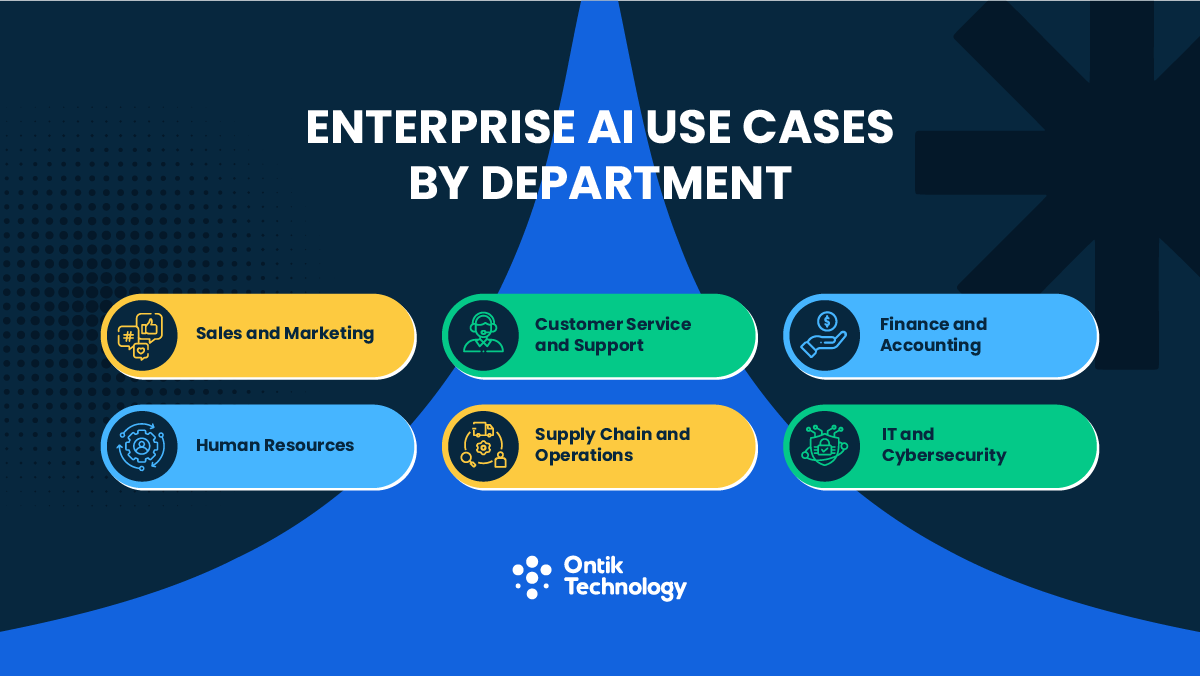
Enterprise AI delivers value across every major business function. Here's where U.S. companies are seeing the biggest impact right now.
Sales and Marketing
AI has fundamentally changed how sales and marketing teams operate. Predictive analytics helps sales reps identify which leads are most likely to convert, so they focus their time where it counts. AI tools analyze customer behavior, purchase history, and engagement signals to build detailed profiles that make personalization possible at scale.
On the marketing side, AI-generated content, A/B testing automation, and campaign optimization tools are cutting the time it takes to go from strategy to execution. Teams that used to take weeks to build campaigns are doing it in days.
Automated CRM updates are another major win. Instead of reps manually logging calls and updating deal stages, AI does it automatically by listening to calls and reading emails. That alone saves hours every week per rep.
Customer Service and Support
AI copilots and intelligent chatbots are handling tier-1 support requests around the clock. Routine questions, password resets, account lookups, and basic troubleshooting all get resolved without a human agent.
The impact on response time is dramatic. One enterprise cut IT problem resolution from three days to under a minute by deploying an AI assistant for employee support. Customer satisfaction scores jumped to 91%.
For more complex cases, AI assists human agents in real time. It surfaces relevant knowledge base articles, suggests responses, and flags issues that need escalation. Agents spend less time searching and more time actually solving problems.
Finance and Accounting
Finance teams are using enterprise AI for fraud detection, invoice processing, financial forecasting, and compliance monitoring. AI algorithms can analyze millions of transactions in real time, flagging patterns that indicate fraudulent activity far faster than any human review process.
Automated invoice processing alone can eliminate significant manual work. Systems that read, categorize, and route invoices for approval are saving finance teams hours every week across most mid-to-large organizations.
Forecasting models that combine ERP data, sales pipeline information, and macroeconomic signals are giving CFOs more accurate projections with less manual effort.
Human Resources
AI is reshaping talent acquisition from the top of the funnel down. Resume screening tools parse thousands of applications and surface the most relevant candidates based on skills, experience, and fit signals. That cuts screening time dramatically and reduces the unconscious bias that creeps into manual review.
Once employees are onboard, AI-powered learning systems personalize training paths based on role, skill gaps, and career goals. HR teams are also using predictive analytics to identify employees at risk of leaving, giving managers a chance to act before someone walks out the door.
Supply Chain and Operations
Supply chain disruptions cost U.S. businesses billions every year. Enterprise AI is changing the equation by giving operations teams real-time visibility and predictive intelligence.
AI models forecast demand with much higher accuracy than traditional statistical methods, reducing both overstocking and stockouts. Route optimization tools cut shipping costs. And predictive maintenance systems monitor equipment health and alert teams before failures happen.
For manufacturers, predictive maintenance alone can reduce unplanned downtime by 30 to 50%. That's a significant operational gain.
IT and Cybersecurity
IT departments are among the biggest beneficiaries of enterprise AI. Autonomous ticket triage routes and resolves support requests without human intervention. AI systems learn from past resolutions and handle an increasing percentage of common issues on their own.
On the security side, AI monitors network traffic, user behavior, and system logs in real time. It detects anomalies that indicate potential breaches, often catching threats that rule-based systems would miss entirely. The speed of AI threat detection is a major advantage in an environment where attackers move fast.
For organizations building or expanding their IT capabilities, cloud solutions built for AI workloads are increasingly the infrastructure layer of choice.
How to Build an Enterprise AI Strategy That Actually Works
Most enterprise AI strategies fail not because the technology is wrong, but because the strategy is weak. Here's what separates the organizations that succeed from those stuck in endless pilots.
Start with business problems, not AI capabilities. The worst AI strategies start with "we want to use AI." The best ones start with "we have a specific problem that's costing us time and money, and we think AI can help." Every AI initiative should connect directly to a revenue, cost, risk, or efficiency outcome.
Prioritize use cases with a value-to-effort matrix. Not every opportunity is worth pursuing right away. Score each potential use case across four dimensions: business value, technical feasibility, data readiness, and time to results. The ones with high value and clear data availability are your starting point.
Get executive sponsorship locked in early. AI transformation requires top-down support. Without a C-level champion, AI projects get deprioritized when budgets tighten or organizational politics get complicated. Securing executive buy-in isn't a soft requirement. It's a hard one.
Build a cross-functional team from day one. AI projects fail when they're treated as IT projects. The best implementations involve data scientists, IT architects, domain experts, and business stakeholders working together from the start. Different perspectives catch problems early and drive better adoption later.
Define success metrics before you build anything. What does "good" look like for this use case? If you can't answer that question before you start, you won't be able to tell whether your AI is working once you deploy it. For organizations that want to move fast without reinventing the wheel, working with a team that specializes in custom software development and AI can compress the strategy-to-deployment timeline significantly.
Enterprise AI Implementation Roadmap
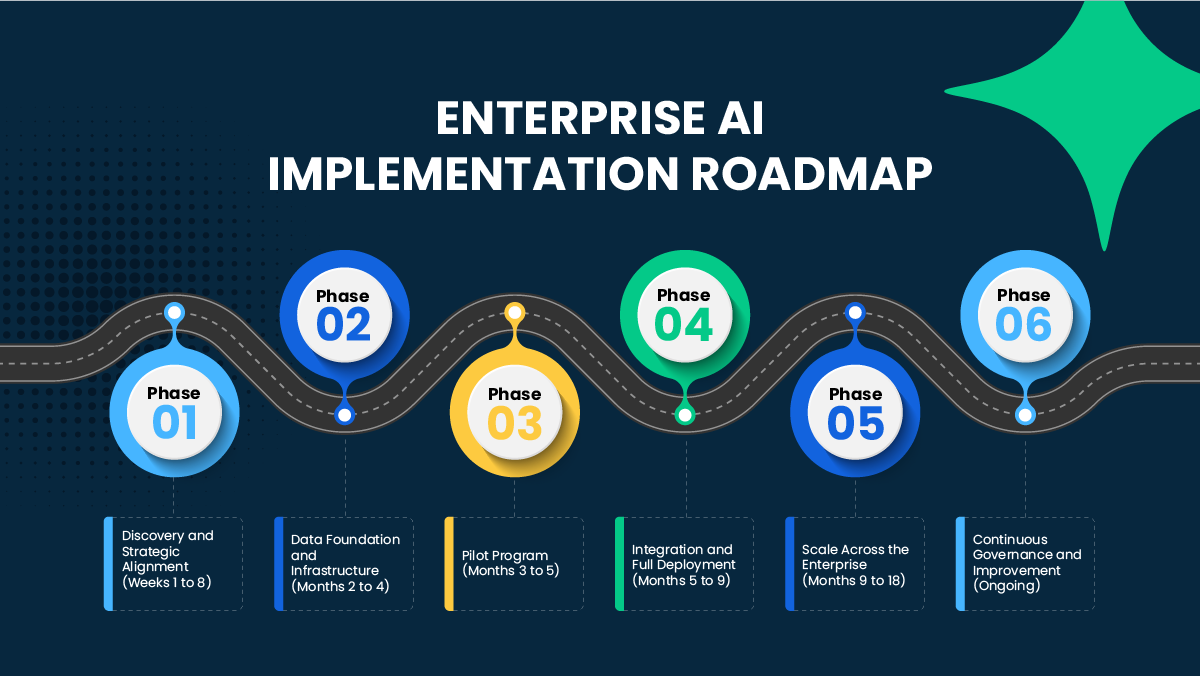
Here's the truth about enterprise AI implementation. Most projects take 12 to 18 months from strategy to scaled deployment. Organizations that try to rush that timeline usually end up in "pilot purgatory" — running endless proofs of concept that never make it to production. A structured, phased approach is the only way to avoid that trap. Here's how it works.
Phase 1: Discovery and Strategic Alignment (Weeks 1 to 8)
Everything starts here. Define your business objectives clearly. What problems are you solving? What does success look like in measurable terms? Assemble your cross-functional team and get executive buy-in documented, not just implied.
This phase also involves a data readiness audit. Inventory your data sources, assess quality, identify gaps, and start thinking about governance requirements. Most organizations discover at this stage that their data is less ready than they thought.
Deliverables from Phase 1 include a prioritized use-case roadmap, a business case with ROI projections, and a governance structure that's established before any AI gets built.
Phase 2: Data Foundation and Infrastructure (Months 2 to 4)
AI is only as good as its data. This phase is about building the plumbing. That means establishing clean, accessible data pipelines, choosing your cloud architecture (public, private, or hybrid), and setting up the integration layer that connects your AI systems to your existing platforms.
Security and compliance controls get built in here, not bolted on later. Data access policies, sensitivity tagging, and audit trails need to be in place before any model training begins.
For most U.S. enterprises, this is the phase that takes longer than expected. Don't underestimate it. Every week you invest here saves you months of rework later.
Phase 3: Pilot Program (Months 3 to 5)
Now you build and test. Select one or two use cases from your prioritized list — ideally ones with high value, clear data availability, and manageable risk. Deploy in a controlled environment with a limited user group.
Organizations that use proven frameworks and pre-built AI components can complete pilots in 12 to 16 weeks. Building everything from scratch typically takes 6 to 12 months. The math strongly favors starting with a solid foundation.
Collect both explicit feedback (what users say) and implicit feedback (how they actually use the system). Both tell you different things. Adjust before you scale.
Phase 4: Integration and Full Deployment (Months 5 to 9)
With validation complete, you integrate AI into live workflows. This is where change management becomes just as important as the technology itself.
Training needs to happen at multiple levels. Basic AI literacy helps everyone understand what the system can and can't do. Role-specific training teaches people how to use the tools relevant to their job. And technical training equips the team that will maintain and improve the system over time.
Internal communication matters here too. People need to understand that AI is augmenting their work, not replacing it. Organizations that communicate this clearly see much higher adoption rates.
Go/no-go decision points should be defined before this phase starts. If the pilot didn't meet your success metrics, that's useful information. Scale what works. Fix or drop what doesn't.
Phase 5: Scale Across the Enterprise (Months 9 to 18)
Scaling is where the real value gets created. Roll out across departments and geographies. Build communities of practice where teams share what's working. Identify internal AI champions who can lead adoption from within their business units.
High-performing organizations don't just scale pilots. They redesign workflows around AI. That's the difference between getting a 10% efficiency gain and getting a 10x outcome.
Phase 6: Continuous Governance and Improvement (Ongoing)
Enterprise AI isn't a project with an end date. It's an ongoing capability. Models need to be monitored for drift and retrained as conditions change. New use cases get added to the roadmap. Governance frameworks evolve alongside regulation.
MLOps pipelines that automate model monitoring, retraining, and deployment are essential at this stage. They're what keep your AI performing reliably as the business changes around it.
For organizations considering MVP development as an entry point for AI, a structured pilot-first approach aligns well with this phased model.
Build, Buy, or Partner: Choosing Your Approach
One of the most important decisions you'll make in your enterprise AI journey is whether to build your AI systems in-house, buy off-the-shelf solutions, or take a hybrid approach.
Building gives you the most control and customization. You own the intellectual property, you can tailor every aspect of the system to your specific needs, and you're not dependent on a vendor's roadmap. The tradeoff is cost, time, and the need for significant in-house AI talent. Building from scratch is the right choice when your use case is truly proprietary or when existing solutions simply don't fit.
Buying gets you moving faster. Major enterprise AI platforms from IBM watsonx, Google Cloud AI, Microsoft Azure AI, Salesforce Einstein, and AWS all offer pre-built solutions with proven infrastructure, security, and integration capabilities. These vendors have invested billions in their platforms, and you benefit from that R&D without having to replicate it. The risks are vendor lock-in and limited customization.
The hybrid approach is where most U.S. enterprises land. You use off-the-shelf platforms as the foundation and build customizations on top. Pre-built AI agents handle commodity use cases like ticket triage or document summarization. Custom models handle the proprietary use cases where off-the-shelf solutions fall short.
When evaluating any solution, look at five things: scalability to your data volumes, security and compliance certifications, depth of integration with your existing systems, support for your specific industry, and total cost of ownership over three years.
Teams that don't have enough in-house AI talent to execute this work often benefit from a dedicated development team model that combines external expertise with deep integration into your organization's goals and context.
Enterprise AI Governance, Risk, and Ethics
Governance is the strongest predictor of whether enterprise AI scales successfully or stalls. And yet only 14% of organizations currently enforce AI assurance at the enterprise level. That gap is a serious vulnerability.
The risks of ungoverned AI are real. Biased models produce unfair outcomes that create legal and reputational exposure. Hallucinating language models generate confident but incorrect information that can mislead employees and customers. Poorly secured AI systems create new attack surfaces for data breaches.
Good governance doesn't slow AI down. It actually speeds it up by reducing rework, preventing costly mistakes, and building the organizational trust that drives adoption.
A solid governance framework addresses several things. First, it defines who is accountable for AI decisions and what happens when something goes wrong. Second, it establishes data access controls and sensitivity classification so AI systems only touch the data they're supposed to. Third, it creates model monitoring processes that catch drift, bias, and degraded performance before they become problems.
On the regulatory side, U.S. enterprises need to track the EU AI Act for any products or services that touch European markets. Executive Order 14179 applies to government contractors. And industry-specific regulations in finance, healthcare, and energy all carry their own AI-related requirements.
Governance-by-design means building these controls into your AI systems from the start rather than adding them later. It's much cheaper and more effective that way. For organizations that handle significant amounts of data and need to stay current on AI governance standards, pairing enterprise AI with strong business intelligence and analytics infrastructure makes governance monitoring significantly more manageable.
Measuring Enterprise AI Success: KPIs and ROI
Here's a problem that doesn't get talked about enough. A lot of organizations deploy enterprise AI and then don't measure it properly. They end up not knowing whether it's working, which makes it impossible to justify continued investment or identify what needs to change.
60% of enterprises still see under 50% ROI from most of their AI projects. That's not because AI doesn't work. It's because they're measuring the wrong things, or not measuring at all. A good measurement framework works across three levels.
Operational KPIs measure how well the AI is performing at the task level. Mean time to resolution in IT support. Invoice processing time in finance. Candidate screening time in HR. These are leading indicators that something is working or isn't.
Financial KPIs connect operational gains to business outcomes. Cost savings per department. Revenue lift from AI-powered sales tools. Reduction in fraud losses. Customer acquisition cost improvement. These are the numbers that matter to the CFO.
Strategic KPIs capture the longer-term competitive impact. Employee satisfaction with AI tools. Customer NPS scores. Time-to-market for new products. These are harder to measure but often represent the biggest value creation.
On the cost side, budget allocation for enterprise AI typically breaks down like this: roughly 30% goes to talent (hiring and training), 25% to infrastructure, 20% to software and tools, 15% to data preparation, and 10% to change management. Initial implementations typically run from $250,000 to $2 million depending on scope and complexity. Ongoing operational costs run about 20 to 30% of that annually.
Set your success metrics before you build. Review them quarterly. And be willing to adjust what you're measuring as you learn more about how your AI is actually being used.
The Future of Enterprise AI
Enterprise AI is entering a new phase. The era of experimentation is ending. What comes next is production-grade, governance-ready, deeply integrated AI that runs as core infrastructure, not a side project.
A few trends are shaping what's ahead.
Agentic AI is moving from concept to production. Today's AI copilots assist humans in making decisions. Tomorrow's AI agents will take autonomous actions across connected enterprise systems. Scheduling, procurement, compliance checks, and multi-step workflows will increasingly run without human intervention at the task level. Humans will set strategy and monitor outcomes, not execute routine steps.
Personalization is getting truly individual. AI that treats all customers or employees as segments is already being replaced by AI that treats each one as an individual. Real-time behavioral signals feed continuous personalization at a scale no human team could match.
AI and IoT are converging. Sensors on factory floors, delivery vehicles, and energy systems are generating data that AI can act on in real time. Predictive maintenance is the entry point. What follows is fully autonomous operational intelligence that monitors, adjusts, and optimizes without waiting for human review.
The AI-native enterprise is emerging. Forward-looking organizations aren't just adding AI to existing processes. They're redesigning their operating models with AI at the center. Roles, workflows, data structures, and decision rights all get rebuilt around AI capabilities. That's a fundamentally different company from one that added a few AI tools.
Organizations that start building AI fluency and infrastructure now will have a compounding advantage. Every month of real-world deployment produces learning, data, and model improvements that late movers won't be able to replicate quickly.
Conclusion
Enterprise AI isn't a technology purchase. It's a strategic transformation that touches your data, your people, your workflows, and your competitive position. The organizations winning with enterprise AI right now share a few things in common. They start with real business problems. They invest in data foundations before models. They build governance in from the start. And they treat change management as seriously as technical implementation.
The failure rate is high for a reason. 70% of enterprise AI projects never reach production. But the 30% that do are building durable competitive advantages that are hard to copy. You don't need to be in the 70%. Start with a clear use case. Get your data in order. Build a cross-functional team. Run a structured pilot. And scale what works. If you're looking for a partner to help you move from strategy to production, explore how Ontik Technology's AI and machine learning services can help your organization build, deploy, and scale enterprise AI the right way. The best time to build your enterprise AI capability was two years ago. The second best time is now.