Prototype vs MVP: A Practical Guide for Founders Ready to Build
Most founders waste months and hundreds of thousands of dollars building the wrong thing at the wrong stage. Not because they lack a good idea. Because they confused a prototype with an MVP.
These two terms get used all the time interchangeably. They are not the same thing. And picking the wrong one at the wrong moment can drain your runway before you ever get to market.
This guide will help you understand what each one actually is, when to use each, and how to make the right call for where you are right now in your product journey. By the end, you will know exactly which to build and why.
What Is a Prototype in Product Development?
A prototype is a testable version of your product idea before a single line of real code gets written. It is something you can put in front of users or stakeholders to get honest feedback on design, flow, and concept.
Think of it as a model. Not a working product. A model.
The initial concept for a product should be viewed as a simple model or conceptual framework, not a finished commercial product. Jack Dorsey's early development of Twitter illustrates this power: his first prototype was a simple, zero-cost sketch, a notepad drawing with a text field and a "Post" button.
The value of this minimal prototype was in immediately validating the core idea's visual and conceptual sense, testing the essential user interaction loop, and confirming viability before any substantial investment. This modeling approach enables rapid validation by focusing solely on the product's core mechanism.
The four types of prototypes you will encounter:
The main job of a prototype is communication. It helps you talk to your design and engineering team in a shared visual language. It also helps you test UX assumptions before you commit to building anything real.
Roughly 75% of software requirements can be defined through screen design and user experience alone. That means a well-built prototype does most of the heavy thinking before development even starts.
What Is an MVP and Why Does It Matter for Startups?
An MVP, or Minimum Viable Product, is the leanest possible working version of your product that still delivers real value to real users. Eric Ries, who wrote The Lean Startup, defined the minimum viable product as the version that lets a team collect the maximum amount of validated learning with the least effort.
Notice the word "working." An MVP is not a simulation. It is an actual product.
"Minimum" means you build as few features as possible to solve the core problem. "Viable" means users have a genuine reason to use it. Together, they push you to ship something real without building everything at once.
Common MVP types founders use:
- Concierge MVP: You manually deliver the service to test if people want it before automating anything.
- Fake-door MVP: You describe a product that does not exist yet and measure how many people try to sign up.
- Explainer video MVP: You show what the product will do and track interest. Dropbox did exactly this.
- Piecemeal MVP: You stitch together existing tools to simulate the full product experience.
Who uses MVPs? Mostly early-stage startups who need to validate an idea before raising investment. Also, larger companies entering unfamiliar markets where success cannot be predicted.
The goal is never perfection. The goal is learning. Early adopters do not expect a polished product. They expect a product that solves a real problem, even roughly.
What Is the Core Difference Between a Prototype and an MVP?

Here is the single most important distinction you need to understand.
A prototype answers: Should we build this, and does it look and feel right?
An MVP answers: Will people actually use this and pay for it in the real world?
One test design. The other tests the market.
A common trap for founders is treating a prototype as market validation. But here is the problem: users will often give positive feedback on a prototype because it looks good. That does not mean they will pay for it, return to it, or recommend it to others. That is what the MVP is for.
Think of a prototype as an empty box with great packaging. It shows you what is inside and how it might feel. But nothing actually works underneath it.
What Is a Proof of Concept and How Does It Fit Before Both?
Before a prototype or MVP enters the picture, some founders need to answer an even more basic question: can this idea actually be built with available technology?
That is what a Proof of Concept (PoC) is for.
A PoC is a small technical experiment. It does not focus on design or user experience. It simply checks whether a specific technical component is feasible. It is mostly internal, and it rarely gets shown to users.
The three-stage validation pipeline looks like this: PoC first to prove technical feasibility, then a Prototype to validate design and experience, then an MVP to test the market.
You can skip the PoC stage if there is no novel technical challenge in your product. Most standard web apps, SaaS tools, and mobile apps do not need a PoC. Go straight to the prototype.
How Is the Building Process Different for a Prototype vs an MVP?
The gap between building a prototype and building an MVP is not just effort. It is a shift in what you are actually creating.
How Do You Build a Prototype Step by Step?
Building a prototype is fast. One designer can complete it in under two weeks. No code required.
- Define the assumption you want to test. What specific question needs answering?
- Sketch low-fidelity wireframes. Paper or a tool like Balsamiq works fine here.
- Build a clickable high-fidelity mockup. Tools: Figma, InVision, Adobe XD.
- Run usability testing with 5 to 8 users. Watch them navigate without guidance.
- Iterate on the design based on what you observed.
The output is a design file, not a product. But it gives you real insight into how users think, what confuses them, and what they expect.
How Do You Build an MVP Step by Step?
Building an MVP requires actual code, a real development team, and deployed infrastructure. The mindset, though, should stay ruthlessly lean.
- Define your core hypothesis. What one assumption does this MVP need to prove?
- Identify the target user and their main problem.
- Prioritise features using the MoSCoW method. Must have, Should have, Could have, Will not have. Feature prioritization is the most important step here. Cut everything that is not "must have."
- Choose your tech stack. Node.js, React, Firebase, AWS are common starting points.
- Build and deploy your core features only.
- Measure using the build-measure-learn loop. Track real behaviour, not opinions.
Typical MVP costs by architecture:
Reid Hoffman once said: if you are not embarrassed by the first version of your product, you launched too late. That is the right mindset for MVP development.
Which Is Cheaper to Build?
A prototype and an MVP live in completely different cost ranges. Understanding that gap can save you from a very expensive mistake.
A prototype costs almost nothing. You need one designer and a tool subscription that runs $15 to $50 per month. Rapid prototyping tools like Figma make this even faster. A professional hi-fi prototype might cost $2,000 to $5,000 if you hire a freelance UX designer. Most founders can build a basic one themselves.
An MVP is a different story. You need a development team, hosting infrastructure, payment integrations, user authentication, and data storage. None of that exists in a prototype. But early adopters will tell you more in two weeks of real product usage than a hundred prototype feedback sessions ever could.
Here is the ROI argument that most founders miss: investing $3,000 to $5,000 in a solid prototype before you build your MVP can prevent $50,000 to $200,000 in development rework. A prototype helps you finalise requirements before a single line of code gets written. That alone justifies the extra step.
Which Is Faster to Build?
Speed is one of the most misunderstood parts of this decision. Founders who skip prototyping to move faster almost always end up moving slower.
A paper sketch takes hours. A low-fidelity wireframe takes one to three days. A full interactive prototype takes one to two weeks. Total team: one designer.
An MVP timeline depends heavily on what you are building. This is one of the most variable parts of the product development stages:
- Simple web app: 4 to 8 weeks
- Standard SaaS product: 8 to 16 weeks
- Mobile app: 12 to 20 weeks
Agile product development keeps things flexible across all these timelines. You ship in small sprints, gather feedback, and adjust rather than waiting for a big reveal.
Spotify launched its first MVP in 2006 as a basic web app built over four months. That product had just enough functionality to prove that people would stream music on demand. Everything else came later.
Here is the thing: skipping the prototype phase does not save time. It almost always adds weeks of rework to the MVP because requirements were never properly defined.
How Should a Founder Decide Between Building a Prototype or an MVP?
The right answer depends entirely on where you are in your validation journey. Not on what feels more impressive to show investors.
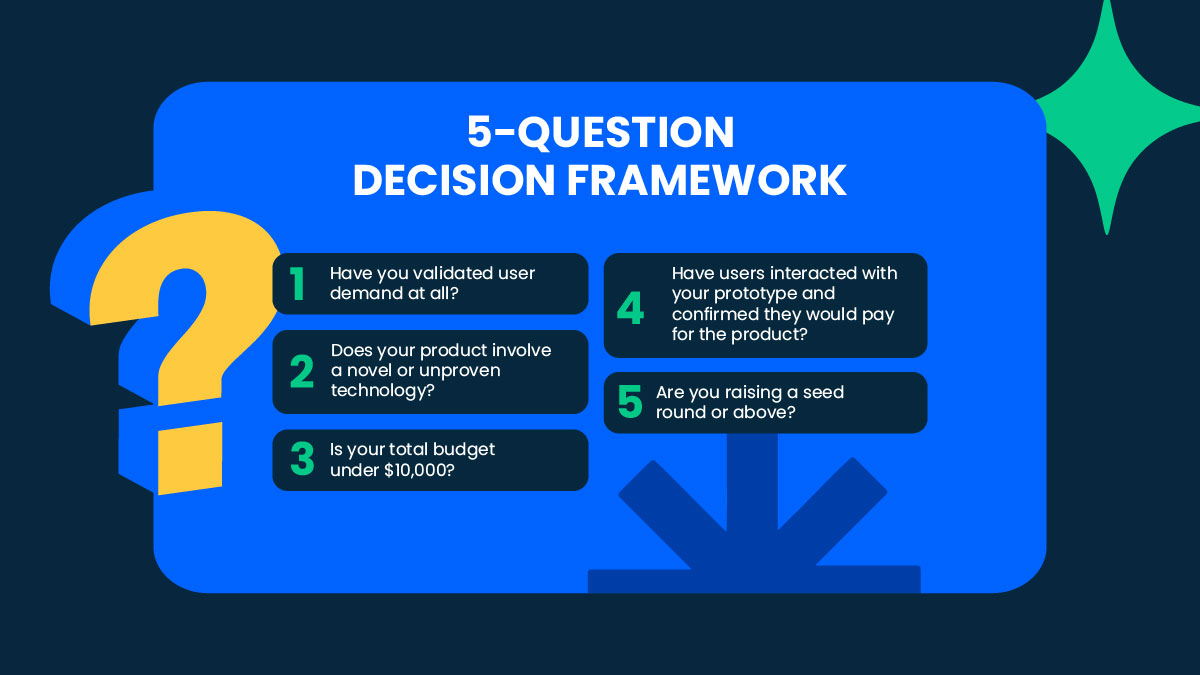
Here is a simple 5-question decision framework:
1. Have you validated user demand at all? If no, build a prototype first. You need UX and concept validation before touching code.
2. Does your product involve a novel or unproven technology? If yes, build a PoC before anything else. Prove it can be built before you design it.
3. Is your total budget under $10,000? Then prototype only. An MVP is out of reach at that budget unless you are using no-code tools.
4. Have users interacted with your prototype and confirmed they would pay for the product? If yes, you are ready to build the MVP.
5. Are you raising a seed round or above? Investors at seed stage and above typically expect a working MVP, not just a prototype.
Stage-based guidance:
You can skip the prototype in two situations: first, if the product is simple enough that an MVP can be built in under a week. Second, if you are a technical founder with deep domain experience who has already validated the UX instinctively.
For most founders, though, the golden rule holds: build a prototype before the MVP. It is the fastest and most reliable way to control costs, finalise requirements, and avoid rework.
What Do Real-World Examples Teach Us About These Decisions?
The best lessons come from founders who made this call under real pressure, with limited money and limited time.
PROTOTYPE: Airbnb Brian Chesky and Joe Gebbia could not afford their rent. They built a simple website with photos of their own living room and three air mattresses to test whether strangers would pay to stay in someone else's home. They validated the core concept before building anything complex. That basic website was a prototype.
Lesson: You do not need a polished platform to test a business model. A rough prototype can answer the most important question.
MVP: Dropbox Dropbox did not build a product first. They made a short explainer video showing how the product would work. Signups exploded overnight. That was a fake-door MVP, not a prototype. It demonstrated actual intended functionality and measured real market demand.
Lesson: An MVP tests whether people want the product. The Dropbox video was not about UX. It was about demand.
PROTOTYPE: Twitter Jack Dorsey's napkin sketch showing a simple status box with a post button was the prototype. The first internal SMS-based version was the MVP. Two separate tools. Two separate questions answered.
Lesson: One led to the other. The prototype defined what to build. The MVP proved people would use it.
MVP: Spotify Spotify launched a basic web app in 2006 after four months of development. It did one thing: stream music on demand. No social features, no playlists, no mobile app. Just the core functionality. It proved the concept worked in the real world before a single advanced feature was added.
Lesson: A lean MVP with one core feature beats a feature-rich product that ships six months too late.
What Is the Build-Measure-Learn Loop and Where Do These Tools Fit?
The build-measure-learn loop is the engine behind Lean Startup methodology. The idea is simple: build the smallest possible thing, measure how real users respond, learn what to build next, and repeat.
Both a prototype and an MVP sit inside this loop, but at different points.
A prototype lives in the early build stage. You build a design, measure UX feedback from test users, and learn what to design differently. The assumptions you are testing are about experience and flow.
An MVP sits in the full build stage. You build a working product, measure real adoption, retention, and revenue signals, and learn whether you have product-market fit. The assumptions you are testing are about the market.
The user feedback loop looks different for each tool. Prototype testing usually means moderated usability sessions where you watch real users navigate your design. MVP feedback collection uses in-app analytics, retention metrics, and direct user interviews after real usage.
Validated learning is the output of both. But prototype learning is about design decisions. MVP learning is about business decisions. And that distinction matters a lot when you are deciding what to build next. Product-market fit is not something you find by asking users if they like your design. You find it by watching what they actually do inside a working product.
What Are the Most Common Mistakes Founders Make Here?
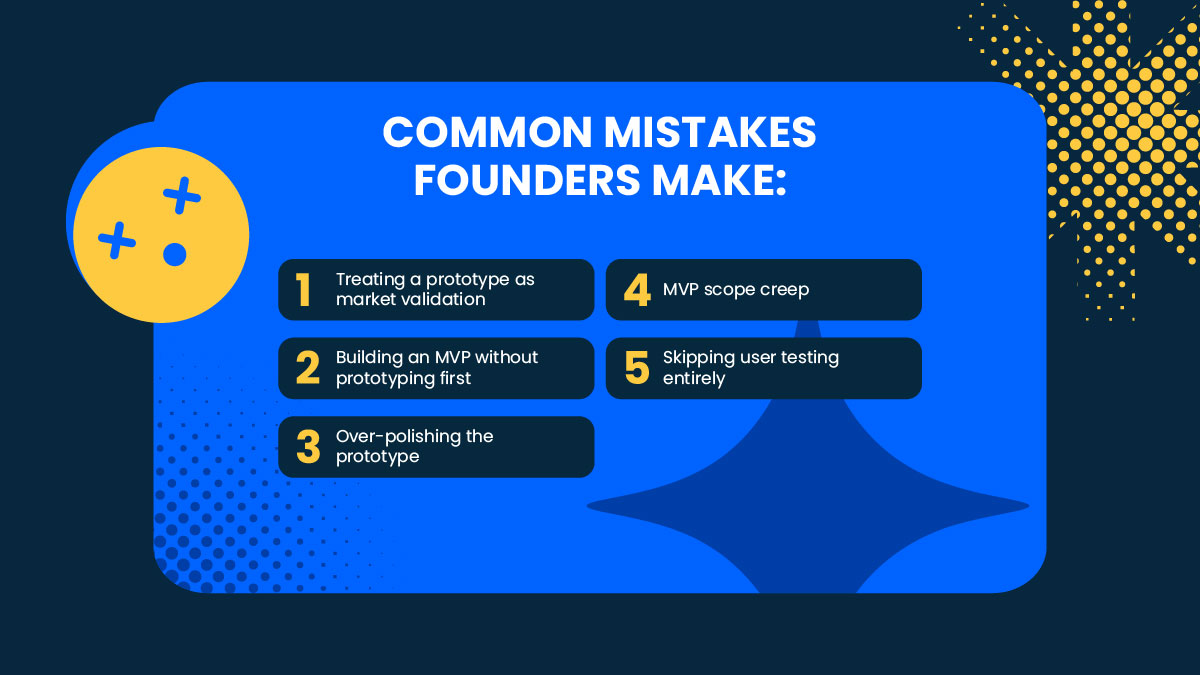
Even experienced founders fall into the same traps. Most of them are easy to avoid once you know what to look for.
Mistake 1: Treating a prototype as market validation A prototype tells you what users think about the design. It does not tell you if they will pay for the product or come back to it. Those are completely different questions.
Mistake 2: Building an MVP without prototyping first This is where most development budgets bleed out. Without a prototype, requirements stay fuzzy. Fuzzy requirements lead to scope changes mid-build. Scope changes cost money.
Mistake 3: Over-polishing the prototype A prototype should be good enough to generate feedback, not good enough to impress people. Spending three weeks on pixel-perfect designs before a single user has seen the product is waste.
Mistake 4: MVP scope creep The temptation to add "just one more feature" before launch is constant. Resist it. Every extra feature is a delay, a cost, and a distraction from the one thing you actually need to prove. If you need a partner to keep your MVP scope disciplined, Ontik Technology's MVP development services are built exactly for this.
Mistake 5: Skipping user testing entirely Some founders build a prototype, show it to their co-founder and two friends, get positive reactions, and move straight to MVP development. That is not user testing. Get your prototype in front of strangers who match your target user profile.
How Does the Prototype-to-MVP Pipeline Work in Practice?
The most efficient path from idea to product is a structured pipeline where each stage feeds directly into the next.
The full flow looks like this: Idea, then PoC if needed, then Prototype, then Usability Testing, then MVP, then Market Feedback, then Iteration.
The handoff moment matters. You move from prototype to MVP when users have confirmed through real testing that they would use or pay for the product. Not when you feel ready. When the data says so.
Rapid prototyping keeps this cycle fast. The faster you iterate on your design, the more confident your MVP requirements become before you spend a dollar on development. Feature prioritization decisions also get much easier when you have real prototype feedback to back them up.
There is also something worth knowing about minimum viable prototypes. This is a prototype detailed enough to generate MVP-quality insights without being a full hi-fi production. Think of it as the middle ground between a rough sketch and a polished mockup. It saves time while still producing actionable feedback.
One more practical benefit: the wireframes, user flow maps, and feedback notes from your prototype phase feed directly into your MVP requirements. A good prototype can cut your custom software development spec time in half.
What Comes After an MVP?
A successful MVP is not the finish line. It is the starting gun for a faster product development cycle.
After your MVP, the next stages look like this. First comes the MLP, or Minimum Lovable Product, which builds on the MVP by adding enough polish and delight that users actually want to recommend it. Then the MMP, or Minimum Marketable Product, which is ready for a broader public launch.
Then your full product. Understanding these product development stages helps you plan resources and timelines at each step.
The post-MVP iteration cycle is straightforward: analyse your user data, identify the top three friction points, ship one improvement sprint, measure the result, and repeat. Agile product development makes this natural because you are already working in short cycles and adjusting based on what you learn.
When do you know it is time to scale? A few concrete signals: retention above 30% at the 30-day mark, organic referral rate above 15%, or consistent revenue growth across three consecutive months. At that point, you likely need to expand your team quickly. A dedicated development team model works well for founders at this stage because it gives you experienced developers without the overhead of full-time hiring.
How Does AI Change the Prototype and MVP Process Today?
AI tools have changed the cost and speed calculation for both prototyping and MVP development. Founders who ignore this shift are moving slower than they need to.
On the prototype side, tools like Figma AI and Framer AI can generate hi-fi mockup screens from a text description in minutes. What used to take a designer three days now takes a few hours.
On the MVP side, AI-assisted development and no-code platforms have compressed typical build timelines from 8 to 16 weeks down to 2 to 6 weeks for simpler products. If you are exploring this approach, Ontik Technology's work on AI MVP development covers how startups are using this today in practical terms.
One important note for AI-specific products: if your product relies on a novel AI component, treat the AI itself as a PoC element. Prove the AI works before designing around it.
How Do You Choose the Right Team?
The team you need to build a prototype and the team you need to build an MVP are very different.
For a prototype, you need one person: a UX/UI designer with skills in wireframing and interactive mockups. Figma or Adobe XD are the standard tools. Cost: $50 to $150 per hour freelance, or $2,000 to $8,000 for a flat project. If you lack design skills yourself, working with a UI/UX design consultant early on prevents the common mistake of building a prototype that looks like it was designed by engineers.
For an MVP, you need a proper team. At minimum: one tech lead, two to three developers covering frontend and backend, and a QA analyst. If you are building a mobile app, add a mobile specialist.
For most early-stage founders, a dedicated development team offers the best balance between speed, quality, and cost control.
Final Thoughts: Where Should You Start?
Choosing between a prototype and an MVP comes down to one question: what do you still need to prove?
If you have not validated whether your idea looks, feels, and flows in a way that makes sense to users, build a prototype. If you have validated design and need to prove that real people will use and pay for a working product, build an MVP. Never skip both.
The prototype tests the design. The MVP tests the market. Both are necessary. Both save you money when done in the right order.
If you are at the point where you know your prototype has been validated and you are ready to move to a production-ready MVP, Ontik Technology builds MVPs for exactly this stage. The team covers everything from UI design through to deployment, so you can stay focused on the product decisions that matter most.
Start where you are. Build what the stage requires. And do not let the fear of imperfection stop you from putting something real in front of real users.
Ready to move from idea to MVP? Talk to the Ontik Technology team and find out what your next step looks like.
Frequently Asked Questions: Prototype vs MVP
Can a prototype be an MVP?
No. A prototype simulates a product experience. An MVP is a real, working product. They serve different purposes at different stages of validation.
Should I always build a prototype before an MVP?
Almost always yes. The two exceptions are very simple tools that can be built in under a week, and experienced technical founders who have validated the UX through deep domain knowledge.
How much does an MVP cost?
Between $20,000 and $250,000, depending on architecture. No-code MVPs sit at the lower end. Fully custom native apps sit at the higher end.
What do investors want to see?
It depends on the stage. At pre-seed, a strong prototype is often enough. At seed and above, investors typically expect a working MVP with real user data.
What is a minimum viable prototype?
It is a prototype with enough fidelity to generate MVP-quality insights without being a full hi-fi production. It sits between a rough sketch and a polished mockup.
Can I skip the PoC stage?
Yes, if there is no novel or unproven technology in your product. Most standard web and mobile products can go straight to prototyping.