AI Development Cost in 2026: Complete Pricing Breakdown, Cost Factors, and ROI Guide

Key Takeaways
- AI development cost in 2026 ranges from $5,000 for a simple chatbot to $2 million+ for a full enterprise AI platform
- The biggest cost drivers are model complexity, data quality, team location, and integration depth
- Generative AI and LLM-based solutions cost more upfront but often deliver faster ROI
- Ongoing costs (maintenance, retraining, monitoring) typically run 15-25% of your initial build cost per year
- Businesses that start narrow, build an MVP first, and use pre-trained models consistently spend less and see results sooner
- For every $1 invested in AI, companies report an average return of $3.70, but only when the project is tied to a clear business goal
Corporate investment in AI is reaching record heights, yet many organizations struggle to track the specific destination of their capital.
Determining the 2026 price tag for AI development is a common challenge, fueled by conflicting market data. With quotes ranging from $10,000 to $500,000, the discrepancy often lies in the lack of standardized project scopes.
Our analysis provides clarity by outlining authentic cost brackets and the variables influencing them. We offer pragmatic strategies for constructing AI that focuses on tangible business outcomes rather than expensive, superficial prototypes.
What Does AI Development Actually Cost in 2026?
The honest answer is that AI development in 2026 costs anywhere from $5,000 to over $2 million and your specific number depends entirely on what you're building and why.
That range isn't a cop-out. A rule-based chatbot answering FAQs and a multi-agent enterprise automation system are both "AI," but they share almost nothing in terms of complexity, team size, or infrastructure needs.
Here's a realistic starting point before we go deeper.
Cost Ranges by Project Size, Startup to Enterprise
Most mid-market projects land between $40,000 and $500,000 for the initial build, with annual operating costs running 15-25% on top of that.
Generative AI vs. Traditional AI Cost Comparison
Traditional AI things like classification models, regression, or rule-based systems is cheaper to build and easier to maintain. You're working with structured data and well-understood algorithms.
Generative AI and large language model (LLM) applications cost more because they require more computation, more testing, and more careful prompt engineering. An LLM-powered assistant with RAG (retrieval augmented generation) typically runs $15,000 to $40,000 at the lower end and well over $200,000 for enterprise-grade versions.
But here's the thing: the cost of running AI models has dropped dramatically. The compute cost for running a GPT-3.5-equivalent model dropped roughly 280x between 2022 and 2024. That compression is continuing in 2026, and it's making generative AI solutions far more accessible than they were even two years ago.
AI MVP vs. Full-Scale AI Product
If you're not sure whether AI will work for your use case, don't build the full product first. An AI MVP lets you validate your idea with a focused, functional version for $20,000 to $60,000. Once you've proven the concept, you scale from a position of confidence, not hope.
Skipping the MVP and going straight to a full build is one of the most common and expensive mistakes businesses make in AI development.
Top 8 Core Factors That Drive AI Development Costs
Your final AI development cost comes down to eight variables to get these right and your budget estimate will be within 15% of actual. Get them wrong and you could end up at 3-4x your original plan.
1. Business Goals and Project Scope
Vague goals create expensive projects. "We want to use AI" is not a scope. "We want to reduce customer support ticket volume by 40% using an AI chatbot integrated with our CRM" is a scope. The clearer your objective, the tighter your estimate.
2. AI Model Complexity and Architecture
A simple classification model costs very little to build. A multi-modal system that processes text, images, and structured data simultaneously costs significantly more. Every layer of complexity you add reasoning, memory, tool use, multi-agent orchestration adds development time and cost.
3. Data Collection, Cleaning, and Labeling
This is where most projects get surprised. Data preparation typically consumes 40-60% of total project timelines. If your data is messy, incomplete, or siloed across systems, expect to spend real money cleaning it before any model training begins. Good AI needs good data. There's no shortcut here.
4. Infrastructure and Cloud Computing Costs
Training a moderately complex neural network costs $5,000 to $20,000 in cloud compute alone. Large language models or complex vision systems can exceed $100,000 per training run. Beyond training, you have ongoing inference costs, storage, and monitoring infrastructure. Plan to allocate 15-25% of your total project budget to cloud solutions and infrastructure.
5. Development Team Structure and Location
Where your team is located changes your cost more than almost any other factor.
A 6-month project with a 5-person team in the US can easily run $500,000 to $1.5 million in labor alone. The same team structure with offshore AI development from South Asia can deliver the same output for 40-60% less.
6. Integration with Existing Systems
Connecting AI to your existing CRM, ERP, databases, or legacy tools adds meaningful cost. Each integration requires custom API development, data mapping, and testing. As a rule, integrations add 20-50% to your baseline development budget and the more complex your existing stack, the higher that number climbs.
7. Security, Compliance, and Governance
Healthcare and financial services projects carry a 25-35% cost premium over standard builds. HIPAA compliance, GDPR implementation, fraud detection architecture, and enterprise-grade encryption all cost real money. Don't treat these as afterthoughts. Building compliance in from the start is always cheaper than retrofitting it later.
8. AI Maintenance, Retraining, and Monitoring
The build cost is just the beginning. AI models drift over time, meaning their performance degrades as real-world data shifts away from what the model was trained on. Budget 15-25% of your initial build cost per year for maintenance, retraining, and monitoring. This is a line item most first-time buyers miss entirely.
AI Development Cost Breakdown by Solution Type
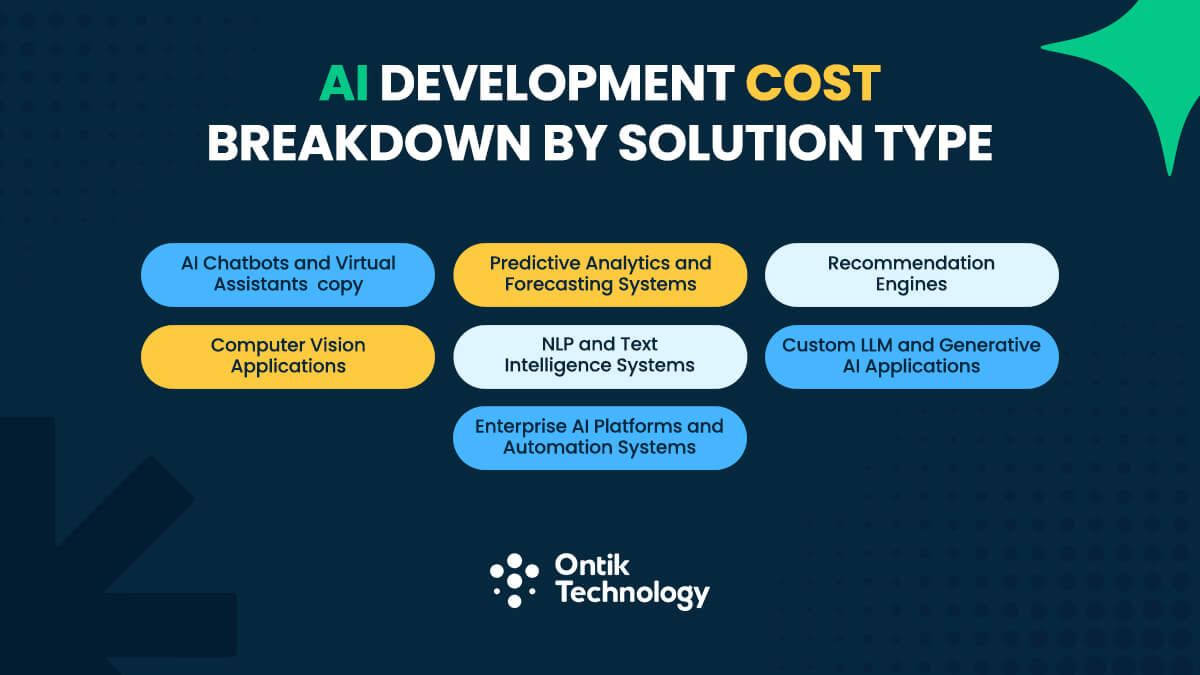
Different AI solutions have very different cost profiles, here's what each one actually costs in 2026.
AI Chatbots and Virtual Assistants
AI chatbot development is the most common AI investment for businesses in 2026, and the price range is enormous.
- Basic rule-based chatbot: $5,000 - $15,000
- NLP-powered chatbot with integrations: $20,000 - $80,000
- Advanced multi-modal chatbot: $40,000 - $100,000
- Enterprise agentic chatbot (multi-agent, full system integration): $100,000 - $300,000+
For AI chatbot solutions in regulated industries like banking or healthcare, add 25-35% to these figures for compliance requirements alone.
Predictive Analytics and Forecasting Systems
Predictive analytics systems typically cost between $40,000 and $300,000, depending on data volume and how many integrations are needed. Demand forecasting for retail or supply chain runs $100,000 to $300,000 for production-grade systems. The biggest cost variable here is data the cleaner your historical data, the faster and cheaper the build.
Recommendation Engines
A recommendation engine for a mid-sized eCommerce platform typically runs $120,000 to $300,000. The cost scales with catalog size, user data volume, and the sophistication of personalization required. Simpler collaborative filtering models come in lower; deep learning personalization systems with real-time inference cost more.
Computer Vision Applications
Computer vision applications, product inspection, object detection, document processing, range from $50,000 for a focused single-use system to $500,000+ for complex multi-environment deployments. The big cost driver is labeled training data. If you don't already have it, collecting and labeling image datasets adds significant time and expense.
NLP and Text Intelligence Systems
NLP development services for document classification, sentiment analysis, entity extraction, or contract intelligence range from $30,000 to $200,000. The more domain-specific the language (legal, medical, financial), the more training data you need and the higher the cost.
Custom LLM and Generative AI Applications
Custom LLM Application Development is the Fastest Growing Category in 2026. You may augment foundation models such as GPT, Claude, and Gemini with fine-tuning and RAG, which keeps the prices down to a reasonable range, typically $30,000 to $150,000 for a well-scoped application.
Building your own foundation model from scratch is a whole other ball game that starts at $500,000 and goes into the millions.
Enterprise AI Platforms and Automation Systems
Full enterprise AI solutions that combine numerous AI capabilities process automation, analytics, NLP and system-wide integration generally cost between $300,000 and $2 million. These are multi-phase, multi-team projects. Typical total cost of ownership over 3 years is 1.5 to 2x the initial build cost.
AI Development Cost by Industry
Industry context dramatically changes what AI development costs, not just because of compliance, but because of the data complexity and accuracy requirements each sector demands.
Healthcare AI Solutions
Healthcare AI development is among the most expensive due to strict compliance requirements (HIPAA, GDPR), the need for extremely high accuracy, and sensitive patient data handling. Expect to add 30-40% to baseline costs for compliance architecture alone.
The upside is significant, AI applications in healthcare could generate up to $150 billion in annual industry savings by 2026, according to Accenture. Businesses building AI and machine learning solutions for healthcare need to treat data governance as a first-class concern from day one.
FinTech and Fraud Detection AI
Financial services AI has a 25-35% cost premium. Fraud detection systems with real-time inference, advanced encryption ($25,000-$50,000 setup) and regulatory compliance (FINRA certification runs $35,000 to $50,000) add up fast.
The ROI in this area is exceptional: Financial services companies have seen a 4.2x return on each dollar they've spent in AI, the greatest of any industry.
Retail and eCommerce AI
One of the most cost-effective sectors is retail AI, including recommendation engines, demand forecasts, dynamic pricing, personalisation. Targeted automation projects are $40,000. Full-platform AI integration is $500,000.
And the payback period is generally quick because the impact on revenue is direct and measurable. AI recommendation engines often pay for themselves within 6-12 months with improved average order value.
Manufacturing and Predictive Maintenance
Manufacturing Predictive maintenance AI $150k - $500k for production-grade systems The expense is driven by the need to integrate sensor data, real-time inference needs, and outdated industrial systems. But the benefits are genuine.
AI driven supply chain optimisation can save 15% in logistics expenses, and boost inventory levels by 35%
SaaS and Enterprise Productivity AI
SaaS AI integrations copilots, workflow automation, intelligent search, AI-assisted analytics, are increasingly built on top of existing foundation models, which keeps costs lower. A focused SaaS AI feature built on an existing LLM API typically runs $30,000 to $120,000.
Full AI-native SaaS platform development scales from $200,000 upward, depending on scale and complexity. Pairing this with strong business intelligence and analytics capabilities multiplies the value delivered.
Hidden AI Development Costs Businesses Often Ignore
The number on the initial quote is rarely the number you'll actually spend. Here are the hidden costs that catch most businesses off guard.
Data Preparation Delays
Data preparation consumes 40-60% of AI project timelines in most real-world projects. If your data lives in multiple systems, has inconsistent formatting, or simply hasn't been collected yet, your project starts late and costs more before a single line of model code is written. Audit your data before you sign any development contract.
Infrastructure Scaling Costs
What works in testing doesn't always work at scale. A model that costs $500/month to run during development can cost $5,000-$10,000/month in production when serving thousands of users. Plan your infrastructure architecture early and build cost flexibility into your design from the start.
Model Drift and Retraining
AI models don't stay accurate forever. As user behavior, market conditions, or input data changes, model performance degrades. Retraining cycles including new data collection, retraining compute costs, and QA can run $10,000 to $50,000 per cycle for complex models. Budget for this. It's not optional.
API and Vendor Dependency
Building on third-party AI APIs (OpenAI, Anthropic, Google) is fast and cost-effective at first. But vendor pricing can change, rate limits can disrupt your product, and you have no control over model deprecation. Factor in migration risk and consider hybrid architectures that reduce single-vendor dependency.
Compliance and Regulatory Expenses
Compliance isn't a one-time cost. GDPR audits, ongoing security testing, and regulatory reporting add recurring expenses that most initial budgets don't account for. If you're in a regulated industry, get a compliance estimate before your development estimate, not after.
Change Management and Team Training
Getting AI into production is only half the job. Getting your team to actually use it is the other half. Training, workflow redesign, and internal change management can add 10-20% to total project cost. Skip this and you risk building something technically successful that nobody uses.
In-House vs. Outsourced vs. Hybrid AI Development
Choosing how to staff your AI project is one of the most consequential budget decisions you'll make, and the right answer depends on your timeline, budget, and long-term AI ambitions.
Building an Internal AI Team
An internal AI team gives you full control and deep institutional knowledge. But the costs are steep. A senior AI architect in the US earns $160,000-$300,000 annually. A machine learning engineer runs $140,000-$280,000. Recruiting alone takes 90-120 days for senior AI roles in 2026 due to intense talent competition. By the time you hire and onboard, your competitors have already shipped.
In-house makes sense if AI is a core, long-term competitive advantage for your business and you have the budget to invest sustainably.
Hiring an AI Development Agency
An AI development agency provides you with a ready-made team, proven methods and a speedier time to market. You pay a premium for that availability.
A typical agency charge in the US ranges from $150-$250/hour, but you bypass the months of hiring and ramp time. This paradigm works well for well-scoped projects with clear deliverables.
Offshore and Hybrid AI Development Models
Offshore and hybrid models are the fastest-growing approach for cost-conscious businesses in 2026. Hiring remote developers from South Asia or Eastern Europe delivers 40-60% cost savings versus equivalent US talent without sacrificing quality on well-structured engagements.
A hybrid model where your product owner and technical lead are local while your development team is offshore combines communication quality with cost efficiency. This is the model that most capital-efficient businesses are adopting right now. Understanding staff augmentation vs. consulting models can also help you pick the right engagement structure for your specific situation.
How to Reduce AI Development Costs Without Sacrificing Quality
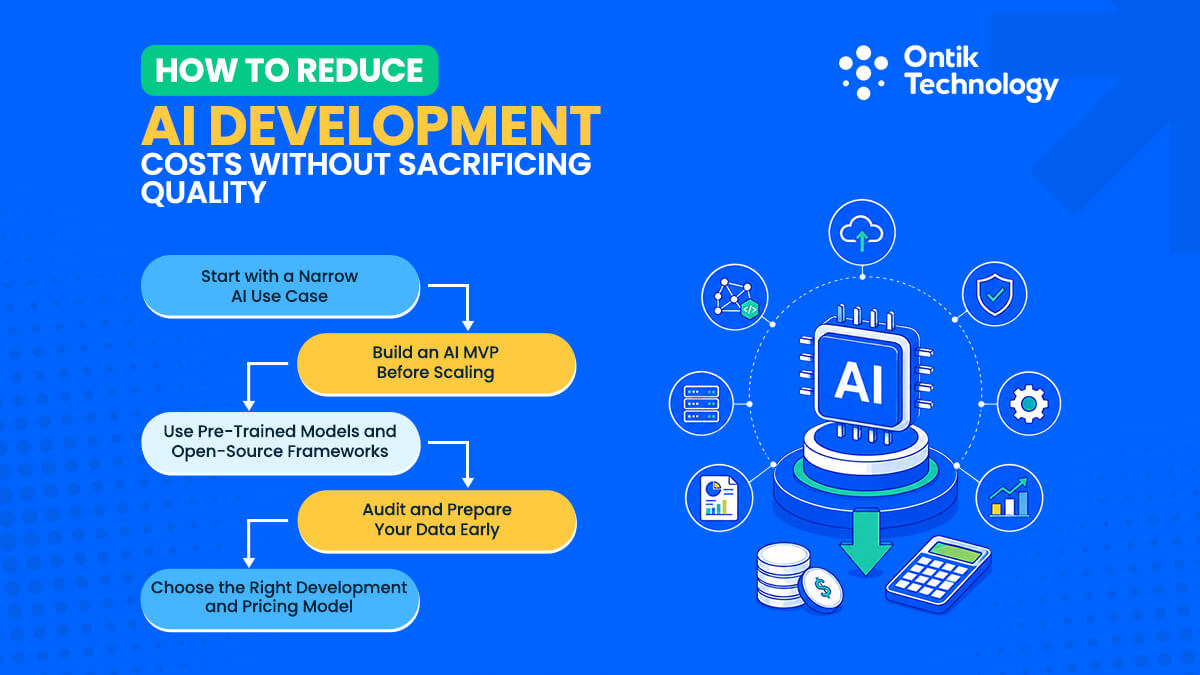
You can cut AI development costs by 30-50% without cutting quality, but only if you make smart decisions before development starts, not during it.
Start with a Narrow AI Use Case
The most expensive AI projects are the ones trying to solve everything at once. Pick one specific problem, build AI that solves it well, and expand from there. A focused use case has a tighter scope, a faster build, and a clearer ROI signal.
Build an AI MVP Before Scaling
An AI MVP lets you test your core hypothesis for $20,000 to $60,000 instead of betting $300,000+ on an assumption. You find out what works, what users actually want, and where the technical complexity really lives, all before committing to a full build. Check out MVP development services as a starting point if you're at this stage.
Use Pre-Trained Models and Open-Source Frameworks
Building an AI model from scratch when a pre-trained alternative exists is almost always the wrong call in 2026. Foundation models from OpenAI, Anthropic, Google, and open-source alternatives like LLaMA and Mistral have already done the heavy lifting.
Building on top of them through fine-tuning or RAG cuts development time and cost by 40-60% compared to building from scratch.
Audit and Prepare Your Data Early
Data problems found during development cost 3-5x more to fix than data problems found before development starts. Run a data audit before you engage any development team. Know what you have, what's missing, and what needs cleaning. This single step can shave weeks and tens of thousands of dollars off your project.
Choose the Right Development and Pricing Model
Fixed-price contracts work for well-defined, stable scopes. Time-and-materials works better for exploratory or complex AI projects where requirements will evolve. A dedicated development team model works best for ongoing AI product development where you need consistent capacity and institutional knowledge over time. Picking the wrong model creates misaligned incentives and budget overruns.
AI ROI - Measuring the Real Business Impact
AI delivers measurable ROI, but only for businesses that define success clearly before they start building.
Defining the Right Success Metrics
Don't measure AI success by how impressive the technology is. Measure it by what changes in your business. Good AI success metrics look like: support ticket volume reduced by 35%, lead qualification time cut from 4 hours to 20 minutes, or inventory waste reduced by 18%. Vague metrics like "improved efficiency" make it impossible to know if your investment worked.
Real-World AI ROI Examples
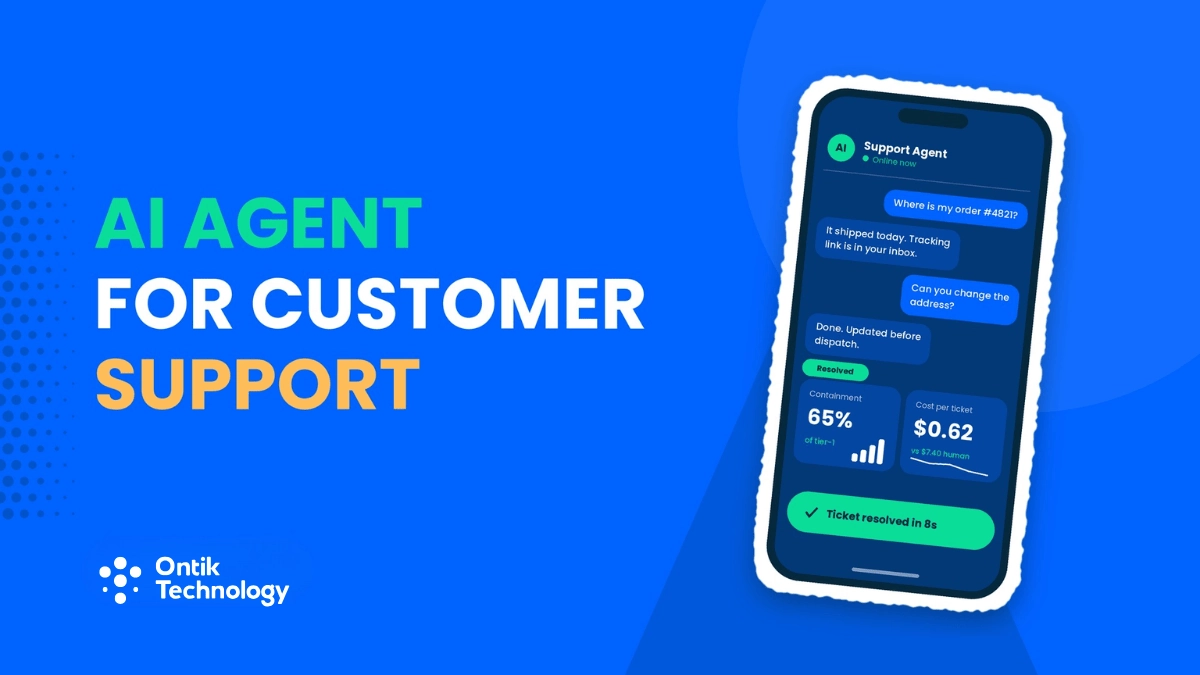
Small business AI chatbot: A retail business invests $25,000 in an AI chatbot for customer support. It handles 65% of inbound queries without human intervention. Support team headcount stays flat while customer volume grows 40%. Break-even in 7 months.
Fraud detection system (FinTech): A payment platform spends $180,000 building an AI fraud detection system. False positive rates drop by 60%, reducing manual review costs by $400,000 annually. ROI exceeds 200% in year one.
eCommerce recommendation engine: A mid-sized online retailer invests $150,000 in a personalization engine. Average order value increases by 22%. The system pays for itself within 9 months and generates an estimated $800,000 in incremental annual revenue.
These aren't outliers. Research from Deloitte puts the average return on generative AI investment at $3.70 for every dollar spent, with financial services leading at 4.2x.
Why Most AI Projects Fail to Deliver ROI
Here's the uncomfortable truth: more than 80% of organizations report no measurable impact on business performance from their AI investments. The reasons are consistent. Unclear goals. Messy data.
Treating AI as a technology project instead of a business transformation. Deploying horizontally (AI everywhere) instead of vertically (AI solving one specific problem really well).
MIT research found that purchasing AI from specialized vendors and building focused partnerships succeeds about 67% of the time. Internal builds succeed only one-third as often. The lesson is clear: the quality of your AI partner matters as much as the technology itself.
Why Businesses Choose Ontik Technology for AI Development
Ontik Technology builds AI solutions that are tied to business outcomes, not just technical deliverables.
End-to-End AI Product Development
From initial strategy through deployment and ongoing optimization, Ontik Technology handles the full AI product lifecycle. You don't need to coordinate multiple vendors or manage handoffs between strategy, design, development, and infrastructure teams. One team, one accountable partner.
Custom AI Solutions Built Around Business Goals
Every AI solution Ontik builds starts with a business problem, not a technology choice. Whether it's an AI chatbot, a predictive analytics platform, a generative AI assistant, or a full automation system, the design is shaped around your specific goals, data environment, and success metrics. The result is AI that actually gets used not AI that sits in a demo forever.
Cost-Effective Offshore AI Development
Ontik's custom software development and AI engineering services are delivered from a cost-efficient offshore model that gives you senior-level talent at 40-60% less than equivalent US or UK agency rates. You get experienced AI engineers, transparent processes, and a team that behaves like an extension of your own without the overhead of in-house hiring. You can also explore how hiring Asian developers compares to other sourcing models if you're evaluating options.
Expertise in Generative AI, NLP, and Automation
Ontik's engineering team works across the full AI stack LLM application development, RAG architecture, NLP systems, agentic AI, MLOps, and AI and machine learning integration with existing business infrastructure. Whether you're building on OpenAI, open-source models, or a hybrid stack, the team has production experience across all of it.
Industries Ontik Technology Serves
Ontik builds AI solutions across healthcare, FinTech, retail and eCommerce, SaaS, manufacturing, and enterprise productivity. Each engagement is shaped by the compliance requirements, data characteristics, and business dynamics of that industry not adapted from a generic template.
If you're ready to talk through your AI project and get a realistic cost estimate, the Ontik process page walks you through exactly how engagements work from first conversation to delivery.
Conclusion: Building AI That Actually Pays Off in 2026
AI development costs in 2026 range from a few thousand dollars to several million and the difference between a successful investment and a wasted one almost never comes down to how much you spent.
It comes down to how clearly you defined the problem, how prepared your data was, and whether you chose a partner who cared about your business outcomes as much as the technical build.
Start narrow. Prove it works. Then scale. That's the formula that's actually delivering ROI for businesses right now.
If you want a realistic, no-fluff estimate for your AI project, reach out to the Ontik Technology team. They'll give you honest numbers and a clear path forward not a pitch deck full of promises.
Frequently Asked Questions
How much does AI development cost in 2026?
AI development cost in 2026 ranges from $5,000 for a basic rule-based chatbot to $2 million or more for a full enterprise AI platform. Most realistic mid-market projects land between $40,000 and $500,000 for the initial build. The exact number depends on your solution type, team location, data readiness, and integration complexity.
What is the biggest cost driver in AI development?
Project scope and model complexity are the single biggest drivers, but data preparation is the most commonly underestimated cost. It typically consumes 40-60% of total project timelines and adds significant labor cost, especially when data is messy, siloed, or incomplete.
Is generative AI more expensive than traditional AI?
Generally, yes.. Generative AI and LLM-based applications cost more to build and test than traditional ML models. But the cost gap is narrowing fast as foundation models become more accessible. And in many cases, generative AI delivers faster ROI because it handles a broader range of tasks without needing separate models for each one.
How much does AI maintenance cost annually?
Expect to budget 15-25% of your initial build cost per year for AI maintenance. This covers model retraining, performance monitoring, infrastructure updates, and ongoing improvements. A system built for $100,000 typically costs $15,000-$25,000 per year to keep performing at the level it launched at.
Should businesses outsource AI development?
For most businesses, yes especially in the early stages. Building an internal AI team takes 90-120 days just to hire, and senior AI engineers command $140,000-$300,000 annually in the US. Outsourcing to a specialist AI development partner, particularly through an offshore or hybrid model, cuts cost by 40-60% and gets your product to market faster. The key is choosing a partner with genuine production experience, not just theoretical AI knowledge.
How long does it take to build an AI solution?
A basic AI chatbot takes 2-6 weeks. A custom ML solution or LLM application typically takes 3-6 months. Full enterprise AI platforms can take 6-18 months depending on scope and integration complexity. Starting with a well-scoped MVP almost always compresses the timeline and the learning it generates makes every subsequent phase faster.