How to Hire Offshore AI Engineers in 2026: Step-by-Step Guide
The AI talent shortage isn't a rumor. It's a hiring reality that's slowing down companies across every industry.
44% of executives say the lack of in-house AI expertise is their single biggest barrier to moving forward with AI initiatives. And it's not getting easier. Hiring cycles for senior AI roles now stretch 30–50% longer than any other technical position in the US and Western Europe. The competition is fierce, the salaries are climbing, and the wait is getting longer.
Here's the thing though. The talent isn't missing. It's just not local.
Mature AI ecosystems in Central and Eastern Europe, Latin America, and Asia are producing world-class engineers in machine learning, NLP, computer vision, and MLOps. Companies that know how to tap into those markets are building serious AI capability at 50–70% lower cost than local hiring, and doing it in weeks, not quarters.
But offshore AI hiring has a very real pitfall. 80% of CTOs surveyed picked the wrong vendor for the first time. The wasted budget averaged $47,000. The wasted time averaged five months. They got developers who had added "AI" to their LinkedIn profiles overnight, not engineers who had shipped production AI systems.
This guide gives you everything you need to do it right. You'll learn how to define your requirements, choose the right region and engagement model, vet candidates properly, protect your IP, integrate your new hires, and manage your offshore AI team for the long term. Let's get into it.
Why Hire Offshore AI Engineers in 2026?
Offshore AI engineers give you faster access to specialized talent at 50–70% lower cost than local hiring, without sacrificing quality. That's the short version. Here's the longer one.
The cost difference is real and significant. AI engineers in the US earn $146,000–$194,000 per year on average. Equivalent engineers in Central and Eastern Europe cost $45,000–$100,000. Latin America runs $25,000–$54,000. Even at the top of the offshore range, you're looking at substantial savings, and those savings compound across a team.
Speed is the other major factor. A good offshore vendor can place vetted AI engineers in 2–6 weeks. Compare that to the months most US companies spend recruiting locally, often for roles that stay open far longer than planned.
And the quality argument against offshore has largely collapsed. Latin America is one such region. The Coursera Global Skills Report shows Python as the top skill for Machine Learning and Data Science, with countries like Brazil and Argentina championing the ML and NLP fields. Up to 40% of AI projects in the region use Python, which shows strong, production-ready expertise. CEE engineers bring strong mathematics foundations and hands-on production experience. Asia offers scale that no other region can match.
This isn't just cost arbitrage anymore. Offshore development is no longer just about cost savings. It has evolved into a strategic approach to accessing global expertise, accelerating innovation cycles, and maintaining a competitive edge.
There is one caveat worth stating upfront. The offshore AI market has a serious quality problem right now. Plenty of developers added "AI" to their profiles without the depth to back it up. Knowing how to vet properly makes the difference between a great hire and a very expensive mistake.
Wrapper vs. Deep AI Developers: Know What You Actually Need
Before you post a job or contact a single vendor, you need to know whether you need someone who connects APIs or someone who builds custom models. They're completely different hires, and confusing the two is one of the most common and costly mistakes companies make.
Wrapper developers work with existing AI services. They integrate APIs from OpenAI, Anthropic, Google, or similar providers into your product. They build the logic that connects your application to a model, handles prompts, manages responses, and creates the user-facing experience around AI. These engineers are faster to hire, more widely available, and cost less than deep AI specialists.
Deep AI developers build and train custom models. They work with your proprietary data to create systems that can't be replicated by plugging into a third-party API. They understand model architecture, training pipelines, evaluation frameworks, and deployment at scale. These engineers are rarer, command higher rates, and take longer to hire.
Here's how to decide which you need:
Most companies starting out need wrapper developers first. Don't over-hire for deep AI capability before you've validated your use case. Start with integration, prove the value, then invest in custom model work when the data and the business case both justify it.
Essential Technical Skills to Look For
Every offshore AI engineer you hire should have Python fluency and hands-on production experience, not just tutorial projects and cloned repos. Beyond that baseline, the specific skills you need depend on your use case.
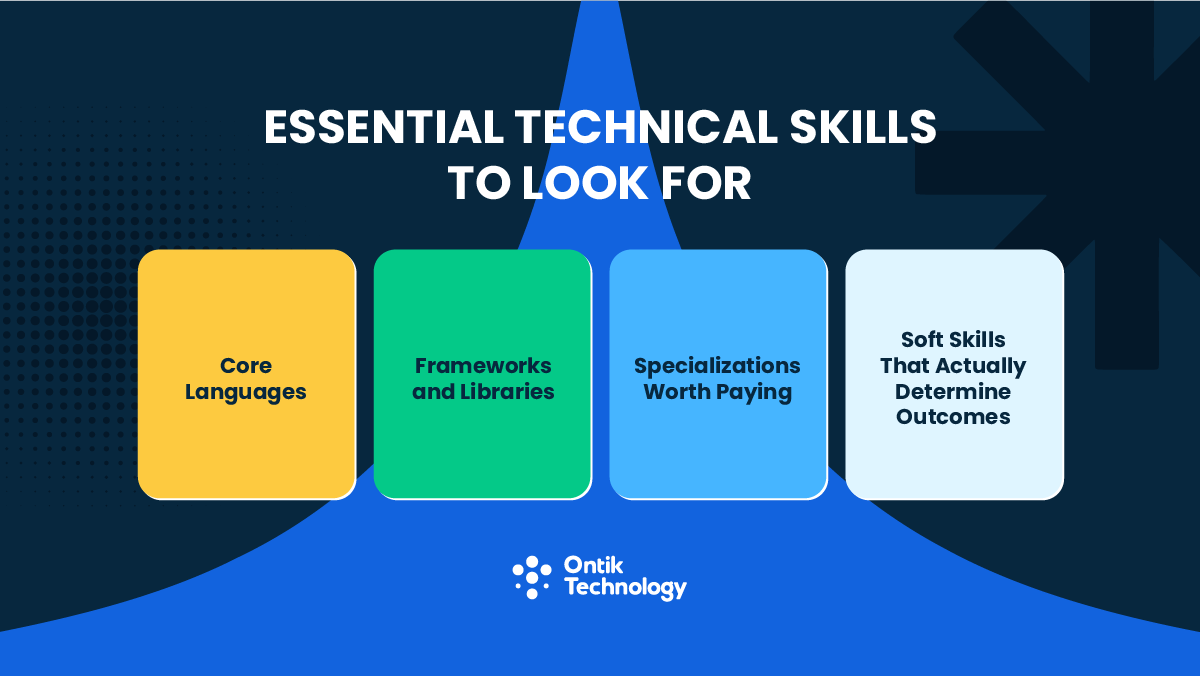
Core Languages
Python is non-negotiable. But fluency means more than knowing the syntax. You want engineers who understand vectorization, efficient data structures, memory management, and performance optimization. Python that works in a notebook and Python that runs reliably in production are two very different things.
R is valuable for statistical analysis and research-heavy roles. C++ and Java matter when you need high-performance computing or AI integration into larger existing systems.
Frameworks and Libraries
For machine learning and deep learning work, the core stack is PyTorch, TensorFlow, Scikit-learn, and Keras. PyTorch tends to dominate research and flexible experimentation. TensorFlow is stronger for production deployment at scale. Both are standard across serious AI teams.
For MLOps, look for experience with MLflow, Kubeflow, and Weights and Biases. These tools manage the model lifecycle from training through deployment, monitoring, and retraining. An engineer who can build models but can't maintain them in production is only half the hire you need.
Hugging Face experience matters for anyone working with large language models or transformer-based architectures. It's become the standard library for working with pre-trained models.
Specializations Worth Paying a Premium For
These skills are where real differentiation happens in 2026.
RAG (Retrieval-Augmented Generation) connects large language models to your own data without expensive full retraining. Engineers who understand RAG architecture can build AI systems that stay current with your data at a fraction of the cost of fine-tuning.
Vector databases like Pinecone, Weaviate, and Chroma are foundational for modern AI applications. If your system needs semantic search, similarity matching, or LLM memory, your engineer needs to know these tools well.
NLP covers transformer architectures, BERT, GPT fine-tuning, prompt engineering, and in-context learning. This is one of the most in-demand specializations right now.
Computer vision engineers work with OpenCV, CNNs, and real-time inference systems. Strong demand exists in manufacturing, healthcare, and logistics.
MLOps specialists handle model deployment, monitoring pipelines, drift detection, and retraining workflows. If you're building production AI, this skillset keeps your system performing reliably after launch.
Soft Skills That Actually Determine Outcomes
Technical depth gets an engineer hired. Soft skills determine whether the engagement actually succeeds.
Watch for how candidates explain complex concepts. Can they describe model trade-offs in plain language? Do they think about business outcomes or just model accuracy? How do they respond when requirements are ambiguous?
Strong AI engineers ask clarifying questions before they start coding. They document decisions. They communicate blockers early. And they adapt quickly as the AI landscape shifts, because it shifts constantly.
Best Regions to Hire Offshore AI Engineers

The three major offshore regions each offer a different mix of cost, skill depth, timezone alignment, and communication quality. The right choice depends on what matters most to your team.
Central and Eastern Europe
CEE is consistently the strongest region for technical depth in AI and ML. Poland, Ukraine, Romania, and the Czech Republic all produce engineers with strong mathematics and computer science foundations built from rigorous university programs.
Poland accounts for over 20% of AI startups in the region, followed by Romania and the Czech Republic, offering deep expertise in computer vision, enterprise ML, robotics, and data-intensive systems, which are often applied in fintech, manufacturing, and defense.
Ukraine has particular strength in computer vision and edge AI. Romania excels in data analytics and systems engineering. The Czech Republic has growing capability in robotics and cybersecurity AI.
English proficiency is high across the region. Business practices align well with Western standards. Teams work in Agile environments with clear ownership and transparent communication.
The trade-off: rates are higher than LATAM and Asia, and the timezone gap makes real-time collaboration with US West Coast teams challenging without some schedule flexibility.
Latin America
For US-based companies, LATAM offers something no other offshore region can: genuine timezone overlap. Engineers in Brazil, Argentina, Colombia, and Mexico operate in UTC-3 to UTC-6, giving US teams 4–8 hours of shared working time per day. That means real-time standups, same-day code reviews, and fast feedback loops without anyone working unusual hours.
Brazil is the region's largest economy, with a robust talent pool in São Paulo and strong AI research. Engineers here often specialize in NLP, data analytics, and machine learning infrastructure. Argentina is a standout for cost-effectiveness and high-quality education, with a vibrant AI community and strong capabilities in computer vision and predictive modeling.
Colombia and Mexico are the fastest-growing AI talent markets in the region, supported by government investment in STEM and digital infrastructure.
Cultural affinity with US teams is strong. Communication is generally clear. And LATAM engineers tend to be comfortable in Agile environments with fast iteration cycles.
Asia
Asia gives you scale and cost efficiency that no other region matches. India is the world's largest source of technical talent, with over 5 million software engineers, including hundreds of thousands in AI, ML, and data engineering. Vietnam and the Philippines are among the fastest-growing tech talent markets in Southeast Asia, with strengths in Python, data engineering, and applied ML.
India has 2,500+ AI providers on major platforms and deep expertise in generative AI, MLOps, and LLM fine-tuning. Vietnam is strong in computer vision and edge AI. The Philippines excels in AI for customer support and process automation.
The main consideration is timezone. Limited overlap with the US and Europe requires well-structured async workflows. But for execution-heavy AI work where deep real-time collaboration is less critical, Asian teams often deliver excellent results at the most competitive rates anywhere.
How to Hire Offshore AI Engineers: A Step-by-Step Process
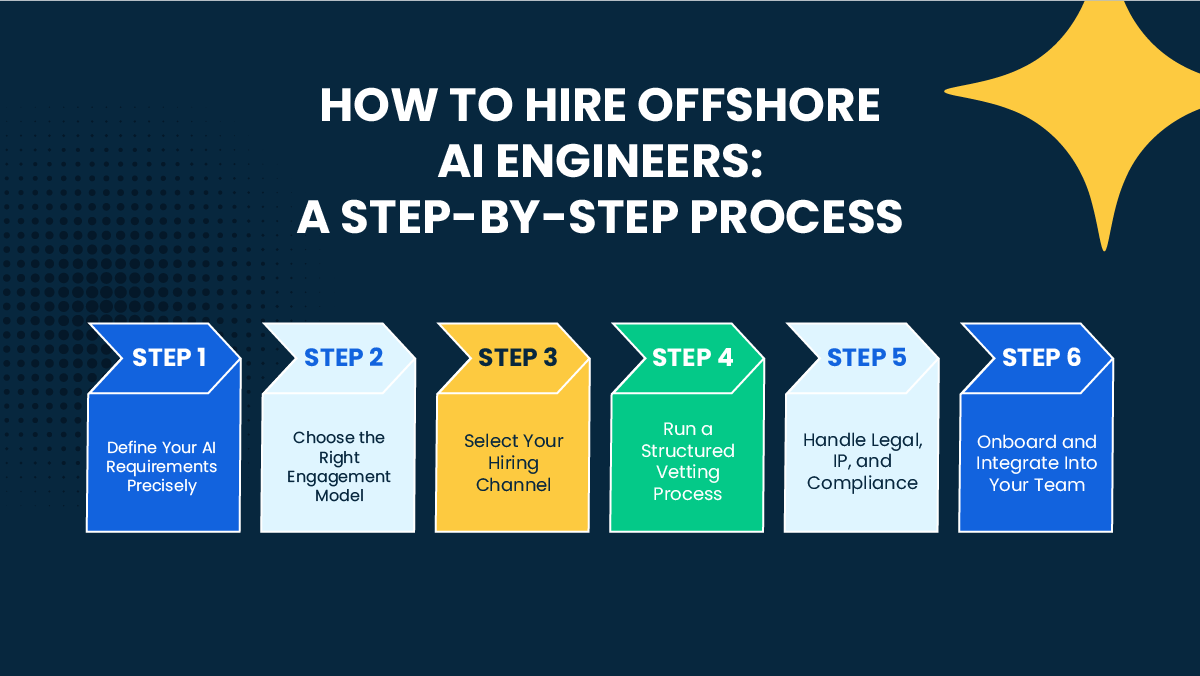
A structured process separates companies that build high-performing offshore AI teams from those that waste months and money on the wrong hire. Follow these six steps and you'll avoid the most common pitfalls.
Step 1: Define Your AI Requirements Precisely
Vague requirements produce wrong hires. Before you talk to a single vendor or candidate, write down the following.
The AI domain you're working in (NLP, computer vision, predictive analytics, MLOps, generative AI). The project stage you're at (R&D, pilot, production). The specific tech stack you need, covering frameworks, cloud platforms, and deployment tools. The concrete success metrics you'll use to evaluate performance, such as model accuracy targets, latency thresholds, and inference cost per 1,000 tokens.
The more specific this document, the faster and more accurate your vetting becomes. It also protects you from vendors who promise everything and deliver a generalist.
If you're unsure where to start, Ontik Technology's AI and machine learning solutions team can help you map your requirements before you begin hiring.
Step 2: Choose the Right Engagement Model
Your engagement model determines cost structure, control level, and flexibility. Here's a straightforward comparison:
Staff augmentation is usually the right starting point. Bring in one or two offshore engineers alongside your existing team, test the relationship and workflow, then scale from there.
Before committing to a model, it's worth understanding how augmentation compares to full consulting. This breakdown of staff augmentation vs consulting covers the key differences in cost, control, and commitment.
For longer-term AI development work, Ontik's dedicated development team model gives you a stable offshore team that integrates deeply into your product and workflows over time.
Step 3: Select Your Hiring Channel
Where you look determines who you find. Each channel has a different quality-to-effort trade-off.
Freelance marketplaces like Upwork and Toptal work well for short-term projects and early experimentation. The talent range is wide. The vetting burden falls entirely on you. Quality varies significantly from one candidate to the next.
Specialized agencies like Ontik Technology pre-screen candidates, handle contracts and HR, and match engineers to your specific stack and timezone needs. The upfront cost is higher, but you get faster placement, better reliability, and someone managing the infrastructure around your hire.
Direct platforms like LinkedIn and regional job boards work if you have strong in-house AI screening capability. Without that, you'll spend weeks filtering resumes that aren't what they appear to be.
Hackathons and Kaggle competitions are genuinely excellent signals for finding AI specialists. Engineers who compete on real ML problems consistently and score well have demonstrated actual capability, not just resume claims.
If you want to hire remote developers with verified AI expertise without running a months-long search yourself, working with a specialized partner is almost always the faster and lower-risk path.
Step 4: Run a Structured Vetting Process
Resumes and LinkedIn profiles are marketing documents. They tell you what someone wants you to think, not what they can actually build. Here's a five-stage vetting funnel that works.
Stage 1: Profile and portfolio screen. Look at their GitHub repos, not just their profile description. You want to see end-to-end projects with clean commits, tests, and documentation. Kaggle participation and open-source contributions are strong positive signals.
Stage 2: Technical quiz, 30 to 40 minutes. Assess fundamentals: vectorization, bias-variance trade-off, feature leakage, evaluation metrics for imbalanced datasets, class imbalance strategies, and basic prompt engineering concepts. Keep it practical, not theoretical.
Stage 3: Live pair-programming session, 45 to 60 minutes. Give them a real problem similar to what they'll actually work on. Watch how they approach it. Do they ask clarifying questions? How do they handle errors? Do they think about edge cases? The process matters as much as the output.
Stage 4: Project deep-dive and system design. Ask them to walk you through a production AI system they've built. Where did the data come from? How did they handle data drift? What monitoring did they set up? How did they handle failure cases? Vague answers here are a red flag.
Stage 5: Paid trial sprint, 20 to 30 days. Give them a real task on your actual project. This is the only true test of how they perform in your environment with your data and your team. Pay fairly for this. Engineers who do strong work in the trial almost always deliver strong work ongoing.
Step 5: Handle Legal, IP, and Compliance
This step gets skipped more than any other, and it's where offshore engagements create the most long-term risk. Sort it out before anyone writes a line of code.
Work-for-hire contracts should explicitly state that all IP created during the engagement transfers to your company. Don't assume this is implied. Write it in clearly.
NDAs should be signed before any technical discussion begins. This includes the screening process. Anyone who sees your codebase, your data, or your system architecture should be under NDA first.
Data handling agreements should specify exactly what data the engineer can access, how it must be stored and transmitted, and what happens to it when the engagement ends.
GDPR and regional compliance matters if you're handling data from EU users. Your offshore engineers need to understand and follow the same data protection standards your in-house team does.
Least-privilege access from day one. Offshore engineers should only have access to the systems and data they actively need for their current work. Audit access regularly and revoke it promptly when scope changes.
In 2026, with enterprise data privacy requirements, AI regulations in the EU and UK, and contractual IP obligations becoming standard, vagueness about data handling is not a minor gap, it is a disqualifying one.
Step 6: Onboard and Integrate Into Your Team
A great offshore engineer who feels like an outsider will underdeliver. Integration is what turns a hire into a high-performing team member.
Set up a single shared environment from day one. Same Git repository, same Agile board, same Slack workspace, same sprint cadence. There should be no "offshore sprint" and "onshore sprint." There's one team and one workflow.
Pair new offshore engineers with an in-house team member for the first two weeks. This accelerates context transfer, builds rapport, and surfaces questions before they become blockers.
Define ownership clearly. Who reviews their pull requests? Who signs off on model performance? Who do they escalate to when requirements are unclear? Ambiguity in these areas creates friction that compounds over time.
Ontik Technology's structured delivery process is built specifically around this kind of seamless integration, making sure offshore engineers contribute meaningfully from day one rather than spending weeks finding their footing.
Red Flags: How to Spot AI-Washing Before You Sign
In 2026, plenty of developers added "AI" to their profiles without the skills to back it up. Here's how to catch it before it costs you.
This is a real and growing problem. They got developers who used ChatGPT to write boilerplate and called it AI development, and vendors who quoted AI-native timelines then delivered at traditional offshore speed.
Watch for these specific warning signs.
They can't name the foundation models they've worked with or explain why they chose them. A genuine AI engineer has opinions about model selection based on trade-offs they've actually navigated. Vague answers mean they haven't navigated them.
Their GitHub has no meaningful AI repos. Tutorial notebooks, cloned projects, and Kaggle starters don't count as production experience. Look for original work with real data, documented decisions, and deployed outputs.
They talk about model features but can't explain evaluation. If they can't articulate how they measured model performance, what metrics they used, and how they handled failure cases, the project experience on their resume is probably shallow.
They have no production deployments. Building a model in a notebook is not AI engineering. Ask specifically about systems they've deployed, monitored, and maintained in a live environment.
They're vague about data handling and privacy. Any engineer who has done real production AI work has thought carefully about data pipelines, access controls, and compliance requirements. Vagueness here is a genuine disqualifying signal.
Their timeline estimates don't add up. A genuine AI engineer can explain why a task takes the time it does, what the dependencies are, and where the uncertainty lies. Unusually fast estimates often mean the engineer hasn't thought through the actual complexity.
The vendor won't let you talk directly to their engineers. Agencies that only communicate through account managers and resist putting you in front of the actual engineers are often managing quality gaps they don't want you to discover before you sign the contract.
How to Manage Offshore AI Engineers Effectively
Hiring is only half the challenge. The teams that get the most from offshore AI engineers have clear processes, measurable KPIs, and a genuine culture of inclusion. The ones that struggle treat offshore engineers as external contractors rather than real team members.
Set KPIs tied to business outcomes, not just code volume. Model accuracy improvements, latency reductions, inference cost per thousand tokens, and time from data input to decision output are the metrics that connect engineering work to business value. "Tickets closed" is not an AI KPI.
Run unified Agile rituals. Shared sprint planning, shared retrospectives, shared demos. When offshore engineers are present for the same ceremonies as in-house engineers, they develop the same context, the same sense of ownership, and the same motivation to deliver quality work.
Build a communication stack that works across time zones. Slack or Teams for async communication. Zoom or Google Meet for syncs. Jira or Linear for task tracking. GitHub for code review with written comments, not just approvals. Document decisions in writing so no one is blocked waiting for a timezone overlap.
Invest in knowledge sharing. Regular technical sessions, cross-team code reviews, and joint model design discussions keep offshore engineers growing and keep your in-house team learning from their perspective too. This is what builds a real long-term AI capability rather than a temporary augmented one.
Take retention seriously. AI talent is in demand everywhere. Competitive compensation, meaningful work, clear growth paths, and genuine inclusion in team culture are what keep offshore engineers committed to your project over the long term. High turnover in an AI team is expensive because domain knowledge walks out the door with every departure.
For more on building sustainable offshore team structures, the guides on offshore staff augmentation and remote staff augmentation cover the operational side in detail.
Offshore AI Engineer Cost Breakdown
Offshore AI engineers cost significantly less than local equivalents, but the real cost comparison needs to go beyond the hourly rate. Here's a full picture.
A few things to factor in beyond the base rate.
Agency fees typically run 15–25% of annual salary for placement and ongoing HR management. This is worth paying for the vetting quality and speed you get in return. Onboarding adds 2–4 weeks before an offshore engineer reaches full productivity, so budget for the ramp-up period in your project timeline.
Management overhead is real but manageable. A well-integrated offshore engineer on a team with clear processes adds roughly 15–20% to your management time in the first month. By month three, they're running independently.
Even with all these factors counted, a mid-level CEE AI engineer at $60,000 per year with a 20% agency fee and proper onboarding still saves you 55–60% compared to a US equivalent. Across a team of three to five engineers, those savings fund significant additional development capacity.
For a fuller picture of what makes staff augmentation worth the investment, the breakdown on benefits of IT staff augmentation covers the value beyond the hourly rate comparison.
Why Consider Ontik Technology as Your Offshore AI Partner
Ontik Technology isn't a staffing agency that places engineers and disappears. It's a full-service technology partner that combines AI consulting, hands-on development, and flexible team models for companies that need real AI capability built and maintained alongside them.
Their AI and machine learning solutions are built by engineers who understand both the strategy and the code. That means you're not just getting someone who can execute a spec. You're getting engineers who can help you figure out the right spec in the first place.
For companies at the pilot stage, their MVP development services are designed to validate AI use cases fast and at manageable cost, before committing to a full build. That's particularly valuable if you're still figuring out where AI creates the most value in your product.
For ongoing development, the dedicated development team model gives you a stable, integrated offshore team that works as a natural extension of your in-house capability. And if you need individual specialist hires rather than a full team, their hire remote developers option covers that too.
The delivery process is built around genuine integration. Offshore engineers who follow your workflows, contribute to your sprints, and build institutional knowledge about your product rather than treating every engagement as a fresh contract from scratch.
Final Thoughts
Hiring offshore AI engineers works when you treat it as a strategic capability decision, not a cost-cutting shortcut.
The companies that succeed define requirements precisely before they hire, vet systematically rather than relying on resumes, protect IP from the very start, integrate offshore engineers into a single team rather than treating them as a separate track, and invest in retention so the knowledge they build stays with the company.
The ones that struggle skip the vetting, underestimate the onboarding, and discover six months in that they hired developers who could demo AI but couldn't ship it in production.
The global AI talent pool has never been deeper or more accessible. The question isn't whether offshore AI engineering can work for your company. It's whether you build the right process to do it well.
If you're ready to build your offshore AI team with a partner who handles both the talent and the delivery, Ontik Technology is worth a conversation. Their team augmentation model is designed specifically for companies that want offshore AI capability without the overhead of managing it entirely from scratch.
Frequently Asked Questions
How long does it take to hire an offshore AI engineer?
Through a specialized agency, you can typically receive vetted candidate profiles within 24–48 hours and have an engineer starting within 2–6 weeks. Direct hiring through freelance platforms or LinkedIn takes considerably longer, often 4–10 weeks, because the vetting burden falls entirely on you.
What's the difference between staff augmentation and a dedicated offshore AI team?
Staff augmentation adds individual engineers to your existing team structure. You direct their work directly. A dedicated team is a fully formed unit, often including a team lead, that operates more independently and integrates into your product roadmap. Staff augmentation suits filling specific skill gaps. Dedicated teams suit long-term product development.
How do I protect my IP when working with offshore AI engineers?
Use work-for-hire contracts that explicitly transfer all IP to your company, sign NDAs before any technical discussions, implement data handling agreements, and enforce least-privilege access from day one. Don't assume IP protection is implied. Write it into every contract, no exceptions.
What is AI-washing and how do I avoid it?
AI-washing is when developers claim AI expertise without the production experience to back it up. Avoid it by reviewing actual GitHub repositories, running live technical assessments on real problems, asking for specific production deployment examples, and requiring a paid trial sprint before committing to a longer engagement.
How do I evaluate real skills vs. resume claims?
Don't rely on resumes. Review GitHub repos for original work, run live coding sessions with real problems, ask for detailed walkthroughs of past production systems, and run a paid trial on your actual project. These steps together give you a reliable picture of actual capability.
Is it better to use a freelancer or an agency for offshore AI talent?
Freelancers work well for short-term, well-defined tasks where you can handle the vetting yourself. Agencies are better for longer engagements, specialized roles, and situations where vetting quality and hiring speed matter. For most AI development work, an agency delivers better risk-adjusted outcomes.
Hire AI Engineers
Build your offshore AI team faster with vetted talent, clear hiring models, and lower costs.