How to Build an AI App? Steps, Features, Costs, Trends
Key Takeaways
1. AI apps learn from data and continuously improve, unlike traditional rule-based software that requires manual updates.
2. The AI app development process includes seven stages: requirement analysis, data preparation, model training, UI/UX design, development, deployment, and ongoing optimization.
3. Building an AI app costs $30,000–$1M+, depending on complexity, data needs, model type, and integration requirements.
4. AI features like personalization, predictive analytics, computer vision, and automation deliver measurable efficiency and revenue gains.
5. Businesses succeed with AI by ensuring high-quality data, choosing the right model, solving real problems, and avoiding bias, drift, and integration pitfalls.
Your competition is already using AI. They are automating tasks you still handle manually. They are predicting customer needs before you even recognize patterns.
Building an AI application is no longer a futuristic luxury. It has become a strategic necessity for businesses that want to stay relevant in 2026. From startups looking to disrupt markets to enterprises aiming to optimize operations, everyone is asking the same question: how to build an AI app that actually delivers results?
This guide walks you through everything you need to know about AI app development. You will learn the step-by-step process to create artificial intelligence applications. You will understand the core components that power intelligent systems. You will discover the features that make AI apps indispensable. Plus, you will get realistic cost estimates and timelines to plan your investment wisely.
Whether you are a CTO evaluating AI strategy, a product owner exploring automation, or a startup founder seeking competitive advantage, this roadmap will help you navigate the complexities of building AI applications.
What Is an AI App?
An AI app is software that learns from data and improves over time without explicit programming for every scenario. Unlike traditional applications that follow fixed rules, AI apps adapt their behavior based on patterns they discover in information.
Your email spam filter is a perfect example. It does not rely on a simple list of banned words. Instead, it analyzes millions of emails to recognize spam characteristics. The more emails it processes, the smarter it becomes at filtering unwanted messages.
Key characteristics include:
- Learning systems that make data-driven decisions
- Adaptive behavior that evolves with usage
- Pattern recognition across large datasets
- Predictive capabilities that forecast outcomes
Common examples include chatbots that understand natural language, recommendation systems that suggest products based on your preferences, and predictive analytics apps that forecast sales trends. This shift from rule-based to learning-based systems transforms how businesses operate and serve customers.
What is AI Application Development?
AI application development combines software engineering, data science, and machine learning models into one integrated process. You are not just writing code. You are teaching systems to think and learn.
The lifecycle follows a clear pattern: data collection leads to model training, which connects to integration, and finally reaches deployment. Each stage builds on the previous one.
Core development phases:
- Data gathering and preparation for model training
- Algorithm selection and model training
- API integration and infrastructure setup
- Continuous monitoring and optimization
At the core, you work with algorithms that process information and generate insights. Model training teaches these algorithms to recognize patterns. Inference applies those learned patterns to new situations. This continuous learning cycle defines modern AI application development and separates it from traditional software projects.
Why Businesses Need AI Apps in 2026?
The business landscape has shifted dramatically. Companies that automate intelligently are outpacing those that rely on manual processes. AI apps provide the competitive edge you need to survive and thrive.
Automation now goes beyond simple task repetition. AI-driven decision systems analyze complex scenarios and recommend optimal actions faster than human teams ever could. Personalization has become a customer expectation, not a nice-to-have feature.
Critical advantages in 2026:
- Real-time intelligence that predicts market shifts
- Cost optimization through automated processes
- Scalable personalization at enterprise level
- Proactive problem detection before issues escalate
Digital transformation without AI is incomplete. Scalability demands systems that grow smarter as they grow larger. AI apps learn from increased data volumes and improve performance as usage expands. This creates a positive feedback loop that traditional applications cannot match.
What Are the Key Benefits of Building an AI App for Your Business?
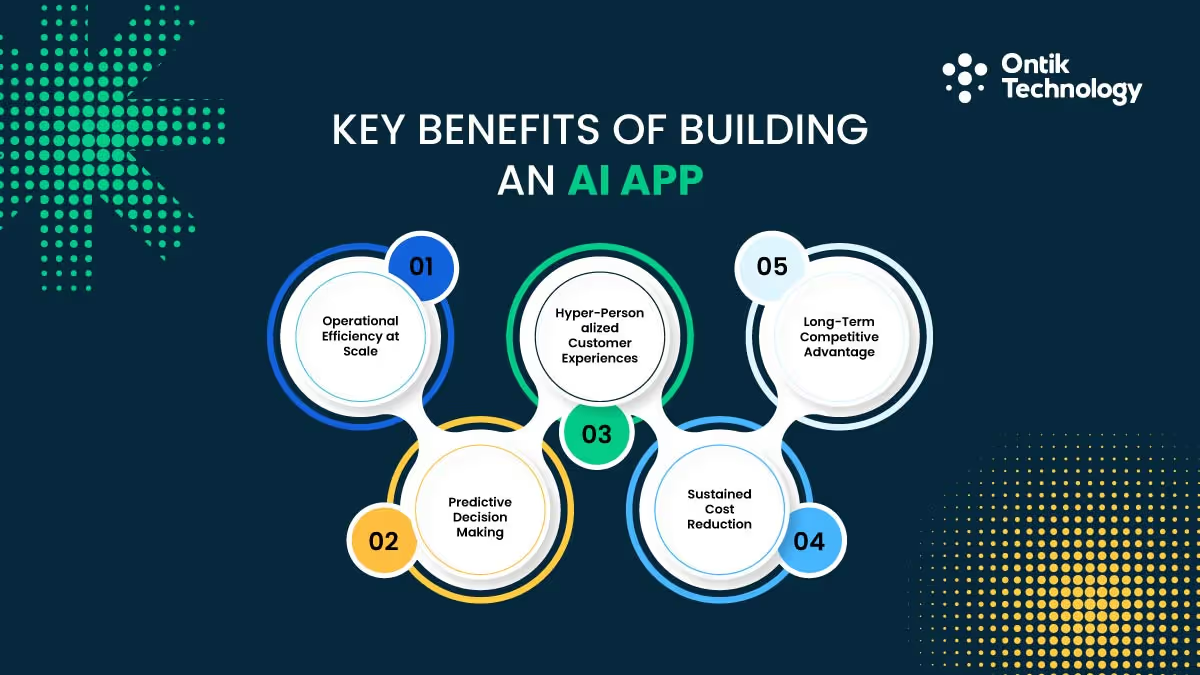
Building an AI application transforms multiple aspects of your operations. The returns extend far beyond simple automation.
Operational efficiency shoots up when AI handles repetitive tasks. Your team focuses on strategic work while algorithms process routine operations. Data entry, document classification, quality checks, and status updates all happen automatically. This shift frees up thousands of hours annually.
Predictive insights change how you plan. Traditional analytics tell you what happened. AI tells you what will happen next. You forecast demand more accurately, anticipate maintenance needs before equipment fails, and identify customer churn risk before it happens.
Personalization scales effortlessly with AI. You can tailor experiences for thousands or millions of users simultaneously. Each customer sees content, recommendations, and offers matched to their preferences. This level of customization was economically impossible before AI made it automated.
Cost reduction comes from multiple sources. You need fewer staff for routine tasks. You waste less on inventory through better demand prediction. You prevent expensive failures through early detection. These savings compound over time as your AI systems become more accurate.
Competitive differentiation becomes sustainable. Anyone can copy a feature. Few can replicate a trained AI system built on your unique data. Your models improve continuously as they process your specific business information.
Customer experience improves when AI powers interactions. Response times drop, accuracy increases, and availability expands to 24/7. Users get help exactly when they need it, translating directly to higher satisfaction and retention rates.
What Are the Core Components of AI Apps?
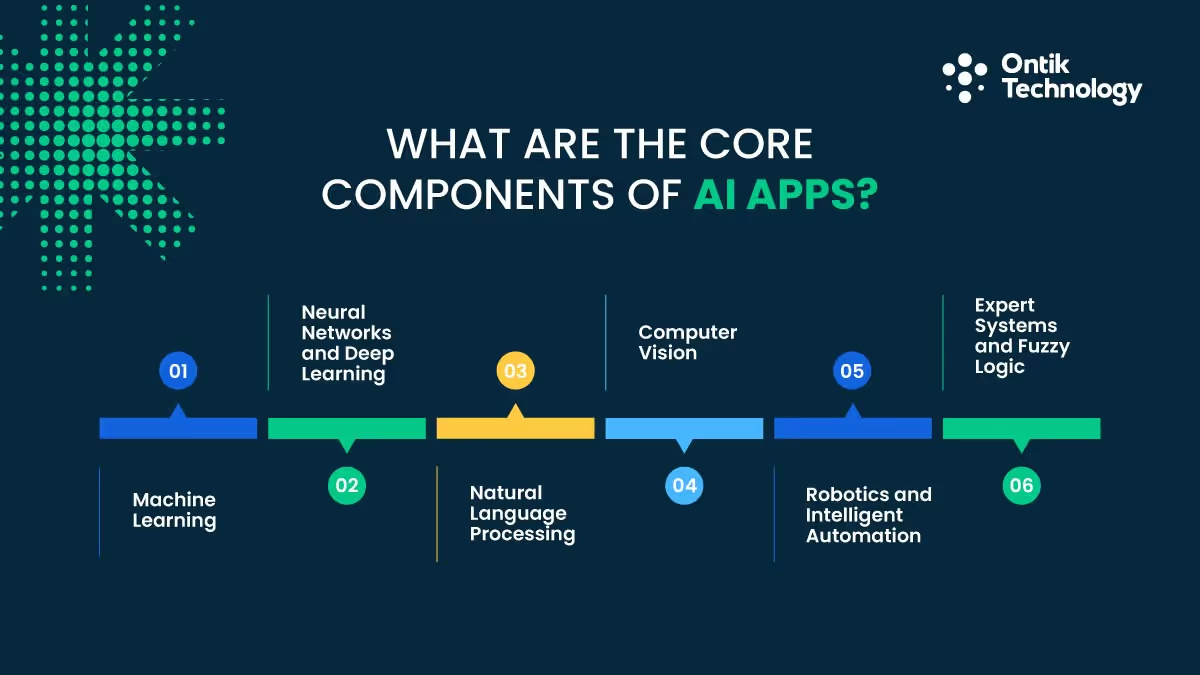
AI applications run on several interconnected technologies. Each component handles specific tasks that combine to create intelligent behavior. Understanding these building blocks helps you build AI applications effectively.
Machine Learning (ML)
ML forms the foundation of most AI apps. It lets systems learn patterns from data without explicit programming for every scenario. Three main approaches power ML systems: supervised learning uses labeled data to train models, unsupervised learning finds patterns without predefined categories, and reinforcement learning trains through trial and error with feedback.
Neural Networks and Deep Learning
Neural networks mimic how human brains process information. They consist of layers of interconnected nodes that transform input data into outputs. Deep learning uses neural networks with many layers to learn complex patterns. Different architectures serve different purposes: convolutional neural networks handle visual data, recurrent networks process sequences like text, and transformer models power modern language understanding.
Natural Language Processing (NLP)
NLP enables machines to understand and generate human language. This capability powers chatbots, translation services, and content analysis tools. Modern NLP relies on large language models trained on massive text datasets. Key tasks include sentiment analysis, named entity recognition, and question answering. NLP transforms how users interact with software through voice commands and natural conversations.
Computer Vision
Computer vision teaches machines to interpret visual information. Your AI apps can identify objects, detect faces, read text in images, and analyze video content. Image classification assigns labels to pictures. Object detection locates multiple items within images. Facial recognition matches faces to identities. Quality control systems use computer vision to spot defects, while retail apps let customers search products by photo.
Robotics and Intelligent Automation
Robotics combines AI with physical systems. Intelligent automation applies AI to business processes. Industrial robots use computer vision and ML to adapt to variations in products and conditions. Robotic process automation handles digital workflows, and when enhanced with AI, these bots handle exceptions and make decisions without human intervention.
Expert Systems and Fuzzy Logic
Expert systems encode human knowledge into rules and inference engines. They provide recommendations based on established expertise. Fuzzy logic handles uncertainty and imprecision, working with degrees of truth rather than strict binary values. While newer AI techniques often overshadow these methods, they remain valuable when you have clear domain rules and need explainable decisions.
These components work together in most AI applications. Your specific mix depends on what problems you solve and what data you have available. Next, we will look at how different industries apply these technologies.
How Are AI Applications Used Across Different Industries?
AI transforms operations across every major sector. The applications vary by industry, but the pattern remains consistent. Businesses identify problems that require intelligence, apply appropriate AI techniques, and measure tangible outcomes.
Healthcare organizations use AI for predictive analytics in patient care. The problem is reactive treatment that only addresses symptoms after they worsen. AI solutions analyze patient data to identify health risks before they become critical. Electronic health records, lab results, and vital signs feed into models that predict complications. The outcome is earlier interventions that improve patient outcomes and reduce hospital readmissions by up to 20 percent.
Finance institutions deploy AI for fraud detection and risk assessment. Traditional rule-based systems miss sophisticated fraud patterns while generating false positives. AI models analyze transaction behaviors, user patterns, and contextual data to spot genuine threats. Banks using these systems reduce fraud losses significantly while improving customer experience by eliminating unnecessary transaction blocks.
Retail businesses implement AI for personalized shopping experiences. Generic product catalogs fail to engage diverse customer preferences. AI recommendation engines analyze browsing history, purchase patterns, and similar customer behaviors to suggest relevant products. E-commerce platforms see conversion rate increases of 10 to 30 percent through intelligent personalization.
Manufacturing companies use AI for predictive maintenance. Unexpected equipment failures halt production and create costly downtime. AI systems monitor sensor data from machinery to predict failures days or weeks in advance. Manufacturers schedule maintenance during planned downtime, reducing unplanned stoppages by 40 to 50 percent and extending equipment life.
Logistics operations optimize routes and inventory with AI. Static routing wastes fuel and time while poor inventory planning creates stockouts or excess. AI algorithms process traffic patterns, delivery priorities, and historical data to create efficient routes daily. Inventory systems predict demand variations to optimize stock levels. Companies reduce delivery costs by 15 to 25 percent while improving service levels.
Education platforms adapt learning paths using AI. One-size-fits-all curricula fail to address individual learning speeds and styles. AI tutoring systems assess student understanding continuously and adjust content difficulty and presentation. Students progress faster and retain more when lessons match their needs precisely.
These examples share common threads. Each industry faces problems where data holds answers but manual analysis falls short. AI apps process that data at scale to uncover insights and automate decisions. The results are measurable improvements in efficiency, accuracy, and outcomes.
What Game-Changing Features Should an AI App Include?
Your AI app needs capabilities that justify its existence. Generic features will not cut it. You want functionality that makes users wonder how they managed without it.
Real-time learning keeps your app current as conditions change. User preferences shift, market dynamics evolve, and new patterns emerge. Apps that learn continuously stay relevant while those relying on static models become outdated quickly.
Personalization engines tailor experiences to individual users. Every person sees content and recommendations matched to their preferences and behaviors. Your AI analyzes thousands of signals to understand what each user needs right now.
Predictive analytics anticipates future outcomes. Sales forecasts guide inventory decisions. Maintenance predictions prevent equipment failures. Churn risk scores trigger retention campaigns. This foresight creates competitive advantages.
Conversational interfaces make interactions natural. Users type or speak questions in plain language. Your AI understands intent, extracts information, and responds appropriately without complex navigation or training manuals.
Automation workflows handle complex processes end to end. Your AI chains multiple steps together, makes decisions at branch points, and handles exceptions. Entire business processes run without human intervention.
Visual recognition processes images and videos. Users search products by uploading photos, while AI-powered tools such as a logo maker can help businesses create visual assets more efficiently. Quality control systems spot defects, and security applications identify people and objects. Computer vision unlocks use cases impossible with text-only systems.
Context-aware responses adjust to situations dynamically. Your AI considers time of day, user location, device type, and recent activities to deliver relevant recommendations that match current context.
These features together create some seriously smart apps. Just pick the ones that fit what you're trying to do and what your users need. Then, we'll dive into how to actually build these things.
What Is the Step-by-Step Process to Develop an AI Application?
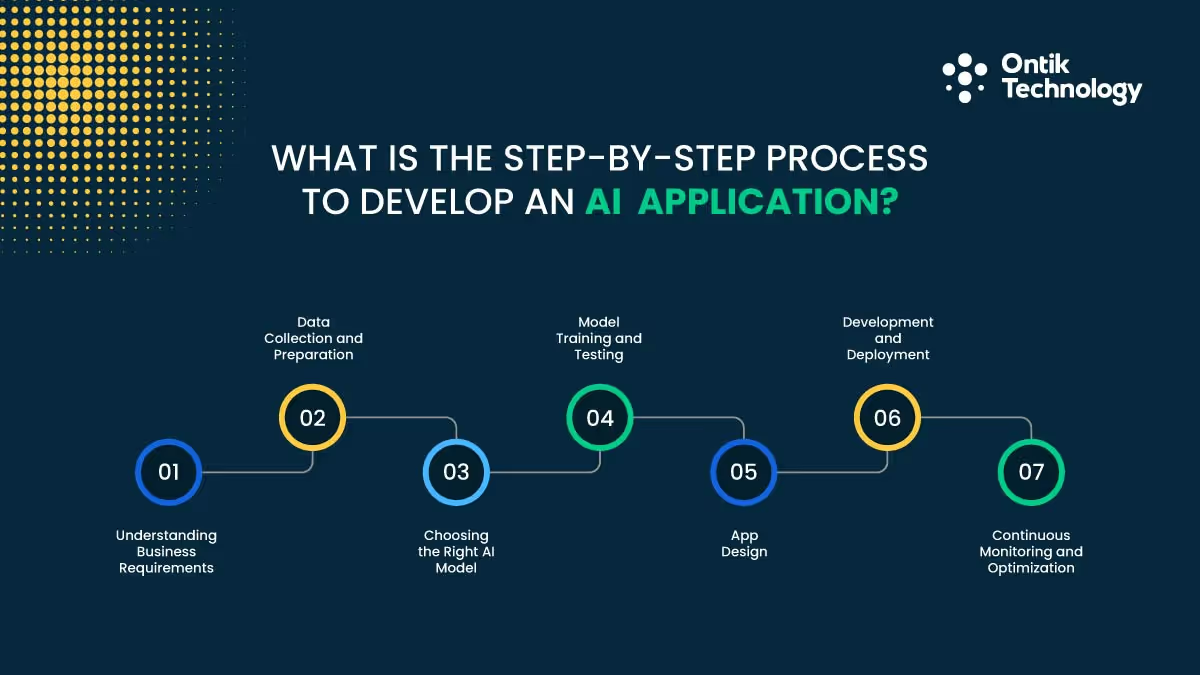
Building AI applications requires a structured approach. You cannot skip steps or rush through phases without risking project failure. This roadmap guides you from concept to deployment.
Understanding Business Requirements
Start by defining exactly what problem you want to solve. Vague goals lead to wasted effort and disappointing results. Ask what success looks like and define metrics you will track. Identify who will use the system and how. Document constraints around budget, timeline, and resources. Engage stakeholders from different departments early to shape requirements that address real needs.
Data Collection and Preparation
Your AI is only as good as your data. Identify what data you need and where it exists. Collect historical examples that represent the problem you want to solve. Clean and structure your data carefully by removing duplicates, fixing errors, and standardizing formats. Split data into training, validation, and test sets to ensure your model generalizes to new situations.
Choosing the Right AI Model
Different problems require different approaches. Classification tasks need models that assign labels to inputs. Regression models predict numeric values. Match your model type to your problem type. Consider complexity versus interpretability tradeoffs. Start simple and add complexity only when needed. Leverage pre-trained models when possible to reduce training time and data requirements.
Model Training and Testing
Training teaches your model to recognize patterns in data. Feed training data through the model repeatedly while algorithms adjust internal weights to improve accuracy. Validate performance on held-out data throughout training. Test rigorously on data the model never saw during development. Measure accuracy, precision, recall, and other relevant metrics. Iterate based on results until you achieve production-ready performance.
App Design and UI/UX Integration
Your AI needs an interface that makes its intelligence accessible. Design workflows that incorporate AI recommendations naturally. Users should understand when AI is helping and what it suggests. Show confidence levels and alternative options when appropriate. Make outputs actionable with clear next steps and rationale. Professional UI/UX design ensures your AI capabilities are accessible and intuitive. Test interfaces with actual users before full development.
Development and Deployment
Integration connects your trained model to application infrastructure. Build APIs that expose model predictions efficiently with low latency. Set up infrastructure to serve models at scale using cloud platforms. Implement monitoring from day one to track prediction performance. Plan rollout carefully by starting with limited users before full deployment.
Continuous Monitoring and Optimization
AI apps require ongoing attention. Models degrade over time as data patterns change. This phenomenon called model drift requires active management.
Monitor key metrics continuously. Set up alerts when accuracy drops below thresholds. Track how predictions influence business outcomes. Measure whether AI delivers expected value.
Collect production data to retrain models regularly. New examples improve accuracy and help models adapt to changing conditions. Establish retraining schedules based on your domain.
Gather user feedback systematically. Track which recommendations users accept or reject. Note where the AI confused people. This information guides improvements.
Optimize based on real-world performance. Adjust thresholds, add features, or try different models as you learn what works. AI development never truly ends. Continuous improvement separates good apps from great ones.
Now let's address the challenges you will face along the way.
How Can Businesses Overcome Common Challenges in AI App Development?
Every AI project encounters obstacles. Knowing them in advance helps you prepare solutions rather than scramble when problems arise.
Data scarcity limits what models can learn. Mitigation strategies include synthetic data generation, transfer learning from related tasks, and semi-supervised approaches. Partner with industry peers to share anonymized datasets when possible.
Bias creeps into AI systems through training data and design choices. Address this through diverse training sets, fairness metrics during development, and regular audits. Include diverse perspectives in your development team and test models across demographic groups.
High costs of compute resources and specialized talent strain budgets. Control expenses through cloud services that charge by usage. Use pre-trained models to reduce training time. Consider partnering with an AI app development company to access expertise without building full teams.
Integration complexity frustrates teams connecting AI to existing systems. Plan integration architecture early in projects. Use API-based approaches that minimize changes to existing code. Build abstraction layers that let you swap AI components without major rewrites.
Compliance issues vary by industry and geography. Build privacy protections and audit trails into systems from the start. Work with legal teams throughout development, not just at the end. Choose AI techniques that provide explainable decisions when regulations require transparency.
Skills gaps hamper progress when teams lack AI expertise. Bridge this through training programs that upskill existing staff or partner with experienced firms for initial projects while building internal capabilities.
What Are the Differences Between Traditional Apps and AI-Powered Apps?
Understanding these distinctions helps you recognize when AI makes sense and when simpler approaches suffice. Not every problem needs AI.
Traditional apps follow if-then logic you explicitly program. AI apps discover their own logic through pattern recognition. Static apps behave the same way every time. AI apps evolve as they process more data.
Rule-based systems require developers to anticipate every scenario. Learning systems need examples of inputs and desired outputs. Traditional apps break when facing unprogrammed situations. AI apps generalize to new scenarios based on learned patterns.
Intelligence versus instructions. Learning versus programming. These differences define when you need AI versus when traditional software works better.
How Much Does It Cost to Build an AI App?
Budget planning requires understanding cost components. AI app development costs vary widely based on scope and complexity. Here is what you should expect.
Data preparation often consumes 30 to 40 percent of total project budgets. You need to collect, clean, label, and structure information before any model training begins. Costs include data acquisition, storage infrastructure, and labor for data cleaning. Expect $10,000 to $50,000 for basic projects, $50,000 to $150,000 for mid-level apps, and $150,000 plus for enterprise systems.
Model development covers algorithm selection, training compute resources, and data science expertise. Cloud computing bills for training can reach thousands of dollars for complex models. Data scientist salaries or consulting fees add significantly. Budget $15,000 to $60,000 for simple models, $60,000 to $200,000 for moderate complexity, and $200,000 plus for cutting-edge approaches.
Infrastructure costs include cloud services for model hosting, API development, database systems, and monitoring tools. Monthly operational costs continue beyond initial development. Plan for $5,000 to $20,000 for basic setups, $20,000 to $80,000 for mid-scale deployments, and $80,000 plus for enterprise-grade infrastructure.
Maintenance requires ongoing model retraining, performance monitoring, bug fixes, and feature updates. Annual maintenance typically runs 15 to 25 percent of initial development costs. This recurring expense is essential for keeping AI apps effective.
Total cost ranges by project complexity:
- Basic AI app: $30,000 to $130,000 for simple use cases
- Mid-level AI app: $130,000 to $430,000 with custom models
- Enterprise AI app: $430,000 to $1,000,000+ for advanced capabilities
Cost estimates based on industry averages from Clutch 2024 AI Development Survey and GoodFirms Technology Cost Report
Several factors drive cost variability. Custom model development costs more than using pre-trained models. Real-time processing requirements increase infrastructure expenses. Regulated industries face additional compliance costs. Integration with complex legacy systems adds development time.
Geography affects labor costs significantly. Teams in North America and Western Europe charge premium rates. Eastern Europe, Latin America, and Asia offer lower costs with strong technical capabilities.
Remember that initial development represents only part of total ownership costs. Factor in ongoing maintenance, infrastructure, and improvement cycles when budgeting.
How Long Does It Take to Develop an AI App?
Time estimates help you plan launches and set stakeholder expectations. AI projects take longer than traditional software development due to data preparation and model training phases.
MVP timeline covers 3 to 6 months for proof-of-concept development with straightforward use cases. You build a working prototype with core AI functionality to demonstrate feasibility and gather early user feedback. For startups looking to validate their AI concepts quickly, MVP development services can accelerate this process. Data availability significantly impacts this timeline.
Mid-scale app timeline spans 6 to 12 months for moderately complex applications with custom models and system integration. You refine models based on initial results, build complete user interfaces, and integrate with existing infrastructure.
Enterprise app timeline requires 12 to 24 months or more for comprehensive AI systems serving many users across multiple use cases. These projects involve extensive data pipelines, complex model architectures, enterprise integration, and staged rollouts.
Data availability serves as the biggest timeline variable. Projects with ready-to-use training data start model development immediately. Those needing months of data collection push back all subsequent phases.
Model complexity affects training time. Simple models train in hours or days. Deep learning systems might require weeks of compute time. Integration scope influences schedules significantly. Standalone apps deploy faster than systems deeply embedded in enterprise infrastructure.
Team experience matters substantially. Groups with AI expertise move faster than those learning as they go. Plan for longer timelines than traditional software projects.
How to Measure the ROI of Your AI App?
Proving value justifies investment and secures funding for future AI initiatives. Track both quantitative and qualitative metrics to demonstrate impact.
Cost savings provide the most straightforward ROI calculation. Measure labor hours eliminated through automation. Calculate prevented losses from predictive maintenance or fraud detection. Quantify efficiency gains from optimized processes and express savings in annual dollar amounts.
Efficiency gains show productivity improvements. Track time required to complete tasks before and after AI deployment. Measure throughput increases in processes AI optimizes. Count how many more transactions your team handles with AI assistance.
Revenue growth demonstrates top-line impact. Attribute sales increases to AI-powered recommendations or targeting. Measure conversion rate improvements from personalization. Track customer lifetime value changes for AI-engaged users.
User engagement indicates product improvement. Monitor time spent in app, feature usage rates, and return visit frequency. Track net promoter scores and customer satisfaction ratings. Higher engagement typically correlates with business value.
Accuracy improvements matter for decision-support applications. Compare AI prediction accuracy to previous methods or human performance. Improved demand forecasting reduces inventory costs. More accurate credit scoring lowers default rates.
Set baseline metrics before AI deployment. Measure the same things before and after to show improvement. Calculate payback period by dividing total implementation costs by annual benefits. Most successful AI projects achieve payback within 18 to 36 months.
Why Choose Custom AI App Development?
Off-the-shelf AI tools tempt with quick deployment and lower upfront costs. However, generic solutions rarely address your specific needs effectively. Custom development delivers advantages that justify the investment.
Unique business requirements demand tailored solutions. Your processes, data structures, and workflows differ from competitors. Generic tools force you to adapt your operations to their constraints. Custom AI apps adapt to your needs instead.
Data ownership and control matter strategically. Pre-built AI services often require sending your data to third-party platforms. This creates privacy risks and competitive exposure. Custom solutions keep your proprietary information internal where it belongs.
Integration flexibility proves critical in complex environments. Off-the-shelf tools might not connect easily with your existing systems. Custom development designs integration from the ground up to avoid painful workarounds and data silos.
Competitive differentiation requires unique capabilities. Everyone using the same AI tools gets the same advantages and limitations. Custom AI trained on your specific data creates competitive moats that others cannot easily replicate.
Scalability control lets you grow on your terms. Pre-built services impose usage limits and pricing tiers that might not match your growth trajectory. Custom infrastructure scales exactly as you need while optimizing costs.
Feature prioritization matches your business priorities. Generic tools include capabilities you will never use while missing features you need. Ontik Technology specializes in custom AI development that focuses resources on what matters most to your operations.
Long-term cost efficiency often favors custom solutions despite higher initial investments. Subscription costs for pre-built AI services compound over years while custom systems have ongoing maintenance costs but avoid perpetual licensing fees.
How a Professional AI Development Company Can Help?
Building AI applications in-house challenges most organizations. Specialized expertise, experience with common pitfalls, and proven methodologies make professional development partners valuable.
Strategy consulting helps you identify where AI creates the most value. Expert firms assess your operations, data assets, and goals to recommend use cases with optimal return potential. This strategic guidance prevents wasted effort on low-value projects.
Data engineering expertise proves especially valuable. Professional teams know how to collect, clean, transform, and structure data for AI applications. They build robust data pipelines that support ongoing operations and prevent common data quality problems.
Model development requires deep technical knowledge. Ontik Technology and similar AI development companies employ data scientists and ML engineers with expertise across techniques. They select appropriate algorithms, tune hyperparameters, and optimize performance to accelerate development.
Deployment infrastructure setup benefits from proven patterns. Professional firms understand cloud platforms, API design, scaling strategies, and monitoring systems. They implement production-grade infrastructure from the start rather than refactoring hastily built prototypes.
Risk reduction comes from learning through others' experience. Development partners have seen problems before and know solutions. They anticipate issues and build mitigation strategies proactively to prevent costly mistakes.
Faster time-to-market results from focused expertise. In-house teams learning as they go face steep learning curves. Professional firms apply established processes that compress timelines and deliver production-ready systems months faster.
Ongoing maintenance and support keep systems running smoothly. AI development companies provide monitoring services, model retraining, and performance optimization. This ongoing partnership ensures your AI apps remain effective as conditions change.
Choose development partners carefully. Look for firms like Ontik Technology with demonstrated expertise in your industry and use case. Review past projects and client outcomes. Verify that their team includes both software engineers and data scientists.
Final Thoughts
AI app development has moved from experimental to essential. Companies that automate intelligently, personalize effectively, and predict accurately are outperforming competitors. The gap between AI adopters and laggards widens every quarter.
You now understand what makes AI apps different from traditional software. You know the core components that power intelligent systems. You have a roadmap for development from requirements through deployment. You recognize the features that create genuine value plus realistic cost and timeline estimates.
The path forward starts with clear goals and expert guidance. Begin by identifying where AI solves real business problems. Focus on use cases with available data and measurable outcomes. Start small with proofs of concept that demonstrate value quickly.
Building AI applications requires commitment beyond initial development. Plan for ongoing maintenance, continuous improvement, and adaptation as your business evolves. The companies winning with AI treat it as a strategic capability requiring sustained investment.
Your competition is already building or planning AI initiatives. Every month you delay gives them more time to learn and capture advantages. Take action today by defining your first use case and engaging experts who can guide your journey.
Ready to transform your business with AI? Connect with experienced partners who can turn your vision into working applications that deliver measurable results.