AI Integration Strategy: From AI-Added to AI-Native Businesses
Most Bangladeshi companies already use AI. Very few have integrated it into how the business runs. PwC's Bangladesh CEO Survey, published in June 2026, found that only one in five CEOs apply AI to a large or very large extent across their business.
The gap is not tools. It is method. Integrating AI into your business takes five steps: audit where you stand, set the rules, connect AI to real workflows, build the skills to run it, and redesign processes around it.
This guide covers each step, what it looks like inside a Bangladeshi company, and how to tell when it is done.
AI-Added vs AI-Native: The Distinction That Decides Your Return
Most companies are AI-added: tools layered on top of unchanged work, with gains that depend on individual enthusiasm and rarely reach the P&L. An AI-native company has rebuilt its operations so AI handles a defined share of the work while people supervise and improve it. Companies move through three stages:
- The caterpillar: a few people use AI on their own. No owner, no policy, no measurable return.
- The chrysalis: rules are set, and at least one workflow runs on AI daily with an owner and a metric.
- The butterfly: processes are designed with AI inside, and teams improve them without waiting on a vendor.
A quick test: if every AI tool stopped working tomorrow and senior management would not notice for a week, you are a caterpillar, however many subscriptions you pay for.
Step 1: Audit Where You Stand and Align Leadership
AI programmes that stall usually committed money before anyone measured the starting point. An audit answers two questions with evidence: where does the company stand today, and where will AI pay back first?
It scores seven areas from 1 to 5: digitalisation, documentation, data readiness, processes, tools and infrastructure, people readiness, and regulatory and risk fit. The shape of the profile matters more than the total, because it shows where to act first.
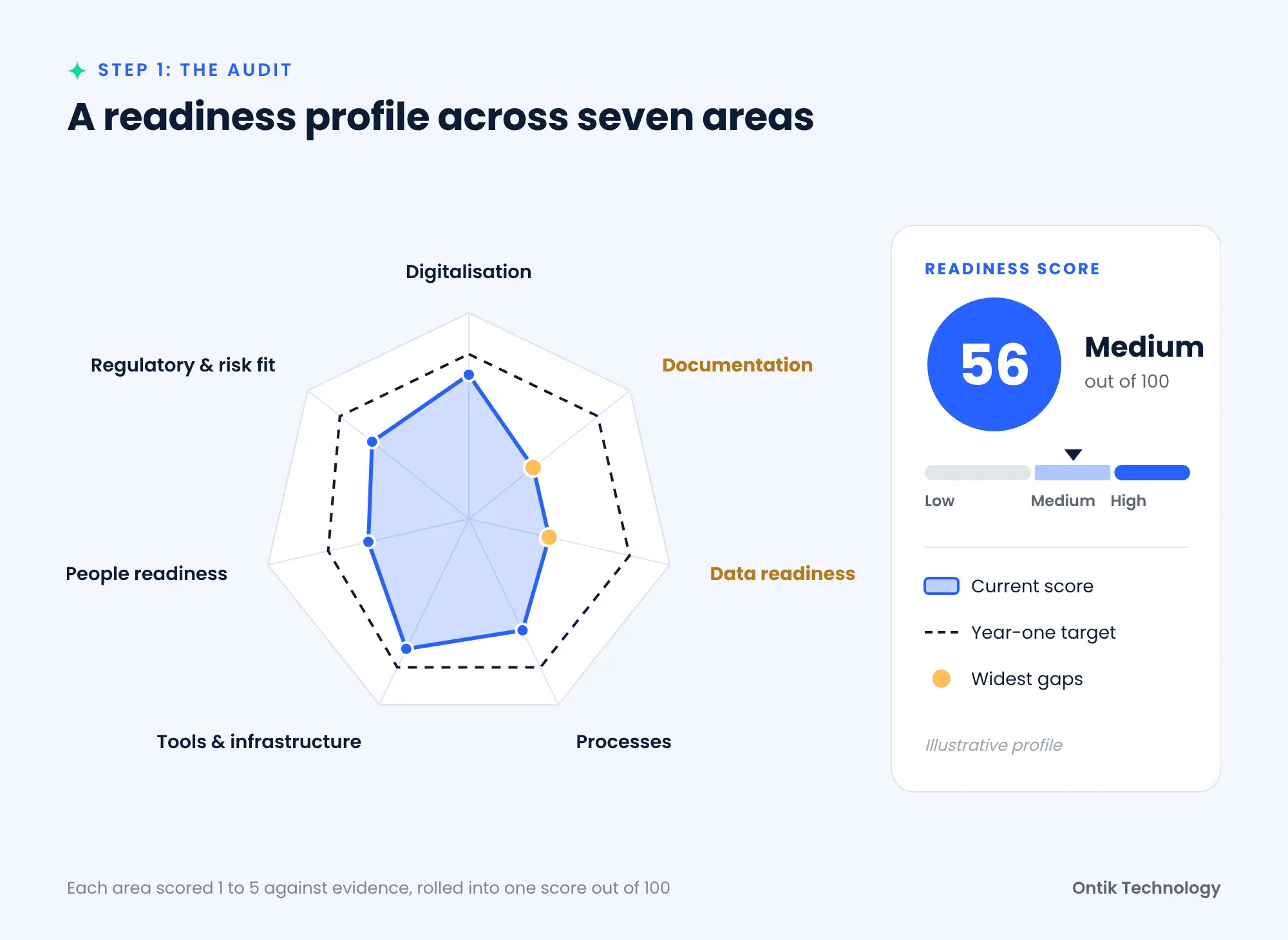
In Bangladesh, two areas decide most outcomes. Data readiness comes first, because operational data is often split across an ERP, personal Excel files, WhatsApp threads and paper registers. Gartner predicts that through 2026, organisations will abandon 60% of AI projects not supported by AI-ready data. Documentation is second. In founder-led businesses, the real process often lives in two or three managers' heads, and nobody can automate a process that has never been written down.
Self-assessment flatters, so a credible audit sets rules opinion cannot get around. In Ontik's readiness audits, an area scores 3 or above only when a supporting document exists, and frontline staff are interviewed without their managers present.
Take a garment manufacturer in Gazipur that asks for "AI in production". The audit finds order data already in the ERP, compliance files assembled by hand and quality checks on paper. Compliance documentation goes first. AI visual inspection, the idea leadership arrived with, moves to year two, because it needs cameras and labelled defect images first.
Step 1 is done when leadership has agreed, in writing, on the first two or three use cases and why they come first.
Step 2: Put Governance in Place Before You Scale
Your staff are already using AI with company data. IBM's 2025 Cost of a Data Breach research found that one in five organisations had a breach caused by shadow AI, meaning tools used without approval.
In Bangladesh this is now a legal question too. The Personal Data Protection Ordinance, 2025 sorts personal data into four classes and, according to Mahbub & Company's summary, requires confidential and restricted data to be stored within Bangladesh, with fines linked to turnover. A sales executive who pastes a customer list into a free overseas AI tool may have moved confidential data out of the country without anyone noticing. The draft National AI Policy 2026 to 2030 adds risk tiers for AI systems. Confirm the current status of both with legal counsel.
A workable AI policy decides six things: which data goes into which tools, which tools are approved, which outputs need human sign-off, who owns each workflow, what gets logged, and what staff do when something goes wrong. The first decision does most of the work.
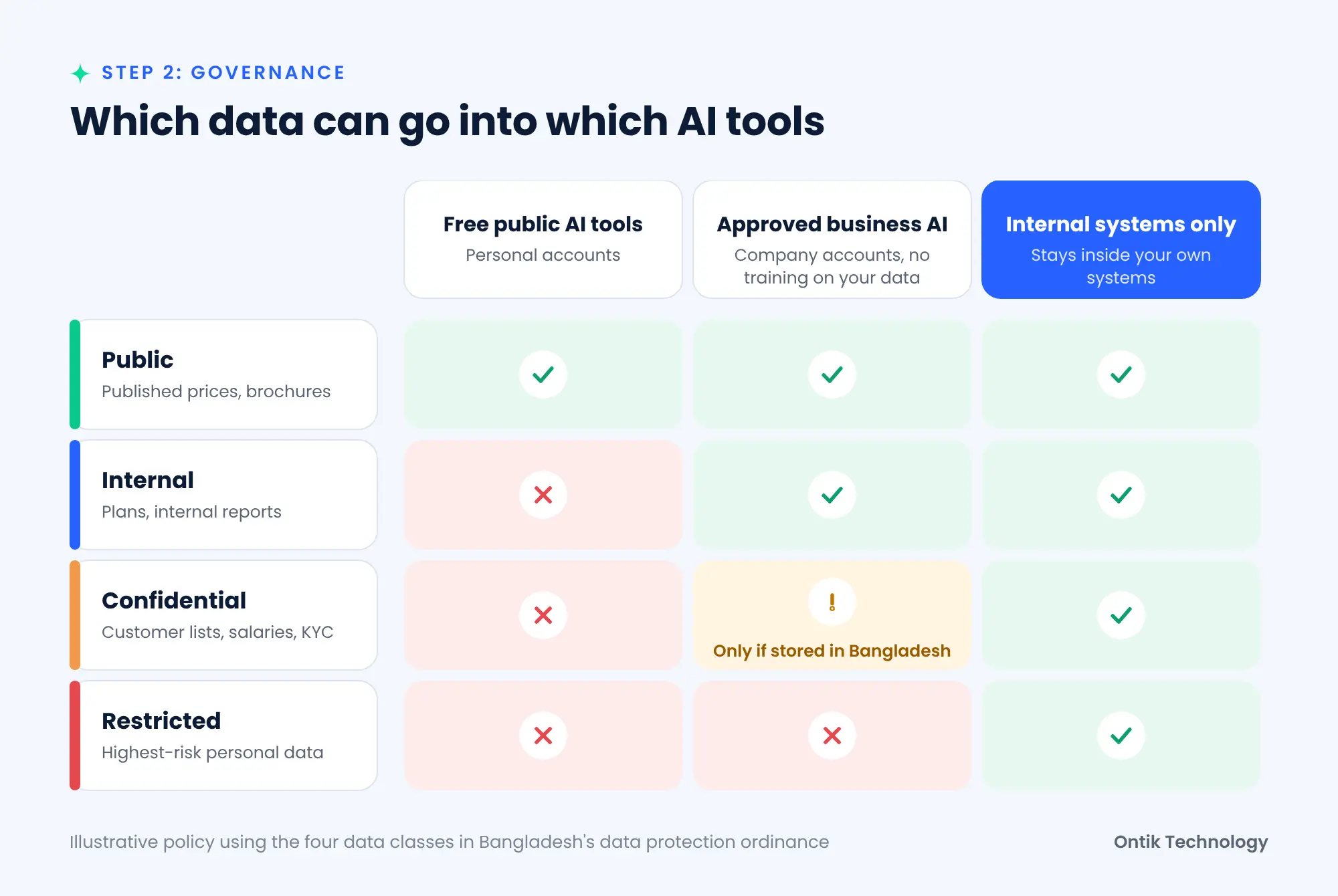
Keep it short. Two pages every loan officer can apply without asking beats forty pages in a shared drive.
Step 2 is done when any employee can answer "can I put this into an AI tool?" without asking their manager.
Step 3: Move AI from Pilot to Daily Workflow
This is where most AI programmes die. The demo impressed the board, the pilot ran for six weeks, and nothing changed. The model is rarely the cause. Pilots stall because they had no business owner, ran on sample data instead of live systems, forced staff to copy data by hand, or never defined success.
Choose the first workflow for volume, clear rules, data that is already digital, an outcome you can measure, and low harm if AI gets it wrong. Resist the most impressive use case. The first workflow exists to prove the company can run AI in production.
Consider a Dhaka online retailer receiving hundreds of Messenger and WhatsApp messages a day, mostly in Bangla and Banglish. An AI agent connected to the order system and courier tracking answers routine questions. Refunds and complaints go to a person with the chat history attached, and an owner reviews three numbers every week.
Step 3 is done when at least one AI workflow runs daily on live data, with a named owner and a metric reviewed weekly.
Step 4: Build the People and Skills to Run AI Yourselves
An AI system that only your vendor understands is a dependency you are paying for. Skilled technical staff in Bangladesh change jobs and move abroad often, so plan for turnover from the first day.
Running AI depends on clear roles more than on data scientists. Every live workflow needs an executive sponsor, a workflow owner, department champions, a technical maintainer and reviewers. Most are part-time responsibilities for people you already employ.
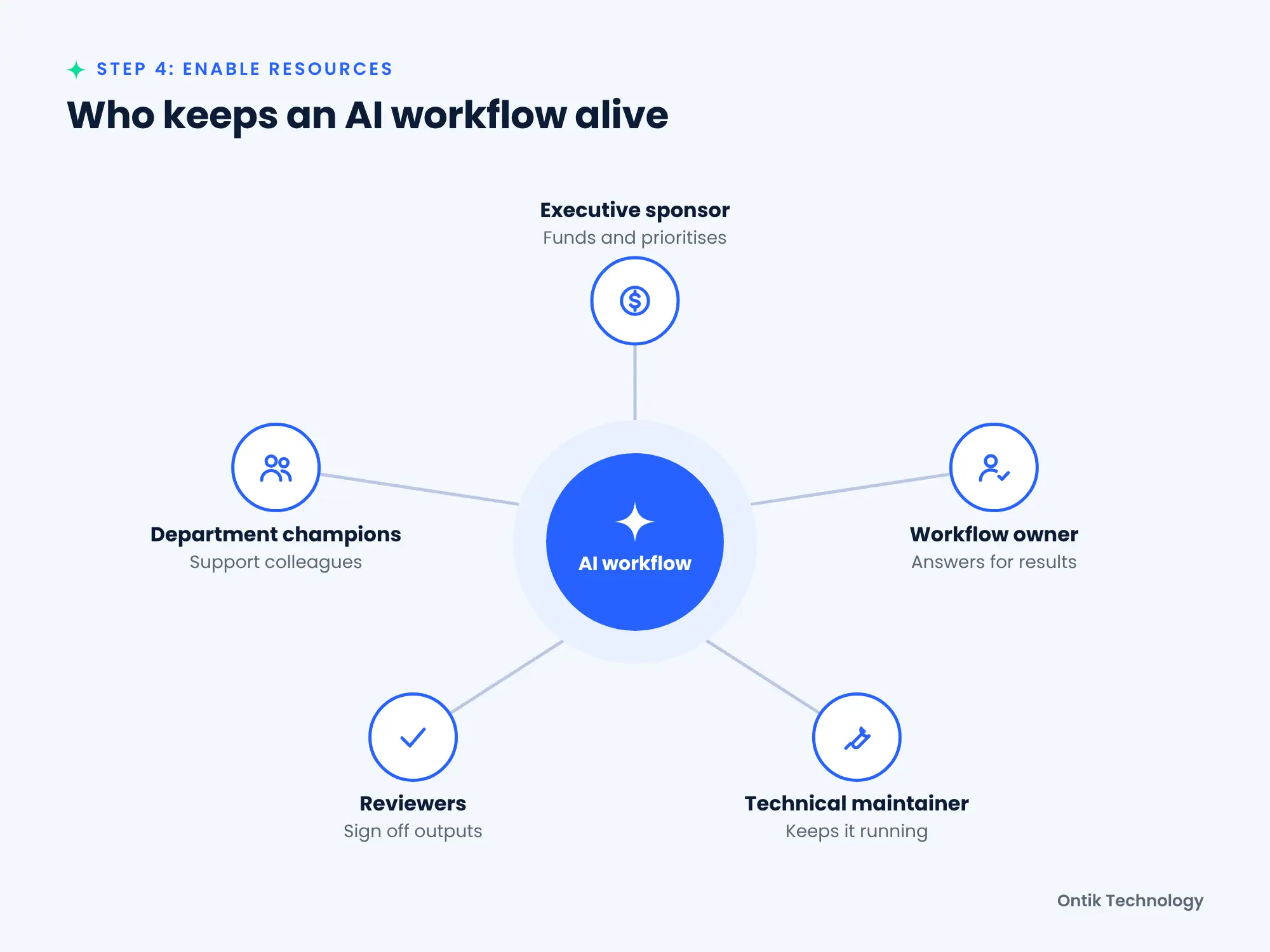
Train by role, not by headcount, and give every workflow a one-page record of what it does, what data it touches and what happens when it fails. Documented systems survive resignations.
Step 4 is done when your AI workflows keep improving while the person who built them is on leave.
Step 5: Redesign Processes Around AI
Steps 1 to 4 make AI work inside the processes you already have. Step 5 rebuilds the processes themselves, so they are designed around AI rather than patched for it.
Patching is the common failure. The tools are new, but the way work flows has not changed: the same handovers, the same approvals, the same waiting. AI speeds up one step and the process around it absorbs the gain.
Take the month-end sales report at a company with branches across the country. In the patched version, staff still collect branch figures by phone and email, compile them in Excel, and then ask AI to write the summary. In the redesigned version, branch systems feed the data directly, AI produces the report every day and flags anything unusual, and the manager reviews the exceptions. Several steps disappear, and decisions happen weekly instead of monthly.
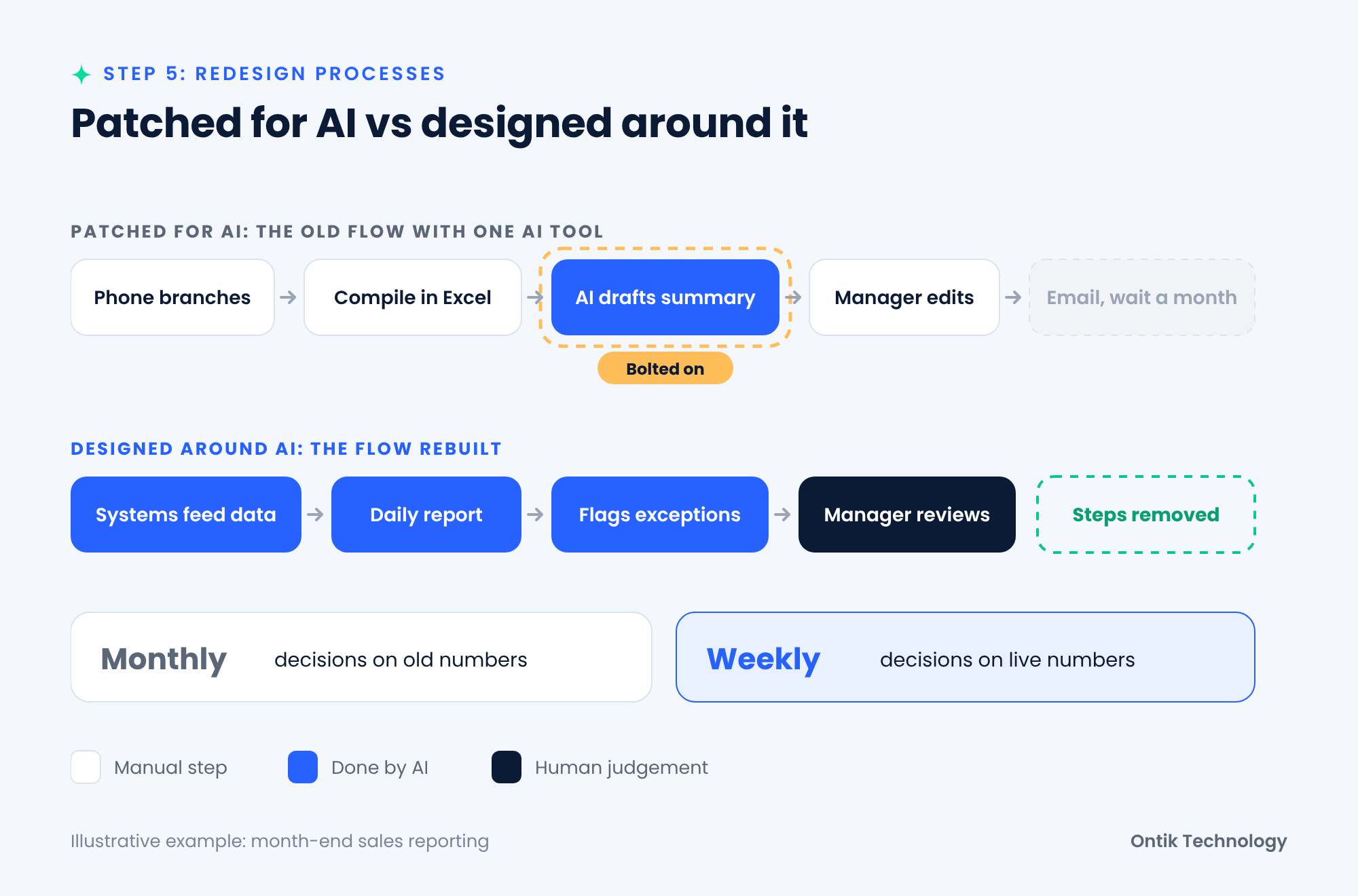
A redesigned process generates new data and exposes the next constraint, which is why Step 5 feeds back into Step 1. Becoming AI-native is an ongoing process, not a finish line.
Step 5 is done when processes are designed around AI, not patched for it.
Where Does Your Company Stand Today?
Go back to the test from the start of this guide. If every AI tool in your company stopped working tomorrow, what would actually stop? For most Bangladeshi businesses, the honest answer is very little.
That is the risk and the opening. Four in five CEOs in PwC's survey are not yet using AI at scale. The companies that build it in now will set the cost base and speed their market has to match. It starts with an honest view of where you stand.
How Ontik Helps You Integrate AI
Ontik's AI consultancy covers all five steps in this guide, from the first audit to systems your team runs on its own. You do not take a consultant's report to a separate vendor and start again.
- AI Audit & Leadership Alignment: an evidence-based readiness audit across the seven areas, a score for each department, use cases ranked by value, and a 90-day and 12-month roadmap your leadership signs off.
- Governance & Policy Design: an AI usage policy, data rules mapped to Bangladesh's data protection law, and a risk register with clear owners.
- AI Automation Implementation: AI agents and automations connected to your ERP, CRM and order systems, working in Bangla and Banglish, with people kept in the loop.
- Enable Resources: role-based training and documentation, so your team runs and improves AI without depending on Ontik.
- Redesign Processes: processes rebuilt around AI, then a re-audit to start the next cycle from a higher baseline.
Ontik is headquartered in Bangladesh with 220+ engineers, so local systems and regulation are everyday work. Every engagement runs under an NDA and a written data-handling policy that names each tool touching your data.
Start with the free 60-second AI-native check to see your stage. Then book a call with our AI Consultants to get the most efficient AI integration process for your business.
AI-native is a metamorphosis, not a makeover. Find out which stage you are in, and let Ontik take the next step with you.