AI App Development in Australia: Features, Costs, Process, and What to Expect
Australian businesses are building smarter. From Brisbane startups to Sydney enterprises, AI powered applications are no longer a luxury. They're the new baseline. And if you're wondering whether now is the right time to build one, the answer is yes, and here's why.
Australia's AI market is on track to hit US$14.53 billion by 2030. That's a 27.75% annual growth rate. Industries from healthcare to mining are embedding AI into their core operations. The businesses investing in AI app development today are the ones setting the pace for everyone else tomorrow.
This guide covers everything you need to know: what AI app development actually involves, which features matter, how much it costs to build an app in Australia, the step by step process, and what to realistically expect along the way.
What Is AI App Development?
AI app development is the process of building mobile or web applications that think, learn, and adapt. Instead of following fixed rules, these apps use data to make decisions, spot patterns, and improve over time.
Think of a customer service app that gets better at answering questions the more it's used. Or a retail app that recommends products based on what a user actually buys, not just what they browse. That's AI at work.
The core technologies behind most AI applications include machine learning, natural language processing, computer vision, and predictive analytics. You don't need all of them. You need the right ones for your use case.
At Ontik Technology, we work with Australian businesses to figure out exactly which AI capabilities will move the needle, and then build them properly.
Why Australia Is the Right Place to Build AI Apps Right Now
Australia is one of the best environments in the world for AI app development. That's not marketing talk. It's backed by data and infrastructure.
AI-related patents in Australia nearly quadrupled between 2015 and 2024. Research publications more than doubled over the same period. The government is actively funding AI innovation through the National Artificial Intelligence Centre. And Australia's strict privacy frameworks make it a trusted destination for AI development, especially for regulated industries.
There are three practical reasons this matters for your business:
Regulatory clarity: Australia's Privacy Act 1988 and the Australian Privacy Principles give AI development a clear legal framework. You know the rules. You can build confidently. And that confidence matters when you're asking users to trust an app with their personal data.
Market access: Australia's position in the Asia Pacific region opens doors to a massive connected market. AI apps built here can scale across the region. That means your investment has a broader commercial ceiling than if you were building for a purely domestic market.
Talent and ecosystem: Australia has a growing pool of AI and machine learning specialists, supported by world-class universities and a maturing tech industry. Sydney, Melbourne, and Brisbane are all active AI development hubs. And the startup culture in cities like Sydney is producing companies that are genuinely pushing the boundaries of what AI powered software can do. For context, you can see what that Sydney startup scene looks like today in this overview of startup companies in Sydney.
If you've been sitting on an AI app idea, the ecosystem around you is ready.
Key Features to Build Into Your AI Application
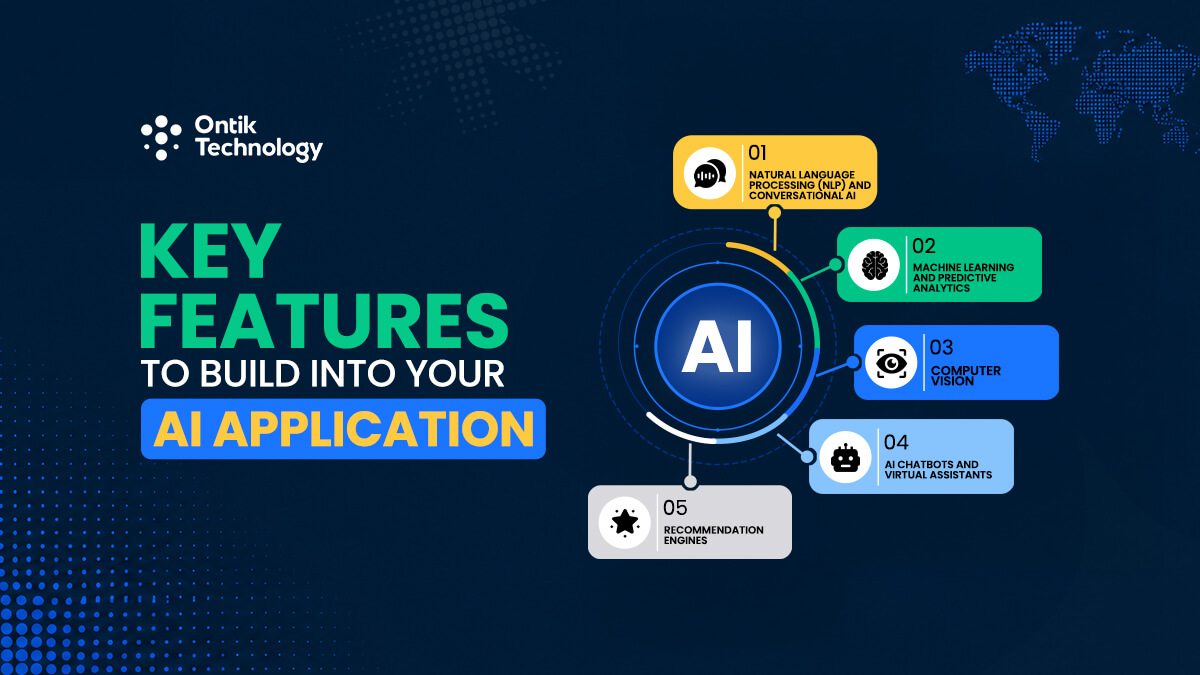
The features your AI app needs depend on what problem it's solving. But some capabilities show up in almost every successful AI application built for the Australian market.
Natural Language Processing (NLP) and Conversational AI
NLP lets your app understand and respond to human language. It's the engine behind chatbots, voice assistants, sentiment analysis tools, and document processing systems.
For Australian apps, NLP models need specific attention. Australian English has its own rhythms, slang, and regional variations. A model trained only on American or British English will miss things. Good NLP development for Australian businesses includes dialect aware training and testing across real user scenarios.
Machine Learning and Predictive Analytics
Machine learning lets your app learn from historical data and make predictions. This is the feature that separates truly intelligent applications from those that just look intelligent.
Predictive analytics is particularly valuable in Australian industries like agriculture, logistics, and finance, where environmental factors and market volatility create complex decisions. A farming app that predicts irrigation needs based on soil data, weather patterns, and crop history is a real world example of ML delivering practical ROI.
Computer Vision
Computer vision gives your app the ability to see and interpret images and video. Australian businesses use it for quality control in manufacturing, medical imaging support, construction site safety monitoring, and agricultural yield assessment.
This is one of the more technically demanding features to build. The model training process requires large labelled datasets and significant computing resources. But for industries where visual inspection is critical, it delivers accuracy and speed that humans simply can't match at scale.
AI Chatbots and Virtual Assistants
An AI chatbot can handle customer queries around the clock, qualify leads, process bookings, and answer internal staff questions without a human lifting a finger. For Australian businesses dealing with high enquiry volumes or after hours support needs, this is often the first AI feature that delivers visible ROI.
A well built chatbot isn't just a scripted FAQ bot. It uses NLP to understand context, remember conversation history, and escalate to a human when it reaches its limits. If you want to see what good chatbot development looks like, check out Ontik Technology's AI and machine learning solutions.
Recommendation Engines
Recommendation systems analyse user behaviour to surface relevant content, products, or actions. They're used in e commerce, EdTech, healthcare, media, and SaaS platforms.
The business case is straightforward. When users see relevant suggestions, they stay longer and convert more. Netflix, Spotify, and Amazon all run on recommendation engines. But you don't need to be a tech giant to build one. Mid-sized Australian businesses are using these systems to personalise experiences at scale.
Cloud Infrastructure and Scalability
Every AI app needs a solid cloud backbone. Without it, you can't store the data your models need, process it at speed, or scale when user numbers grow. Australian AI apps typically run on AWS Sydney, Azure Australia East, or Google Cloud Platform.
Ontik Technology's cloud solutions team designs infrastructure that scales with your application, so you're not rebuilding everything six months after launch.
Security, Privacy, and Compliance
Security isn't a feature you add at the end. It's built into the architecture from day one. Australian AI apps must comply with the Privacy Act 1988, the Australian Privacy Principles, and relevant industry regulations like APRA for finance and the My Health Records Act for healthcare.
Key security features include end to end encryption, role based access control, audit logging, and secure model inference. If your app handles sensitive data, budget for a dedicated compliance review as part of the development process.
How Much Does It Cost to Develop an AI App in Australia?
The cost to build an AI app in Australia ranges from AUD $15,000 to $300,000 or more, depending on complexity, features, team location, and timeline. There's no single number that fits every project, but the tables below give you a solid starting point.
AI App Development Cost by Complexity (AUD, 2026)
AI App Development Cost by Feature Type (AUD)
Hourly Rate Comparison: Where Your Development Team Is Based
Team location is one of the biggest levers in your total app development cost. Here's how rates compare:
Many Australian businesses use a hybrid model. They work with a local AI development company for strategy and oversight while using offshore developers for execution. This keeps quality high without blowing the budget. Ontik Technology's dedicated development team model is built exactly for this kind of setup.
Ongoing Costs After Launch
Your app development cost doesn't stop at go-live. AI apps have real ongoing expenses:
- Cloud infrastructure: $200 - $2,000+ per month
- Model retraining and maintenance: $500 - $5,000 per month
- Security auditing: $1,000 - $5,000 per cycle
- API and platform licensing: varies by provider
Budget roughly 15 to 20 percent of your initial build cost annually for maintenance and operations. It's not optional. It's part of running a reliable AI application.
The AI App Development Process: Step by Step
Building an AI app isn't like building a standard mobile app. The process is more iterative, more data dependent, and more collaborative. Here's what it actually looks like when done well.
Step 1: Discovery and Strategy (2 to 4 Weeks)
Every AI project starts with a discovery phase. This is where you and your development team get on the same page. You define business goals, map user journeys, assess technical feasibility, and review what data you have available.
This phase typically costs $5,000 to $15,000 AUD, but it saves far more in avoided rework down the line. Businesses that skip discovery almost always pay for it later with scope creep, budget overruns, or a product that solves the wrong problem.
At Ontik Technology, our development process starts here, because getting the strategy right is what makes everything else work.
Step 2: Data Strategy and Preparation (2 to 6 Weeks)
AI is only as good as the data it learns from. Before any model is built, your team needs to identify data sources, assess data quality, design storage pipelines, and handle privacy and anonymisation requirements.
This step often takes longer than clients expect. And it should. Poor data is the single biggest reason AI projects fail in Australia. It can consume 20 to 30 percent of the total project budget, but it determines everything that follows.
If your business doesn't have enough historical data to train a model, don't panic. Options include synthetic data generation, open datasets, or starting with a rules based system that collects training data over time.
One thing worth knowing: businesses that treat data strategy as a standalone discipline, separate from app development, tend to get better results. It forces the right conversations early. What data do we actually have? Is it accurate? Is it complete? Is it legal to use it? These aren't technical questions. They're business questions. And answering them before development starts is what separates successful AI projects from expensive ones.
Step 3: UI/UX Design (3 to 6 Weeks)
AI apps need specialised UX thinking. When the app makes a decision or a recommendation, users need to understand why. Transparency builds trust. Confusion kills adoption.
Your design team will produce wireframes, interactive prototypes, and conversation flow designs for any chatbot or voice features. They'll also design for edge cases: what happens when the AI gets it wrong? What does the user see? How do they correct it?
For public facing Australian apps, WCAG 2.1 AA accessibility compliance is best practice. Government and healthcare apps may require it by law. Ontik Technology's UI/UX design consultants build these considerations into the design process from the start, not as an afterthought.
Step 4: Development and Integration (8 to 20 Weeks)
This is where the bulk of your mobile app development cost is spent. The development phase includes building and training ML models, developing backend APIs, writing frontend application code, and integrating with third party systems.
Common AI frameworks used in Australian development include TensorFlow, PyTorch, and Hugging Face. Third party AI services like OpenAI, Google Cloud Vision, and AWS Rekognition are often integrated where they reduce cost and speed up delivery.
Your app also needs integration with existing business systems. That might be a CRM, an ERP, a payment gateway, or a government data API. Each integration adds development and testing time.
For businesses that want to start small and validate before scaling, MVP development is the smart path. You build the core AI feature, test it with real users, and expand based on what you learn. You can also read more about AI MVP development to understand how this approach works in practice.
Step 5: Testing and Quality Assurance (2 to 4 Weeks)
Testing an AI app is more complex than testing a standard application. You're not just checking that buttons work. You're validating that the model makes accurate, fair, and consistent decisions.
Testing covers two layers. Functional testing checks that the app works as specified. Model testing evaluates accuracy, bias, robustness, and performance under real world conditions. This includes confusion matrix analysis, A/B testing of model variants, and load testing for scalability.
Bias testing deserves special attention. Australia's ethical AI guidelines are clear. A model that discriminates based on gender, location, or demographic group creates legal and reputational risk. Build bias audits into your QA process.
Step 6: Deployment and Launch (1 to 2 Weeks)
Deployment moves your application from staging to production. For Australian AI apps, this typically means deploying to cloud infrastructure in an Australian data region, configuring monitoring dashboards, setting up auto-scaling, and submitting to the App Store or Google Play.
A soft launch with a small group of real users is often smarter than a full public release. It gives you real world feedback before you're at scale. Problems found at this stage are far cheaper to fix than problems found after a major public launch.
Step 7: Ongoing Maintenance and Optimisation (Continuous)
AI apps don't run themselves. Models degrade over time as real world data patterns change. This is called model drift, and it's one of the most common reasons AI apps quietly start performing worse months after launch.
Post launch maintenance includes monthly model retraining, performance monitoring, bug fixes, security patching, and feature updates based on user feedback. Plan for this from the beginning. Budget 15 to 20 percent of your initial development cost per year for ongoing operations.
If you're not sure whether to hire a full-time team or work with an external partner, Ontik Technology's team augmentation model gives you experienced AI specialists on demand without the overhead of permanent hires.
Top 8 AI App Development Companies in Australia
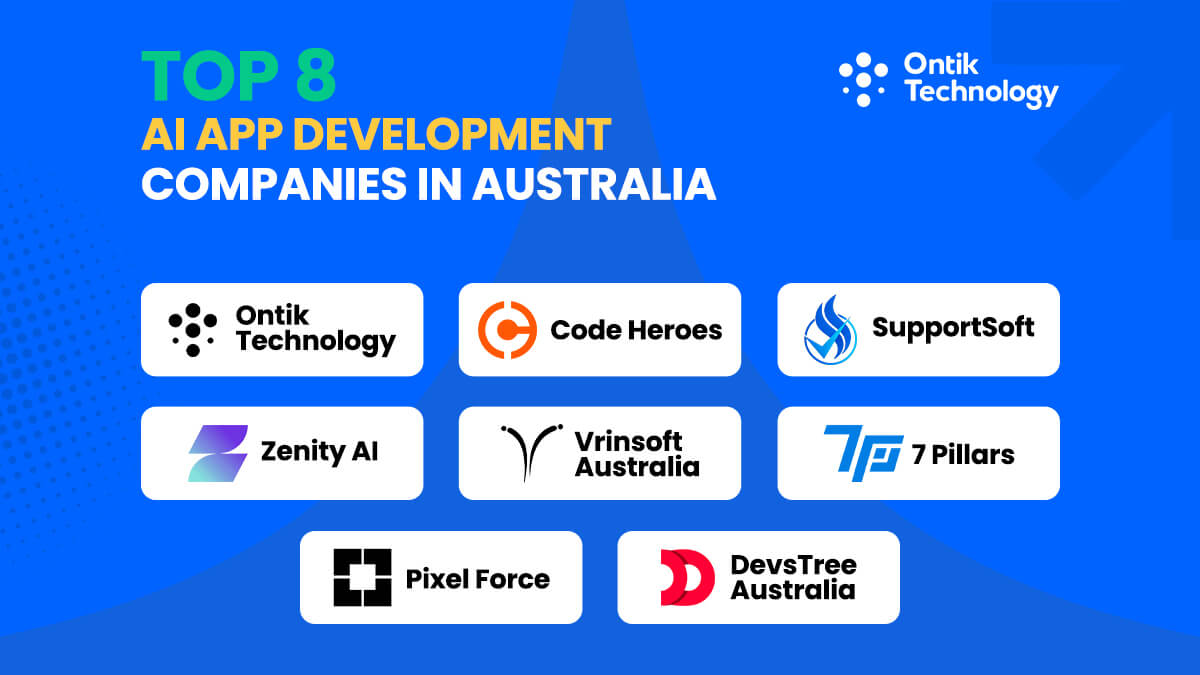
Choosing the right development partner changes everything. Here are eight Australian AI app development companies worth knowing.
1. Ontik Technology
Ontik Technology is a full-service AI and software development company working with Australian businesses across healthcare, fintech, logistics, and e commerce.
Their team covers the full stack: AI and machine learning, mobile app development, cloud infrastructure, and UI/UX design.
They specialise in building practical AI solutions that solve real business problems, not just impressive demos. Their custom software development service is particularly well suited for businesses with unique requirements that off the shelf tools can't handle.
2. Code Heroes
Code Heroes is an Australian AI app developer focused on business-ready intelligent applications. They serve clients in retail, finance, and professional services, combining solid software engineering with applied ML expertise.
3. SupportSoft
SupportSoft specialises in AI automation, chatbot development, and process intelligence. They're a strong choice for SMEs that want AI features integrated with existing tools like CRMs and ERPs without a full rebuild.
4. Zenity AI
Zenity AI focuses on conversational AI, autonomous agent development, and generative AI workflows. They're one of the more forward-looking options if you're exploring LLM-based or agent-driven applications.
5. Vrinsoft Australia
Vrinsoft brings global AI and mobile development experience to the Australian market. They offer ML model training, computer vision, and enterprise integration across a range of industries.
6. 7 Pillars
7 Pillars combines design thinking with AI engineering. They work primarily in health, wellness, and education, with a strong emphasis on ethical and user centred AI products.
7. Pixel Force
Pixel Force is one of Australia's most recognised app development studios. Their portfolio includes AI enhanced consumer apps and enterprise platforms for ASX listed companies and government clients.
8. DevsTree Australia
DevsTree is a technically strong option for complex AI projects. Their team covers ML, computer vision, NLP, and full-stack development, with clear project management processes and transparent pricing.
What Drives AI App Development Costs Up (and Down)
If you want to control your app development cost, you need to understand what moves the number in each direction.
Complexity of AI models. Custom ML models trained on your own data cost significantly more than integrating a pre built API. A bespoke NLP model for legal document analysis is a very different project from deploying a standard chatbot.
Data readiness. Clean, well labelled data is cheaper to work with. Messy, incomplete, or unstructured data needs more preparation time. More preparation time means higher cost.
Platform coverage. Building for iOS only costs less than iOS plus Android. Adding a web version increases cost further. Be clear upfront about which platforms your users are actually on.
Third-party integrations. Each integration with an external system adds development and testing time. Ten integrations cost more than two. Prioritise the ones that matter most for your MVP.
Team model. Hiring remote developers or working with an offshore augmented team can significantly reduce your app making charges without sacrificing quality, provided the engagement is managed well. You can read more about how different team models compare in Ontik's guide on staff augmentation vs consulting. And if you're evaluating whether augmentation is the right model for your team specifically, this breakdown of the benefits of IT staff augmentation is worth a read before you decide.
Timeline pressure. Shorter timelines require bigger teams working in parallel. That increases the mobile app creation cost. If budget is tight, a longer timeline often means a lower overall spend. And a more considered build usually means fewer post launch problems, which saves money in a different way.
Industries Driving AI App Adoption in Australia
AI app development in Australia isn't limited to tech companies. The strongest adoption is happening in sectors you might not expect.
Healthcare. AI apps for telehealth triage, diagnostic support, and patient engagement are growing rapidly. Compliance requirements add to the cost of app development here, but the ROI on reducing administrative burden is significant.
Agriculture. Precision farming apps that monitor soil conditions, predict irrigation needs, and assess crop health are addressing real economic challenges for Australian farmers. This sector is one of the world's most active AI adopters.
Finance and fintech. Fraud detection, credit risk modelling, and robo advisory platforms are standard in Australian fintech. The regulatory environment is strict, but the business case is clear.
Mining and resources. Sixty percent of Australian mines are preparing to adopt AI by 2025. Predictive maintenance, equipment monitoring, and worker safety applications are the primary use cases.
Retail and e commerce. Personalised recommendations, demand forecasting, and AI customer support are already standard for mid to large Australian retailers.
Legal and professional services. Document review, contract analysis, and compliance automation are growing fast in Sydney and Melbourne law firms. Business intelligence and analytics solutions are often the entry point for firms in this space.
What to Realistically Expect When Building an AI App
Developing an AI application requires a fundamental departure from standard mobile app creation. You must transition from deterministic logic, where specific inputs yield fixed outcomes, toward a probabilistic model where systems learn and adapt over time. Expect several significant strategic shifts throughout this development process.
It takes longer than you think- Development timelines are influenced by the complexity of the models and the state of your data. While a basic chatbot can be delivered in 2 to 3 months, a custom ML platform for an enterprise can take 9 to 18 months from discovery to launch. This includes time for data preparation, which alone can consume 20 to 30 percent of the project budget. Plan your roadmap accordingly to avoid premature launch pressure.
Iteration is part of the process- AI projects are experimental by nature. You won't get the model right on the first try, as performance depends on continuous tuning and refinement. Expect multiple rounds of testing for accuracy, bias, and robustness under real-world conditions. This iterative cycle is not a sign of failure; it is the fundamental way high-quality AI is built to ensure consistent decisions.
Data is your most important asset- The performance of your AI application is directly tied to the quality of the data it learns from. Businesses that invest in a robust data strategy early, identifying sources, ensuring accuracy, and handling anonymization saves significant time and money during development. Poor data is the primary reason many AI projects fail, so prioritizing clean, well-labeled data is essential.
You need a cross-functional team- Successful AI projects require more than just coders; they demand a blend of ML engineers, data scientists, backend developers, UX designers, and business analysts working in sync. If you are working with a dedicated development team, ensure they possess these specific specializations to handle both the technical model training and the user experience requirements.
ROI comes, but it takes time- Most AI applications demonstrate a meaningful return on investment within 12 to 24 months of launch. Initial KPIs should not focus solely on revenue but on adoption rates, model accuracy, and efficiency gains. Once these foundational metrics are solid, business revenue and long-term scalability usually follow.
Ongoing maintenance is mandatory- AI apps do not run themselves after deployment. Models can degrade over time due to "model drift" as real-world data patterns evolve. Budget roughly 15 to 20 percent of your initial build cost annually for continuous model retraining, performance monitoring, and security patching to keep the application reliable.
How to Choose the Right AI App Development Partner in Australia
The partner you choose matters as much as the technology you build. Here's what to look for when evaluating Australian AI development companies.
Look for a genuine portfolio. Ask to see past AI projects with real outcomes, not just screenshots. If they can't tell you what the app achieved, that's a red flag.
Check for domain experience. A company that has built healthcare AI understands compliance requirements you won't have to explain from scratch. Industry knowledge speeds things up and reduces risk.
Ask about post launch support. Many agencies disappear after delivery. You need a partner who will retrain your models, monitor performance, and keep the app running reliably.
Understand their team model. Are they building your app locally, offshore, or with a hybrid team? There's no wrong answer, but you deserve to know. Ontik Technology is transparent about this. You can see exactly how they work on their our process page.
Talk to their past clients. References matter. A reputable AI development company in Australia will connect you with previous clients without hesitation.
Ready to Build Your AI App?
Australia's AI ecosystem is ready. The infrastructure, talent, and regulatory clarity are all in place. The businesses building AI applications today are setting themselves up for the next five years.
Whether you're starting with an AI chatbot, a recommendation engine, or a full custom ML platform, the path forward starts with a conversation.
Ontik Technology works with Australian businesses of all sizes to design, build, and launch AI-powered applications that deliver real results. Explore their mobile app development and AI and machine learning solutions, or reach out to talk through your project.
Your AI app starts with one question: what problem do you want it to solve? Start there, and everything else follows.
Build Your AI App
Connect with Australian AI experts to build scalable, high-performing AI apps faster.