Rise of AI Product Engineering: Services, Lifecycle, Business Value, and Future Outlook

Services related to product engineering are no longer considered to be back-office functions. They have evolved into the driving force behind how businesses construct, ship, and scale intelligent goods in a world that never stops moving.
It is anticipated that the global market for product engineering services would increase from more than $1.39 trillion in 2025 to more than $2.3 trillion by the year 2033 with this growth. Simply said, that is not a number.
It is a sign that companies all over the world are moving away from purchasing information technology services and instead starting to invest in continual product creation.
It is no longer optional to have a concept of how product engineering operates whether you are in the process of developing software, scaling a software as a service platform, or changing a legacy system. It is the cornerstone of maintaining one's competitive edge.
What Is Product Engineering? (And Why It's Not Just Software Development)
Product engineering is the end-to-end practice of designing, building, and continuously evolving a product, combining technical depth with a sharp focus on real user problems. It's not just writing code. It's thinking about why the product exists, who it serves, and how it should grow over time.
A product engineer sits at the crossroads of engineering, design, and product strategy. They don't just complete tasks handed to them. They take ownership of outcomes. If a feature isn't adopted by users, that's their problem too, not just the product manager's.
What Does a Product Engineer Do?
A product engineer designs, develops, and refines products by combining technical skills with an understanding of business goals and user needs. In practice, that means:
- Prototyping new features and validating them with real users
- Collaborating with designers and PMs from day one, not at the handoff stage
- Troubleshooting performance issues before customers report them
- Making architecture decisions that serve the product's future, not just the current sprint
Product Engineering vs. Traditional Software Development
The conventional method of developing software is based on projects. You are finished after you have received a specification, build it, and deliver it. The process of product engineering is distinct. This approach considers software to be a living product that must be regularly adapted to client data, changes in the market, and new technological developments.
Take this into consideration. A bridge to the specification is constructed by a development team. A product engineering team will enquire as to whether the bridge is heading in the appropriate direction, will make adjustments to the design based on the patterns of traffic, and will install intelligent sensors once the bridge has been launched in order to monitor load. The same mechanical talent, but a radically different cognitive approach.
The significance of this distinction is considerably greater in the field of software product engineering. It is not enough for engineers to comprehend the product's technical architecture; they must also be familiar with the product's business model. They are not only involved in delivery, but also in the discovery and validation processes.
What Are Engineered Products?
Engineered products are solutions built through structured design, development, and testing processes to meet specific user or market needs. In the software world, these include SaaS platforms, mobile applications, IoT systems, embedded software, and AI-powered tools. The defining trait is intentionality: every component exists to serve a purpose, and that purpose is tied to measurable outcomes.
The Core Product Engineering Services Landscape
The product engineering services market covers a wide range of capabilities, and understanding what falls under this umbrella helps you make smarter decisions about where to invest.
Here's how the core service areas break down:
Software Product Engineering vs. Hardware Engineering
Software product engineering focuses on applications, platforms, and digital systems. Hardware engineering deals with physical devices, chips, and embedded systems. In practice, most modern products blur this line. A smart device needs both great firmware and a great app. That's why the best product engineering solutions treat software and hardware as a single, connected system.
Digital Product Engineering
Digital product engineering applies product thinking specifically to software-based products. It combines cloud infrastructure, agile delivery, and continuous feedback loops to build products that evolve with their users. This is what most technology companies mean today when they talk about product engineering.
Custom, SaaS, and Enterprise Product Engineering
Not every business needs the same approach:
- Custom product engineering builds tailored solutions for unique business problems, rather than adapting off-the-shelf tools.
- SaaS product engineering focuses on multi-tenant architecture, continuous delivery, and subscription-model alignment where every deployment affects all users.
- Enterprise product engineering adds layers of compliance, legacy system integration, and organizational scale to the equation.
Agile Product Engineering Services
Agile product engineering services structure the entire development process around short, iterative cycles. Cross-functional teams, daily feedback, and frequent releases replace the old waterfall model. The result is faster course correction and products that actually reflect what users need, not what was assumed months ago during planning.
Product Engineering Lifecycle: From Concept to Market

The product engineering lifecycle is a structured, six-stage process that takes a product from raw idea to market-ready solution, and then keeps it evolving. It goes well beyond development. Each stage builds on the last, and skipping any one of them is where most product failures begin.
Stage 1: Ideation and Conceptualization
Before moving on to any potential solutions, this is the stage where you characterise the problem. Clarification of the product concept, validation of the market need, and evaluation of the technical feasibility are the goals of this project. Interviews with customers are conducted, consumer pain spots are mapped, and the teams determine what success actually looks like.
In this context, a common error is to rush to wireframes before first establishing whether or not the problem is indeed present. A discovery period of two weeks can save you six months of time spent constructing something that is not what you want.
Stage 2: Requirements and Product Design and Engineering
Here, user needs get translated into detailed technical specifications. This includes architecture decisions, UI/UX design, and data models. UI/UX design isn't cosmetic at this stage. It's a core engineering input. The design determines how users interact with every technical decision made downstream.
This is also where you define what "done" looks like for version one, and what's explicitly out of scope.
Stage 3: Prototyping and Development
Teams build a functional prototype first, then iterate toward the full product. This approach surfaces problems early, when fixes are cheap. Development in this stage follows short cycles with regular demos and real user feedback built into the rhythm, not bolted on at the end.
For teams working on mobile app development or web platforms, this stage often involves parallel workstreams across frontend, backend, and API layers.
Stage 4: Validation, QA and Product Engineering Testing
Product engineering testing goes beyond finding bugs. It includes performance testing under realistic load, security auditing, accessibility checks, and user acceptance testing. The goal is to validate that the product behaves correctly AND that it solves the problem it was built for.
Simulation and digital twin environments are increasingly used here to test products before physical or large-scale deployment.
Stage 5: Deployment and Launch
Within the realm of contemporary product engineering, deployment is not a one-day affair. The process is meticulously managed through the utilisation of CI/CD pipelines, feature flags, and staged rollouts. By doing so, teams are able to limit risk and have the ability to immediately pull back in the event that something breaks during production.
Documentation, verification of compliance, and alignment with the go-to-market process all take place simultaneously.
Stage 6: Support, Evolution and Product Modernization
The product doesn't stop after launch. This stage covers performance monitoring, user feedback analysis, bug fixes, and feature iteration. It also includes product modernization, which means updating architecture, migrating to cloud-native infrastructure, or rebuilding parts of the system as the product scales.
The best product engineering teams treat post-launch as the most important stage, because that's where the real user data lives.
Key Practices and Technologies Powering Modern Product Engineering
The practices below aren't trendy extras. They're the operational backbone of any high-performing product engineering team in 2025 and beyond.
Agile Product Engineering Services: Iterative Cycles and Cross-Functional Teams
Agile isn't just a methodology. In product engineering, it's the structural foundation that keeps teams aligned and shipping. Two-week sprints, continuous backlog refinement, and cross-functional ownership replace the old handoff culture. Engineers, designers, and product managers work in the same room, or at least the same sprint.
DevOps in Product Engineering: CI/CD and Continuous Delivery
DevOps connects development and operations into a single, continuous flow. Automated testing, continuous integration, and continuous delivery pipelines mean that code can go from a developer's laptop to production in hours, not weeks. This speed matters because it shortens the feedback loop between what you build and what users actually experience.
Cloud-Native Product Engineering: Scalable Infrastructure
Cloud-native engineering builds products designed to run on cloud infrastructure from the start, rather than lifted-and-shifted from on-premise systems. Cloud solutions built this way are more resilient, easier to scale, and significantly cheaper to maintain at volume. Microservices, containerization, and serverless functions are the standard toolkit.
AI Product Engineering: Generative AI, Predictive Analytics, and AI-Native Design
AI product engineering is the fastest-growing segment of this market. 80% of engineering workforce will need to upskill for generative AI by 2027.
This includes generative AI tools that automate repetitive coding tasks, predictive analytics built into product features, and AI and machine learning capabilities embedded into the product architecture itself, not added later as an afterthought.
Agentic AI is also emerging as middleware for complex workflows, handling tasks that used to require human coordination across systems.
Data, Telemetry and Observability: Measuring What Matters
You can't improve what you can't see. Modern product engineering teams instrument their products from day one with telemetry: event tracking, error logging, performance metrics, and user behavior signals. Business intelligence and analytics tools then turn that raw data into decisions. This is how teams know which features to build next and which ones to cut.
Business Value of Product Engineering Services
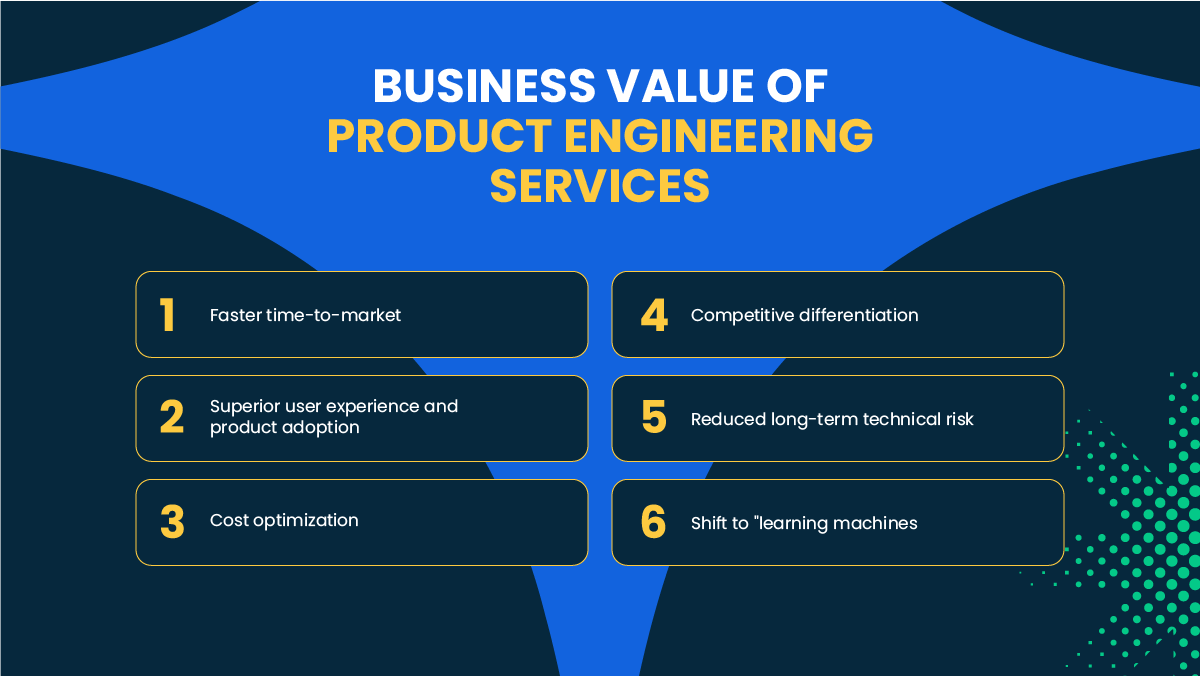
Investing in product engineering services delivers measurable business outcomes, not just better code. Here's where the real value shows up.
Faster time-to-market: Specialized engineering teams remove the learning curve. They've already solved the infrastructure problems, established the workflows, and built the toolchain. You ship faster because you're not starting from zero. For context, a startup working with an experienced product engineering partner can compress a typical three-month build into six weeks, without cutting corners on quality.
Superior user experience and product adoption: Products built with continuous user feedback built into the process are more intuitive. And more intuitive products get adopted. It's that simple. A product that users actually love doesn't need a massive marketing budget to grow. User experience isn't a final coat of paint. In product engineering, it's baked into every decision from the architecture stage forward.
Cost optimization: This one surprises people. Outsourcing or partnering with a product engineering firm often reduces total R&D costs because you avoid the overhead of hiring, training, and retaining specialized talent for capabilities you need intermittently. You pay for outcomes, not headcount. A fully loaded senior engineer costs between $150,000 and $250,000 per year in most Western markets, plus benefits, management overhead, and ramp time. Partnering with a specialized team can deliver the same output for a fraction of the total cost when structured well.
Competitive differentiation: Smart, connected, software-defined products stand out in crowded markets. A company that ships a product with embedded AI and real-time analytics beats a competitor shipping static software every time. The product itself becomes the differentiator, not just the price or the brand.
Reduced long-term technical risk: Products built with a product engineering mindset are designed for change. The architecture is modular, the codebase is tested, and the team has observability in place. That means less accumulation of technical debt, and fewer expensive rewrites eighteen months down the line.
The shift to "learning machines": The most forward-thinking companies no longer think of their products as things you sell. They think of them as systems that continuously learn from customer data. Every interaction becomes a signal. Every signal improves the product. That feedback loop is what product engineering is built to create and maintain. Companies that make this shift don't just build better products. They build products that get better by themselves over time.
Product Engineering for Different Business Contexts
Product engineering looks different depending on the size, stage, and goals of your business. Here's how to think about it across four common contexts.
Product Engineering for Startups: MVP, Speed, and Lean Teams
For startups, product engineering is about validating fast and wasting nothing. The priority is getting a working MVP to market quickly, learning from real users, and iterating before the runway runs out. Lean cross-functional teams, rapid prototyping, and ruthless scope management are the tools of the trade. You're not building for scale yet. You're building for learning.
Enterprise Product Engineering: Scale, Compliance, and Modernization
Enterprises face a different set of problems. Their challenge is often modernizing legacy systems while keeping existing operations running, managing compliance across markets, and coordinating engineering across large, distributed teams. Product engineering at this scale requires strong governance, integration expertise, and a long-term architectural vision.
SaaS Product Engineering: Continuous Delivery and Subscription Model Alignment
SaaS products live and die by retention. Product engineering for SaaS means continuous delivery, because users expect new features regularly. It means robust multi-tenant architecture, because one bug affects all customers. And it means aligning every engineering decision with the subscription model: reduce churn, increase activation, and shorten time-to-value.
In-House vs. Product Engineering Consulting and Outsourcing
Building an in-house product engineering team gives you control and deep product context. But it's slow to build and expensive to maintain. Working with a dedicated development team or product engineering consulting partner gives you speed, specialized expertise, and flexibility. The right choice depends on your stage, budget, and how central engineering is to your core business model.
For many companies, a hybrid model works best: an in-house team owns the product vision and architecture, while an external partner handles execution capacity and specialized capability.
Signs you're ready to partner externally include: your in-house team is bottlenecked on delivery, you need a capability you don't have (AI integration, embedded systems, mobile), or you need to move faster than your current hiring pipeline allows. The key is finding a partner who acts as an extension of your team, not a vendor who delivers tickets. Check how they handle staff augmentation vs. consulting models before you commit, because the engagement structure shapes the outcome as much as the technical work does.
Common Mistakes and Pitfalls in Product Engineering
Even experienced teams make these mistakes. Knowing them upfront is the only way to avoid them.
Unclear success metrics: If your team can't answer "how will we know this feature worked?", you're building on guesswork. Define measurable outcomes before you write a single line of code.
Premature architectural complexity: Building for a million users when you have a hundred is a classic trap. Over-engineering early burns time, adds debt, and often produces architecture that doesn't even fit the product's actual direction once you learn more from users.
Siloed teams: When engineering, design, and product management work in separate lanes with handoffs between them, things break down. Context gets lost. Features get built that technically work but don't solve the real problem. Cross-functional collaboration from day one isn't a nice-to-have.
Neglecting post-launch operations and observability: Shipping is not the finish line. Teams that treat deployment as the end of the job are the ones who get caught off guard by production failures, performance degradation, and user drop-off they didn't see coming.
Skipping MVP validation: Jumping straight from idea to full build without a structured validation phase is where most product failures start. An MVP isn't a cheap version of the product.
It's a learning tool designed to answer specific questions about your assumptions before you invest heavily in answers. Many teams confuse "moving fast" with "skipping validation." They're not the same thing. Moving fast with unvalidated assumptions just means you reach the wrong destination sooner.
Treating engineering and product as separate departments: This is a cultural problem as much as a structural one. When product managers write requirements and hand them over to engineering, critical context gets lost.
Engineers who don't understand the "why" behind a feature make different decisions than those who do. Getting engineers into customer conversations early, even just listening to a few user interviews, meaningfully changes the quality of technical decisions made throughout the build.
How to Measure Success in Product Engineering
Success in product engineering is measurable, and you should be tracking it at two levels: engineering health and business outcomes.
Engineering metrics to watch:
- Cycle time: How long does it take from starting a feature to shipping it? Shorter cycles mean faster learning.
- Deployment frequency: High-performing teams deploy multiple times per day. It's a signal of healthy CI/CD and team confidence.
- Change failure rate: What percentage of deployments cause a problem in production? This measures engineering quality, not just speed.
- Mean time to recovery: When something breaks, how fast do you fix it?
Product and business metrics that matter:
- Feature adoption rate: Are users actually using what you built?
- Customer retention and churn: Is the product worth coming back to?
- Net Promoter Score: Do users recommend it?
- Time-to-value: How quickly does a new user get their first meaningful outcome from the product?
Product engineering testing benchmarks are also worth tracking. Teams with strong QA practices show lower defect escape rates (bugs that reach production) and shorter regression cycles. These aren't vanity metrics. They directly affect how fast you can ship with confidence.
The connection between these numbers and revenue is direct. Faster cycle times mean faster response to market changes. Higher adoption rates mean better retention. Better retention means lower customer acquisition cost. Product engineering metrics and business outcomes are the same conversation.
One statistic that is frequently disregarded is the product engineering testing quality score, which corresponds to the proportion of important paths that are covered by automated tests. It is more common for teams who have a high test coverage to deploy with greater confidence and more frequently.
Teams that have low coverage generally deploy slowly and cautiously because they perceive each release as a potential risk. The development of a robust testing culture at an early stage is not a desirable extra. Simply said, it is what allows speed to be maintained throughout time.
If you are unsure of where to begin with measurement, try selecting one metric from each of the categories listed above and putting it on a dashboard that is shared by everyone. Make sure that everyone in the team can see it. Each and every act of transparency has the potential to affect behaviour more quickly than any other process modification might.
Future Outlook: Product Engineering Trends Shaping 2026 - 2030
The product engineering services market is heading toward $2.3 trillion by 2033, growing at roughly 7% CAGR. But the more interesting story is what's driving that growth.
AI-native engineering. By 2027, 80% of engineering designs are expected to incorporate AI systems. Generative AI is already automating significant portions of code generation, documentation, and testing. The engineers who thrive in this environment will be the ones who use AI to amplify their judgment, not replace it.
Agentic AI and the rise of the product engineer role. AI agents are beginning to act as middleware for complex enterprise workflows, handling coordination tasks that used to require human oversight. This shifts the product engineer's role further toward architecture, strategy, and outcome ownership, and away from routine task execution.
Sustainable engineering as standard. Designing for longevity, energy efficiency, and lower resource consumption is moving from a "nice to have" to a regulatory and customer expectation. Engineering teams will need to make sustainability a first-class design constraint alongside performance and security.
Edge computing and hyper-personalization. Processing data closer to where it's generated (on-device, at the edge) enables real-time personalization without the latency of cloud round-trips. Products built with edge-first architecture can deliver experiences that feel instantaneous and deeply contextual.
Connected ecosystems: IoT, embedded systems, and mobility. Growth in AI-powered IoT and connected mobility is driving massive demand for embedded, secure, and real-time systems. Web development and mobile applications are increasingly just the interface layer for much more complex connected product ecosystems underneath.
Market growth from $1.39T to $2.3T. The companies capturing that growth won't just be building more software. They'll be building products that continuously adapt to customer data, integrate intelligence at the architecture level, and treat engineering as a strategic capability rather than a cost center.
Conclusion: Why Product Engineering Is the New Competitive Moat
Product engineering services represent a fundamental shift in how businesses create and sustain value. The old model, buying IT services to maintain existing systems, is losing ground to a new model where continuous product innovation is the strategy itself.
The companies winning right now aren't the ones with the biggest budgets. They're the ones who've built product engineering as a core capability: teams that ship fast, learn faster, and build products that get smarter over time. Whether you're a startup racing to validate your first MVP, an enterprise modernizing a legacy platform, or a SaaS company trying to cut churn, the principles are the same. Build with intention. Measure obsessively. Evolve continuously.
If you're ready to build products that actually move the needle, OnTik Technology works with teams at every stage to deliver end-to-end product engineering solutions, from first concept to scaled, intelligent products.
FAQs
What is product engineering?
Product engineering is the end-to-end process of designing, building, testing, and continuously evolving a product. It combines technical development with user research, business strategy, and post-launch iteration to create solutions that solve real problems and grow over time.
What is a product engineer?
A product engineer is a technical professional who takes ownership of outcomes, not just outputs. They design and build products while staying closely connected to user needs, business goals, and cross-functional teams including design and product management.
What does a product engineer do?
A product engineer prototypes features, writes and reviews code, collaborates with designers and PMs during discovery, monitors product performance post-launch, and iterates based on real user data. Their work spans the full product lifecycle, not just the development phase.
What is product engineering in software engineering?
In software engineering, product engineering refers to building software as a continuous, evolving product rather than a one-time project. It emphasizes customer outcomes, iterative development, cross-functional collaboration, and post-launch improvement.
What are product engineering services?
Product engineering services are specialized capabilities provided by a firm or team to help businesses design, develop, test, and scale products. These services cover UI/UX design, software development, embedded systems, cloud architecture, AI integration, QA, and ongoing product support.
What is the product engineering lifecycle?
The product engineering lifecycle is the structured process a product goes through from initial idea to market and beyond. It includes six stages: ideation and conceptualization, requirements and design, prototyping and development, validation and testing, deployment and launch, and ongoing support and evolution.
Build Smarter Products
Plan, launch, and scale digital products with end-to-end product engineering support.