AI SaaS Product Guide: Definition, How to Build, Development Costs, and Real Examples
Key Takeaways
- 2026 is the breakout year for AI SaaS market leadership.
- AI SaaS combines SaaS delivery with learning, predictive, and generative intelligence.
- A structured 8-stage process de-risks AI SaaS product development.
- AI SaaS costs $40K–$400K+, with APIs and outsourcing cutting spend.
- Winners focus on narrow pains, workflow integration, and ROI-driven automation.
The AI SaaS market is exploding from $71 billion in 2024 to $775 billion by 2031, a 38.28% annual growth rate. This makes 2025 the pivotal year where early movers building AI SaaS products capture market share.
Success stories like Grammarly serving 30 million daily users, Salesforce Einstein transforming CRM, and ChatGPT reaching 100 million users faster than any software as a service example prove the opportunity. These companies understood the fundamental shift in AI SaaS product development.
Modern customers demand intelligent tools, making manual-workflow SaaS obsolete. This guide defines AI SaaS, details the build process from discovery to scaling, provides development costs, explores generative AI infrastructure options, and shares insights from successful AI-powered SaaS companies.
Whether you are exploring AI machine learning solutions or planning your product strategy, understanding AI SaaS development is essential.
What Is an AI SaaS Product? Understanding the Definition and Core Concepts
An AI SaaS product combines subscription-based software delivery with artificial intelligence capabilities. Unlike traditional software that follows programmed rules, AI powered SaaS platforms make decisions based on data patterns, learning and adapting from every interaction.
To define saas model clearly, traditional software follows programmed rules. AI powered SaaS platforms make decisions based on data patterns. This core difference changes everything about AI SaaS product development, particularly when you are planning custom software development services for your business.
The Building Blocks of AI SaaS Architecture
Every successful AI SaaS platform has four essential components. Your SaaS foundation provides multi-tenant architecture and cloud infrastructure for user management. Your AI layer powers intelligence through machine learning models, natural language processing, and predictive analytics. Data pipelines enable real-time processing and vector databases. Your user interface delivers conversational elements and personalized dashboards that make AI accessible.
AI SaaS Product Ideas Across Industries
- Healthcare: Diagnostic assistants analyze data/images for treatment paths.
- Finance: Fraud detection and personalized investment advisors.
- Marketing: Content generation (blogs, social, ads) tailored to brand voice.
- Customer Support: AI chatbots handle tier-1 inquiries, routing complex issues.
- Sales: AI CRMs predict deal closure and suggest outreach times.
- HR: Resume screening and employee engagement platforms predicting retention risks.
- Legal Tech: Contract analysis for risk identification and compliance.
- Supply Chain: Inventory forecasting and logistics optimization.
- EdTech: Personalized learning and automated, detailed grading systems.
These examples show how AI transforms traditional SaaS into intelligent, high-value systems.
Traditional SaaS vs AI-Powered SaaS
A traditional CRM stores contacts and tracks interactions manually. An AI SaaS platform like Salesforce Einstein analyzes thousands of deals simultaneously, predicts conversion probability, and suggests optimal timing for outreach. This fundamental difference shows how AI solutions for SaaS providers deliver measurable business outcomes rather than just data storage.
The Business Value of Intelligent Automation
AI SaaS products development deliver measurable advantages. Automation reduces manual tasks by 40 to 60 percent while personalization drives usage up by 20 to 35 percent. Predictive accuracy exceeds 80 percent in well-trained systems, and scalability becomes exponential as AI handles ten times the workload without proportional support staff increases.
Why Build an AI SaaS Product in 2026? Market Opportunity and Business Case
The AI SaaS market explosion from $71.54 billion in 2024 to $775.44 billion by 2031 represents a once-in-a-generation wealth creation opportunity. McKinsey reports 78 percent of companies already use AI, and 40 percent are aggressively increasing budgets. The window to capture market leadership is closing fast.
Three Unstoppable Forces Creating Historic Opportunity
The technology breakthrough is complete. Foundation models like GPT-4, Claude, and Gemini power billion-dollar companies today. Inference costs plummeted 90 percent since 2020, making AI economically viable for startups. Small teams now build what required research labs three years ago.
Customer demand shifted from interest to expectation. Seventy-three percent of buyers prioritize AI capabilities when evaluating software. After experiencing ChatGPT and Grammarly, customers will not settle for manual workflows anymore.
Competitive dynamics reward speed over perfection. Traditional SaaS companies scramble to retrofit AI into decade-old architectures while burning millions. New entrants build AI-first, capturing frustrated customers. The companies moving now define categories. The companies waiting become footnotes.
The Economics Are Dramatically Better
AI SaaS commands 15 to 30 percent premium pricing and achieves 95 percent retention versus 85 percent for traditional products. AI handles 60 to 80 percent of support inquiries, cutting costs by 40 percent. Automated onboarding improves activation by 25 to 35 percent. Lean teams serve enterprise-scale customer bases.
The 2025 Window Is Everything
Market leaders emerge within 18 to 24 months. By late 2026, markets commoditize and competition shifts to price. Every delay lets competitors build data moats while their AI improves from usage. This opportunity rivals the mobile revolution and cloud migration. The only question is whether you will capture it.
How to Build an AI SaaS Product: Complete 8-Stage Development Process
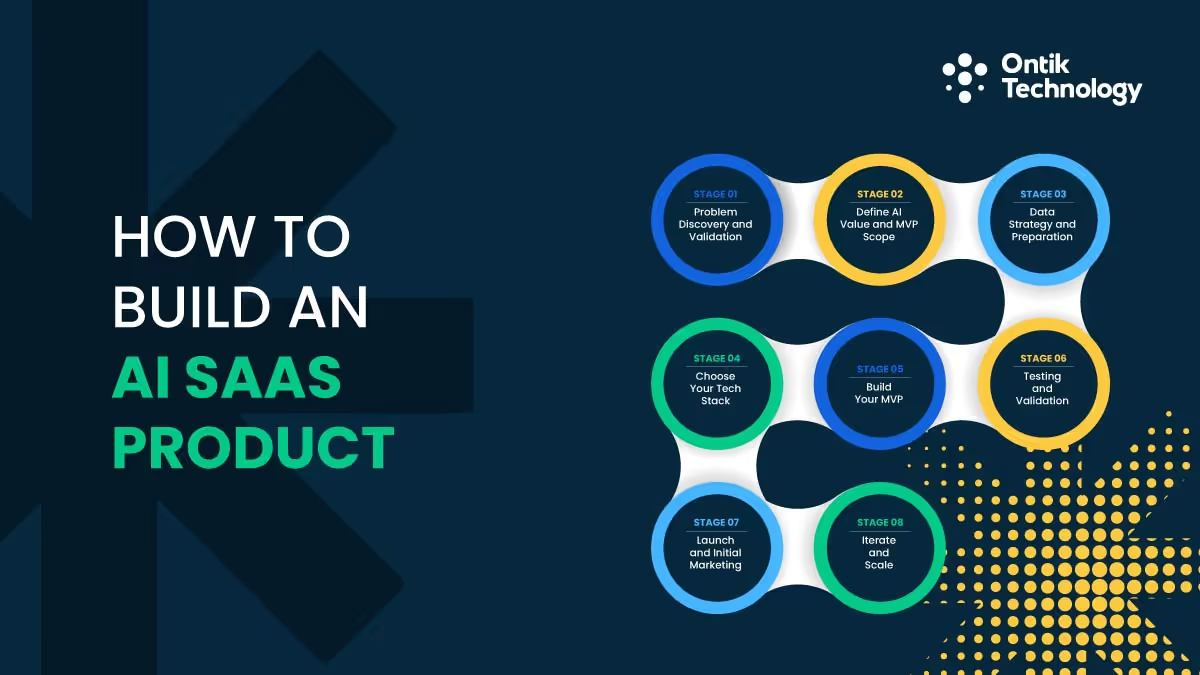
Learning how to build a saas with ai differs from traditional development. You validate both problem and solution fit. This framework provides a proven AI SaaS product development path with validation gates preventing expensive mistakes in AI SaaS projects. Following our proven development process ensures you stay on track from concept to launch.
Stage 1: Problem Discovery and Validation (2 to 3 weeks)
Conduct 20 to 30 customer interviews before coding your AI SaaS platform. Ask about workflows, pain points, and previous attempts. Run competitive analysis of existing AI SaaS tools.
Define success metrics for AI SaaS development. Your deliverable is a problem statement plus user personas. Red flags include starting with technology instead of problems in AI SaaS projects.
Stage 2: Define AI Value and MVP Scope (2 to 3 weeks)
Decide what AI does in your solution. Understanding AI SaaS product classification criteria helps specify whether it predicts, generates, classifies, or recommends.
Define your minimum viable product ruthlessly for AI SaaS projects. Choose one core AI feature plus minimal interface. Here is a SaaS example. Your customer support MVP includes email integration, AI responses, and human review. No multi-channel support or analytics yet in initial AI SaaS development.
If you lack the technical resources to build your MVP internally, consider partnering with experienced development teams. Ontik Technology offers MVP development services that can accelerate your launch timeline.
Their expertise in AI and machine learning, combined with web development and UI/UX design, helps transform your idea into a working product. You can also explore their dedicated development team option for ongoing support, or their custom software development services for more specialized needs.
Stage 3: Data Strategy and Preparation (3 to 4 weeks)
Data determines AI SaaS product development success more than algorithms. Choose pre-trained APIs for general tasks, small datasets under 10,000 samples, or budgets under $100,000.
Build custom models for specialized domains, datasets over 100,000 samples, or when privacy is paramount for your AI SaaS platform. Most early AI SaaS products start with APIs, transitioning to custom models with revenue.
Budget 20 to 30 percent of timeline for data work. Underestimating requirements is why AI SaaS projects fail. If data preparation feels overwhelming, development partners with AI and machine learning expertise can help structure your data strategy from the start.
Stage 4: Choose Your Tech Stack (1 to 2 weeks)
Selecting the best options for generative AI infrastructure affects speed and scalability. Consider OpenAI GPT-4, Anthropic Claude, or Google Gemini for AI SaaS development. Evaluate Meta Llama 3 or Mistral AI for more control.
Vector databases like Pinecone, Weaviate, or Pgvector power semantic search in AI powered SaaS. LangChain or LlamaIndex simplify workflows in AI SaaS projects.
Python dominates AI SaaS development. FastAPI delivers performance while Django offers complete features. JavaScript works for unified codebases when building AI SaaS products. Choose Python for heavy machine learning or JavaScript for real-time features in AI powered SaaS. Many teams leverage web development expertise to build robust frontend interfaces. For Web3 integrations or blockchain features, specialized Web 3.0 development partners can add decentralized capabilities to your stack.
Stage 5: Build Your MVP (8 to 12 weeks)
Your AI team integrates models and engineers prompts for the AI SaaS platform. Application teams create user flows and authentication. Integration connects AI to frontend for complete AI powered SaaS experience.
For founders without technical teams, this stage often requires outside help. A dedicated development team can handle the entire build process while you focus on customer discovery and business development. This approach works especially well for non-technical founders with strong domain expertise.
Your MVP succeeds demonstrating value, completing user journeys, handling load, and collecting feedback for AI SaaS tools. Ship imperfect working products rather than waiting for perfection in AI SaaS product development.
Stage 6: Testing and Validation (2 to 3 weeks)
Testing AI SaaS products requires validating AI-specific dimensions. Functional testing covers user flows. AI testing examines output quality, bias evaluation, and latency for your AI SaaS platform.
Security testing verifies encryption and access controls for AI powered SaaS. User acceptance with 10 to 20 beta users provides feedback. Your deliverable is test reports and launch decisions for AI SaaS projects.
Stage 7: Launch and Initial Marketing (2 to 4 weeks)
Soft launch to waitlists reduces risk for AI SaaS projects. Consider Product Hunt for buzz. Create content demonstrating AI SaaS development expertise.
Monitor metrics daily for AI powered SaaS. Track signups, activation, and usage. Conduct weekly interviews. Focus on first 10 to 50 customers confirming fit for your AI SaaS platform.
Stage 8: Iterate and Scale (Ongoing)
AI SaaS product development continues post-launch. Improve core AI, reduce onboarding friction, and optimize costs in AI SaaS projects. Monitor cost per user for opportunities reducing API calls.
Your scaling checklist ensures sustainable economics at 10x usage, auto-scaling infrastructure, systematized support, metrics dashboards, and validated pricing for AI SaaS platforms. Implementing cloud solutions helps manage infrastructure complexity as you grow. Business intelligence and analytics tools provide insights into user behavior and system performance as your product matures.
Common Pitfalls to Avoid
Overengineering before proving value wastes resources in AI SaaS development. Underestimating data needs hurts AI performance. Ignoring inference costs threatens AI powered saas economics. Neglecting user experience kills AI SaaS products. Skipping validation and treating compliance as afterthoughts create risks in AI SaaS projects.
AI SaaS Development Cost: Complete Budget Breakdown
Understanding saas development costs is critical. Building an AI SaaS product costs $40,000 to $400,000 plus depending on complexity, team location, and technology choices in AI SaaS development.
Three Tiers of AI SaaS Development
Basic AI SaaS MVP costs $40,000 to $80,000 taking 3 to 4 months with outsourced developers. You integrate pre-trained APIs for one feature. Examples include content tools or chatbots for initial AI SaaS projects.
Intermediate AI SaaS Product costs $80,000 to $200,000 taking 4 to 6 months with mixed developers. You use fine-tuned models for 2 to 3 features with polished experience. Examples include support platforms or CRM assistants as AI SaaS tools.
Enterprise AI SaaS Platform costs $200,000 to $400,000 plus taking 6 to 12 months with specialists. You build custom models with compliance and white-label options meeting b2b saas ai startup investment criteria.
Detailed Cost Components
Development team costs consume 50 to 60 percent of saas development costs:
- AI engineers cost $100 to $200 per hour for 200 to 400 hours totaling $20,000 to $80,000
- Backend developers cost $70 to $150 per hour for 300 to 500 hours totaling $21,000 to $75,000
- North American developers charge $100 to $200 per hour
- Eastern European developers cost $40 to $80 per hour
- Asian teams range $25 to $50 per hour when you hire remote developers
Technology costs account for 15 to 25 percent:
- AI APIs at $500 to $5,000 monthly
- Cloud hosting at $300 to $3,000 monthly
- Databases at $200 to $1,500 monthly
Additional budget allocations:
- Data acquisition takes 5 to 15 percent at $5,000 to $50,000
- Compliance requires 5 to 10 percent at $15,000 to $50,000
- Design consumes 5 to 10 percent at $10,000 to $45,000
Smart Ways to Optimize Costs
Reduce saas development costs by 40 to 60 percent with strategic choices. Start with APIs saving $20,000 to $80,000 initially in AI SaaS development.
Strategic outsourcing saves 40 to 60 percent when executed properly. The challenge most companies face is finding developers who understand both AI architecture and SaaS economics. Working with experienced technology partners who have shipped multiple AI products eliminates trial-and-error costs and accelerates time to market by months.
Leverage open-source tools saving $10,000 to $30,000. Roll out features in phases validating core functionality before building advanced AI SaaS tools. Serverless architecture reduces costs by 30 to 50 percent for AI powered saas. Consider team augmentation to scale your development capacity cost-effectively while maintaining control over your product vision and roadmap.
Understanding Your Return on Investment
AI SaaS products achieve payback within 18 to 36 months. Example for AI SaaS development: invest $120,000, charge $100 monthly, $300 acquisition cost. Break-even at 1,200 customers for your AI SaaS product takes 15 to 18 months. AI powered saas commands 15 to 30 percent premium pricing.
Essential Technology Stack for AI SaaS Development

Selecting the best options for generative ai infrastructure determines shipping speed, AI SaaS platform scalability, and ownership costs. Let's examine modern AI SaaS product development architecture layers.
AI and Machine Learning Layer
Foundation models power your AI SaaS product. OpenAI GPT-4, Anthropic Claude, and Google Gemini handle natural language for AI SaaS development. Meta Llama 3 or Mistral AI provide control for AI SaaS tools.
Selection criteria include cost at $0.03 per 1,000 tokens, privacy requirements, and specific capabilities for AI SaaS platforms. Vector databases like Pinecone, Weaviate, or Pgvector enable semantic search in AI powered saas. LangChain or LlamaIndex simplify workflows in AI SaaS projects.
Application Backend and Frontend
Python dominates AI SaaS development. FastAPI delivers performance while Django offers complete features for AI SaaS platforms. JavaScript works for unified codebases with NestJS or Next.js when building AI SaaS products.
Choose Python for heavy machine learning in your AI SaaS product. Pick JavaScript for unified codebases or real-time features in AI powered saas. React plus Next.js is recommended for most AI SaaS development projects. Tailwind CSS enables rapid styling while Shadcn/ui provides components for AI SaaS tools. Professional UI/UX design consulting can dramatically improve user adoption rates.
Data and Infrastructure Layer
PostgreSQL is best for AI SaaS product development, handling relational data plus vector storage through pgvector. MongoDB works for flexible schemas. Redis provides caching for AI SaaS platforms.
AWS offers most services for AI SaaS development while Google Cloud provides excellent AI tools. Docker plus Kubernetes ensures consistent environments for AI SaaS products. Datadog, Sentry, or Prometheus catch issues in AI powered saas. Implementing business intelligence and analytics helps you monitor performance and make data-driven decisions.
Real-World AI SaaS Success Stories: Examples and Case Studies
Examining successful AI SaaS products reveals patterns in positioning and implementation that work for AI SaaS development.
LazyChat: Ontik Technology's AI-Powered Customer Support Platform
LazyChat demonstrates how focused AI SaaS product development solves specific market pain points. Built by Ontik Technology, LazyChat is an AI sales agent that handles customer conversations across Facebook Messenger, WhatsApp, and Instagram automatically.
The platform addresses a critical problem for growing e-commerce businesses where message volume overwhelms small teams. LazyChat's AI responds instantly to customer inquiries, answers product questions, takes orders, and resolves common support issues without human intervention. The system speaks naturally in different languages, adapting to how customers actually communicate.
Key success factors include deep vertical specialization for e-commerce workflows, multilingual AI trained on local market patterns, and seamless integration with platforms businesses already use. LazyChat achieved 30 percent sales increases for clients by eliminating missed conversations and late replies. The pricing model scales with message volume at $39 to $199 monthly, making AI accessible to businesses of all sizes.
This AI SaaS platform shows how understanding specific market needs and building AI that solves real workflow problems creates immediate value. Rather than general-purpose AI requiring extensive configuration, LazyChat works out of the box for its target market. The lesson for AI SaaS development is clear: narrow focus with deep execution beats broad capabilities with shallow implementation.
Grammarly and Salesforce Einstein: Proven Patterns
Grammarly serves 30 million users with AI-powered writing assistance, starting narrow with grammar checking before expanding. Freemium pricing lets users experience AI value before paying. Salesforce Einstein embedded AI into existing CRM workflows, adding predictive scoring and automation to familiar interfaces. Both demonstrate that AI adds most value when integrated into existing workflows rather than requiring new tool adoption.
Common Patterns Across Winners
Successful AI SaaS products begin focused, then expand. Freemium/trials allow users to experience AI value first. Continuous feedback-driven improvement is key. Easy integration via extensions, APIs, or existing tools reduces friction. Vertical specialization outperforms horizontal approaches. Premium pricing is justified when automation value is clear.
Common Challenges in AI SaaS Development and How to Overcome Them
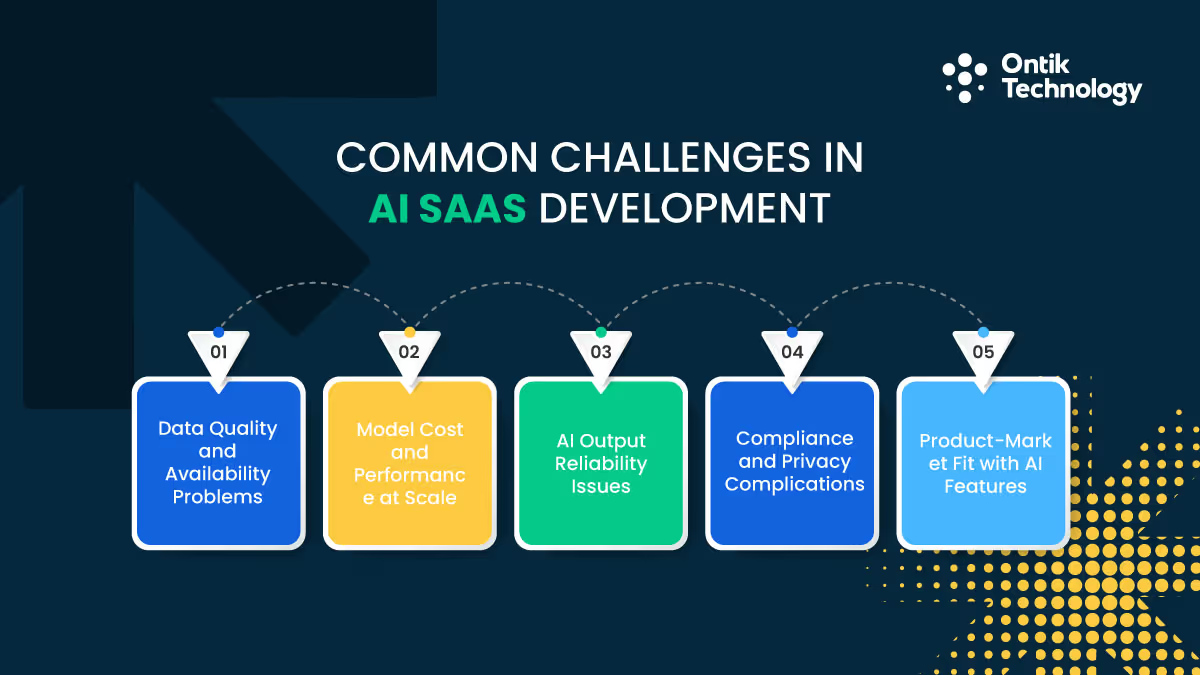
AI SaaS product development introduces unique obstacles that separate successful launches from expensive failures. At Ontik Technology, we have navigated these challenges across dozens of AI implementations, developing proven frameworks that anticipate problems before they derail timelines.
Data Quality and Availability Problems
Most companies lack datasets AI SaaS platforms require. Poor training data leads to inaccurate predictions eroding trust in AI powered saas.
Our approach starts with realistic expectations for AI SaaS development. We use synthetic or public datasets for MVPs and design AI SaaS products that collect training data with clear consent. We establish partnerships with providers like Scale AI and budget 20 to 30 percent timeline for data work, ensuring quality foundations rather than rebuilding later.
Model Cost and Performance at Scale
AI inference costs explode as AI SaaS platforms grow. Token pricing seems cheap but adds up for AI powered saas.
We focus on optimization from day one. Our implementations include caching that reduces API calls by 40 to 60 percent, intelligent model routing that uses smaller models for simple tasks, and fine-tuned open-source models for high-volume operations. We monitor cost per user weekly, catching economic problems before they threaten viability.
AI Output Reliability Issues
AI models hallucinate in AI SaaS platforms. Outputs prove inconsistent across AI powered saas implementations. Bias appears from training data.
We build comprehensive guardrails into every AI SaaS product. Our validation layers check responses before reaching users. We implement human-in-the-loop workflows for critical decisions and run regular bias audits. We communicate AI limitations transparently and define acceptable accuracy thresholds before launching AI SaaS projects.
Compliance and Privacy Complications
AI amplifies privacy concerns in AI SaaS development. Regulations impose strict requirements. Enterprise customers demand certifications meeting b2b saas ai startup investment criteria for AI SaaS platforms.
Our compliance-first approach minimizes data collection, encrypts everything, and implements opt-in mechanisms from the start. We work with legal experts and budget $15,000 to $50,000 for compliance, treating it as investment rather than overhead. This prevents costly retrofits when enterprise customers request certifications.
Product-Market Fit with AI Features
Impressive technology means nothing without solving real problems in AI SaaS projects. Many AI SaaS products have sophisticated AI but poor engagement.
We prioritize problem validation throughout development. Our process measures feature usage, not just accuracy, and includes weekly customer interviews. We focus on outcomes rather than algorithms and define success metrics beyond AI performance, ensuring products deliver business value customers will pay for.
Future-Proofing Your AI SaaS: Scaling and Growth Strategies
Launching MVPs begins AI SaaS product development journeys. Sustainable growth requires strategic scaling across dimensions for AI SaaS platforms. At Ontik Technology, we have guided dozens of AI SaaS products through this scaling journey, understanding exactly where bottlenecks emerge and how to architect for growth from day one through our custom software development services.
Technical Scaling Path
Infrastructure needs evolve as AI SaaS products grow. Stage 1 serves 0 to 100 users with simple monoliths on managed services. Stage 2 supports 100 to 1,000 users separating frontend from backend plus adding caching for AI powered saas.
Stage 3 handles 1,000 to 10,000 users with microservices and horizontal scaling in AI SaaS development. Stage 4 scales beyond 10,000 users with multi-region deployment for AI SaaS platforms. Our cloud solutions team architects this progression, anticipating scaling needs before they become problems.
Model strategies evolve with scale in AI SaaS projects. Start with external APIs, move to fine-tuned models when API costs exceed hosting, then build custom models with competitive advantages in AI SaaS tools. We help clients make these transitions smoothly, avoiding the common pitfall of premature optimization or delayed migration that bleeds budget.
Team Scaling and Business Model Evolution
First 10 customers get served by founding teams plus contractors for AI SaaS development. Growing to 100 customers requires first AI hire plus customer success for AI SaaS products.
Scaling to 1,000 customers adds data engineer and DevOps supporting AI powered saas. Beyond 1,000 customers needs specialized AI teams for AI SaaS platforms. Our dedicated development team model accelerates this scaling by embedding experienced engineers who understand AI SaaS economics. Unlike traditional hiring that takes months, we assemble specialized teams in weeks, maintaining quality standards while you focus on customers.
At launch of AI SaaS projects, use simple tier pricing. During growth, add usage-based components aligning pricing with value for AI SaaS tools. At scale, introduce enterprise custom pricing meeting b2b saas ai startup investment criteria. We have helped clients navigate these pricing evolutions, testing models that maximize revenue without triggering churn.
Metrics That Matter Most
Track Net Revenue Retention targeting 110 percent for AI SaaS products. Monitor Gross Margin targeting 75 percent in AI SaaS development. Watch Customer Acquisition Cost Payback under 12 months for AI powered saas.
Measure AI Feature Adoption ensuring users value intelligence in AI SaaS platforms. Our business intelligence and analytics solutions provide real-time dashboards tracking these metrics, helping teams make data-driven scaling decisions rather than guessing. These strategies provide frameworks for sustainable scaling of AI SaaS projects.
Conclusion
The AI SaaS market offers generational opportunity. With 38 percent plus annual growth through 2031, early movers in AI SaaS product development define categories for decades.
Accessible AI technology, customer demand, and proven business models create ideal conditions for transformative AI SaaS products. Success in AI SaaS development requires solving real problems with appropriate technical architecture using the best options for generative ai infrastructure while scaling sustainably through monitoring and iteration in AI SaaS projects.
Winners will make AI invisible in AI SaaS platforms, focusing on outcomes rather than algorithms in AI powered saas. Start problem discovery this week for AI SaaS development. Conduct 10 interviews validating pain points. Choose technical approaches matching capabilities when you hire saas developer talent. Budget realistically using frameworks covering saas development costs.
AI SaaS products are marathons requiring continuous improvement in AI SaaS platforms. Learn how to create a saas product properly understanding what saas means. The question is not whether to build AI into SaaS but whether to lead or follow in AI SaaS product development. 2025 is the year to lead with AI powered saas. Partner with experienced technology providers to accelerate your AI SaaS journey and turn your vision into reality.